Login

Anti-Money Laundering (AML) Training

Diploma in Anti-Money Laundering (AML) at QLS Level 5 | CPD Accredited | 24/7 Tutor Support | Instant Access
4.8
46 Reviews

stds1254 Students

Accreditation Icon
Accreditation Icon

Anti-Money Laundering (AML) Course Star Icon Anti-Money Laundering (AML) Training

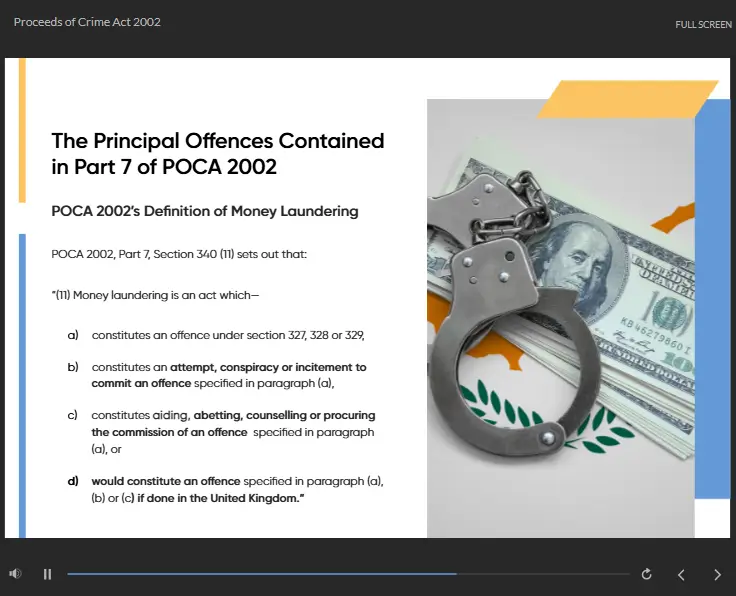
Financial crime continues to evolve, therefore organisations must stay alert and compliant at all times. The Anti Money Laundering diploma course is designed to introduce essential principles that protect businesses from illegal financial activity. This structured learning journey explains how money laundering operates, while also exploring key legislation such as the Proceeds of Crime Act 2002.

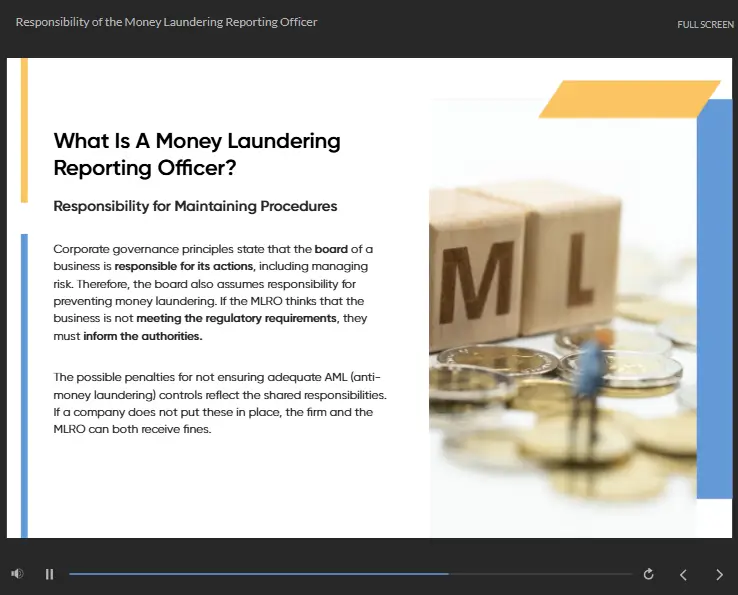
Moreover, this AML Training Course highlights the importance of regulatory frameworks and organisational responsibilities. Learners will explore the duties of a Money Laundering Reporting Officer, alongside effective strategies such as risk-based approaches and customer due diligence. In addition, record keeping and identifying suspicious transactions are clearly explained to ensure legal compliance.

By completing this AML Training Course, learners build awareness of financial crime prevention, while also strengthening their ability to contribute effectively within regulated sectors. As a result, this Anti Money Laundering diploma course supports both entry-level learners and professionals aiming to enhance compliance knowledge through a recognised AML Training Course.

Limited Time Offer

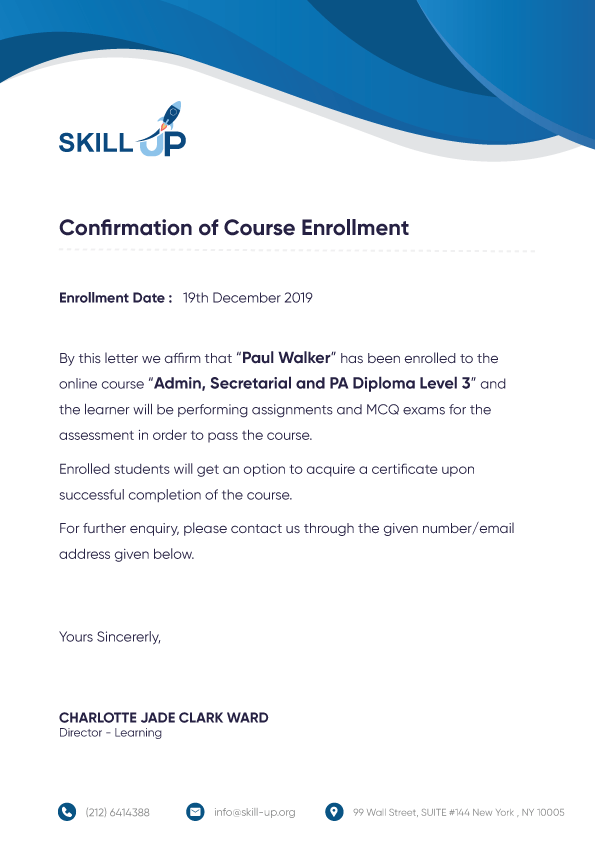
Free Enrolment Letter Included
Course completion certificate preview

Anti-Money Laundering (AML) Course Description Icon Course Description

In today’s regulated financial environment, knowledge of compliance is no longer optional—it is essential. The Anti Money Laundering diploma course introduces the foundations of detecting and preventing illicit financial flows. Furthermore, this AML Training Course provides structured insight into laws, regulations, and organisational duties that shape modern compliance practices.

Throughout this Anti Money Laundering Online Training UK, learners explore critical topics including customer due diligence, suspicious transaction identification, and reporting responsibilities. Consequently, the Anti Money Laundering diploma course builds confidence in recognising warning signs and responding appropriately within professional settings.

Key Benefits:

  • Develop awareness of financial crime frameworks
  • Strengthen compliance knowledge for regulated sectors
  • Improve ability to identify suspicious activities
  • Enhance familiarity with legal requirements
  • Build confidence in reporting procedures

Additionally, this AML Training Course emphasises risk-based strategies and record maintenance, ensuring learners stay aligned with legal expectations. Therefore, the Anti Money Laundering diploma course serves as a valuable step for individuals seeking to improve compliance awareness through a reliable Anti Money Laundering AML training online.

Note: Skill-up is a Janets-approved resale partner for Quality Licence Scheme Endorsed courses.

Anti-Money Laundering (AML) Course Learning Outcome Icon Learning outcome

Anti-Money Laundering (AML) Course Certificate Icon Certificate of Achievement

Quality Licence Scheme Endorsed Certificate 

Upon completing the final assessment, you can apply for the Quality Licence Scheme Endorsed Certificate of Achievement. Endorsed certificates can be ordered and delivered to your home by post for only  £109.

Order Your QLS Certificate 

An extra £10 postage charge will be required for students leaving overseas. 

Skill Up Recognised Certificate

Upon successful completion of the Anti-Money Laundering (AML) Training course, you have the opportunity to request a Skill Up Recognised Certificate. This certificate holds significant value, and its validation will endure throughout your lifetime.

  • 1. PDF Certificate + PDF Transcript: £14.99
  • 2. Hardcopy Certificate + Hardcopy  Transcript: £19.99
  • 3. Delivery Charge: £10.00 (Applicable for International Students)

Anti-Money Laundering (AML) Course Question Icon Who Is This Course For?

Anti-Money Laundering (AML) Course Career Path Icon Career Path

Anti-Money Laundering (AML) Course FAQs Icon Frequently Asked Questions

Anti-Money Laundering (AML) refers to UK laws, regulations and processes designed to prevent criminals from disguising illegal funds as legitimate income. In the UK, AML is critical for protecting the financial system, preventing fraud, tackling organised crime, and complying with regulations set by bodies such as the FCA, HMRC and the National Crime Agency.

UK AML regulations apply to banks, financial institutions, accountants, estate agents, solicitors, money service businesses, crypto asset firms, and other regulated sectors. Any business that handles customer funds or conducts financial transactions may be legally required to carry out AML checks, customer due diligence (CDD), and ongoing monitoring.

AML checks are identity and risk-assessment procedures used to verify customers and detect suspicious activity. In the UK, these typically include identity verification, proof of address checks, source of funds verification, sanctions screening, and politically exposed person (PEP) checks. Businesses must also monitor transactions for unusual or high-risk behaviour.

Failure to comply with UK AML regulations can result in severe penalties, including unlimited fines, business restrictions, reputational damage, and criminal prosecution. Regulators such as the Financial Conduct Authority (FCA) and HMRC can take enforcement action against individuals and organisations that fail to meet AML compliance standards.

Know Your Customer (KYC) is a key component of AML compliance. KYC focuses on verifying a customer’s identity, while AML covers broader activities such as risk assessment, transaction monitoring, and reporting suspicious activity. In the UK, businesses must implement both KYC and AML measures to meet regulatory requirements.

Examples of Anti-Money Laundering practices include:

1. Customer Due Diligence (CDD): Verifying client identity before business transactions.

2. Suspicious Activity Reporting (SAR): Notifying the National Crime Agency (NCA) of suspicious behaviour.

3. Transaction Monitoring: Tracking unusual financial patterns.

4. Know Your Customer (KYC) checks: Confirming clients’ financial background and source of funds.

5. Risk Assessment: Evaluating and managing potential AML risks.

These examples ensure that UK businesses comply with AML regulations and prevent financial misconduct.

The three main types of Anti-Money Laundering measures include:

1. Preventive Measures: Policies like KYC, CDD, and risk-based assessments to deter money laundering.

2. Detective Measures: Monitoring systems and audits to identify suspicious financial activities.

3. Corrective Measures: Reporting, freezing assets, and cooperating with authorities when laundering is detected.

Together, these AML strategies strengthen the UK’s defence against financial crime.

The three stages of money laundering in AML are:

1. Placement: Illegally obtained money is introduced into the financial system.

2. Layering: Complex transactions are made to obscure the money’s origin.

3. Integration: The “cleaned” money is reintroduced into the economy as legitimate funds.

The five pillars of an AML compliance programme are:

1. Risk Assessment: Identifying and evaluating potential risks.

2. Internal Controls: Implementing policies and systems to manage AML risks.

3. Customer Due Diligence (CDD): Verifying client identities and monitoring ongoing transactions.

4. Training: Educating employees on AML obligations and red flags.

5. Independent Audits: Regular reviews to ensure compliance with UK AML regulations.

These pillars form the foundation of a strong AML framework in the UK’s financial system.

The three primary types of money laundering are:

1. Traditional Laundering: Moving money through banks, shell companies, or real estate.

2. Digital Laundering: Using cryptocurrencies or online platforms to conceal illegal funds.

3. Trade-Based Laundering: Manipulating invoices, over- or under-valuing goods to disguise money movements.

Each type poses unique risks to UK financial institutions, making ongoing vigilance essential.

Anti-Money Laundering (AML) Training Reviews

Excellent

4.8 / 5
Based on 46 reviews

98%

Would Recommend

1254

Certified Learners

100%

Authentic Reviews
Freya

Great course for anyone working in finance or compliance. The content was direct, clear, and very relevant.

Lily

A strong introduction to anti-money laundering principles. Helpful for understanding regulatory responsibilities.

Grace

A well-structured course covering key AML regulations clearly. It improved my awareness of identifying suspicious financial activity.

Curriculum

  • play Introduction to Money Laundering
    play 00:16:00
top