

This maintenance calorie calculator helps determine how many calories your body needs to maintain its current weight and avoid obesity and health conditions. This is one of the best maintenance calorie calculators to estimate daily maintenance calories.
In simple terms, maintenance calories are the number of calories your body needs to stay the same weight. Therefore, once you know this figure, you can adjust your intake with confidence instead of following generic advice.
This blog explains what maintenance calories are, how to work out maintenance calories, and how a maintenance calorie calculator that UK users rely on actually works.
Table of Contents
What Are Maintenance Calories?
Maintenance calories refer to the daily energy intake required to keep your body weight stable. In other words, if you eat this amount consistently, your weight should neither increase nor decrease over time.
However, maintenance calories are not a fixed number. They depend on your height, weight, age, sex, and daily activity. For example, a warehouse worker in Manchester will have higher maintenance kcal needs than an office worker in London.
Moreover, understanding what are maintenance calories helps you avoid extreme dieting. Instead of cutting calories too low, you can work from a realistic baseline.
What Is Calorie Maintenance Explained Simply
Calorie maintenance means matching the calories you eat with the calories your body burns each day. This includes basic body functions and movement.
Therefore, when people ask, “what is calorie maintenance?”, the simplest answer is balance. Eat too little, and you lose weight. Eat too much, and you gain weight.
Many people search for how to find maintenance calories because they want accuracy. A calculator provides an estimate, but your real maintenance calories become clear through tracking.
What Is My Maintenance Calories and Why It Matters
You may wonder, “what is my maintenance calories, and why should I care?” The answer is simple. Without this number, every diet decision is a guess.
For instance, if your maintenance calories are 2,200 but you eat 1,800, you are in a calorie deficit. However, if you unknowingly eat 2,400, weight loss will not happen.
Therefore, finding maintenance calories is the foundation of sustainable progress.
Maintenance Calories Flow Chart (Simple Guide)
Follow this step-by-step flow to find your daily calories:
| Step | What to Do | Why It Matters |
|---|---|---|
| Step 1 | Enter your age, height, weight, and gender | Your body burns calories differently |
| Step 2 | Calculate your BMR (Basal Metabolic Rate) | Calories needed at complete rest |
| Step 3 | Choose your activity level | Exercise changes calorie needs |
| Step 4 | Get your maintenance calories | Calories required to stay the same weight |
| Step 5 | Adjust if needed | Reduce or increase calories for goals |
Quick note: Maintenance calories help you stay the same weight, not lose or gain.
Why Should You Calculate Maintenance Calories?
Many people try to lose or gain weight without knowing their calorie maintenance. As a result, progress stalls or becomes inconsistent.
By calculating maintenance calories, you set a clear starting point. This makes every adjustment logical instead of emotional.
Moreover, UK health professionals often stress sustainability. Crash diets may work short-term, but they fail long-term. Knowing your maintenance calories helps you avoid that cycle.
Weight Maintenance, Fat Loss, and Muscle Gain
Maintenance calories support three main goals: maintaining weight, losing fat, or gaining muscle. The difference is how much you eat above or below that level.
For fat loss, you eat below maintenance. For muscle gain, you eat above it. However, both require knowing your baseline first.
Therefore, before searching for a calorie deficit or surplus, you should calculate calorie maintenance accurately.
Who Needs to Work Out Maintenance Calories?
Almost everyone benefits from working out to burn off maintenance calories. Beginners often underestimate intake, while experienced gym-goers overestimate activity.
For example, UK shift workers, NHS staff, and delivery drivers often burn more calories than they realise. On the other hand, desk-based roles may require fewer calories.
In addition, people returning to exercise after injury should find maintenance calories again, as needs change over time.

What Should Be Your Daily Calorie Intake?
Daily calorie needs vary widely across the UK population. While general advice exists, it should not replace personalised calculations.
The NHS suggests average intakes of around 2,500 calories for men and 2,000 for women. However, these figures are guidelines, not maintenance calories.
Therefore, asking “what is my calorie maintenance?” is far more useful than following averages.
Daily Calories for Men and Women in the UK
Men typically have higher maintenance calories due to muscle mass and body size. However, active women may require more calories than sedentary men.
For example, a physically active woman working in retail may maintain weight on 2,300 calories. Meanwhile, a sedentary man may maintain weight on 2,100.
Thus, calculators help estimate maintenance calories more accurately than generic advice.
Why One-Size-Fits-All Calorie Advice Doesn’t Work
One-size-fits-all advice ignores lifestyle and metabolism. Searching “kg how many calories” often leads to oversimplified answers.
However, two people weighing the same can have very different maintenance calories. Activity, age, and muscle mass all matter.
Therefore, learning how to calculate maintenance calories gives you personalised clarity.

What Is a Maintenance Calorie Calculator?
A maintenance calorie calculator estimates how many calories your body needs daily to maintain weight. It uses formulas based on science rather than guesswork.
Most calculators ask for age, height, weight, sex, and activity level. Then, they calculate an estimate.
However, calculators are tools, not final answers. They provide a starting point, which you refine over time.
What Does a Maintenance Calories Calculator Do?
A maintenance calories calculator works by estimating your basal metabolic rate and adjusting it for activity.
This gives you a daily calorie figure, often called calorie maintenance or maintenance kcal.
Therefore, when people ask how do I find my maintenance calories, a calculator is usually the fastest method.
Maintenance Calories Calculator UK – What Makes It Different
A maintenance calories calculator UK version uses metric units and activity assumptions more common in the UK.
For example, walking, public transport use, and job-based movement differ from other countries.
Thus, a UK-focused calculator provides more relevant estimates than generic global tools.
How to Calculate Maintenance Calories – What Are My Maintenance Calories?
Calculating maintenance calories involves three main steps. Each step builds on the last.
Although calculators do this automatically, understanding the process improves accuracy.
Moreover, knowing how calculations work helps you adjust when results don’t match expectations.
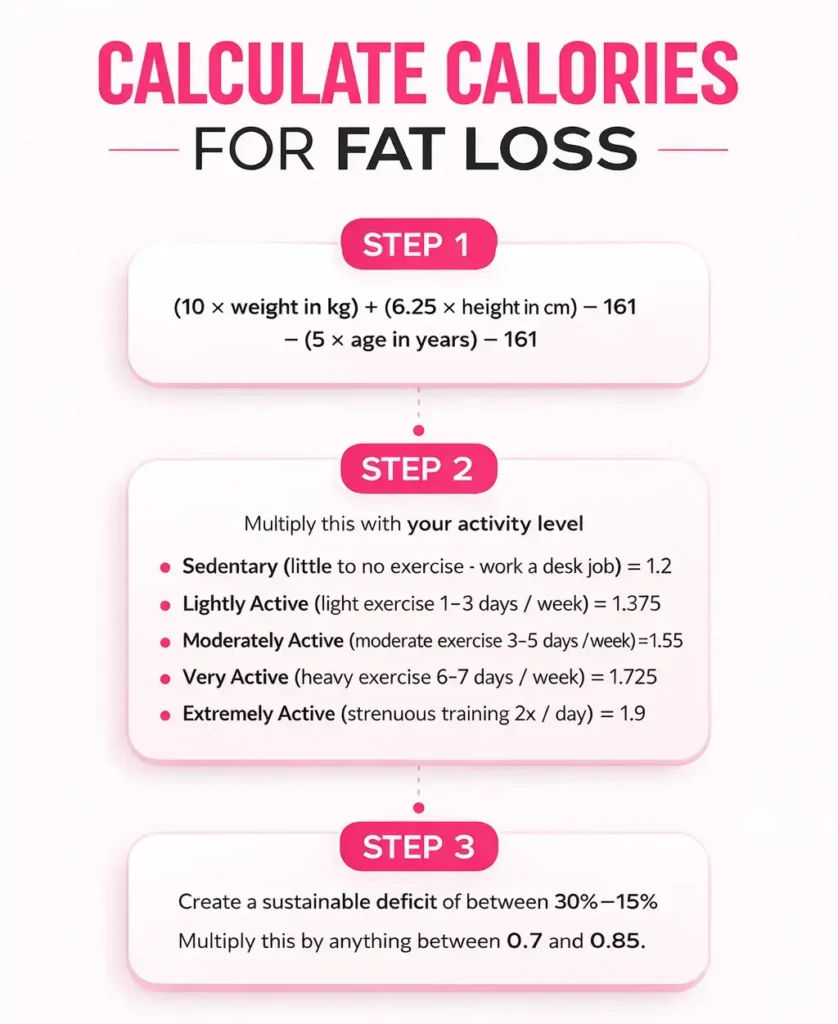
Step 1 – Calculate Your Basal Metabolic Rate (BMR)
Your BMR is the number of calories your body needs at rest. It supports breathing, circulation, and basic functions.
Most maintenance calorie calculators use the Mifflin-St Jeor equation. It is widely accepted and accurate for most people.
Your BMR is the number of calories your body burns just to keep your organs functioning while you sleep. To calculate calorie maintenance, you must start here. Most UK experts use the Mifflin-St Jeor equation.
For example, a man weighing 80kg who is 180cm tall and 30 years old would have a BMR of roughly 1,800 calories. This is the absolute minimum his body needs to survive. However, nobody just lies in bed all day, so we must add more to this figure.
Step 2 – Adjust for Activity Level
This is where many people get confused when trying to work out maintenance calories. You must multiply your BMR by an activity factor:
– Sedentary (Office job, little exercise): BMR x 1.2
– Lightly Active (Light exercise 1-3 days/week): BMR x 1.375
– Moderately Active (Moderate exercise 3-5 days/week): BMR x 1.55
– Very Active (Hard exercise 6-7 days/week): BMR x 1.725
Step 3 – Find Your Caloric Maintenance
After adjusting for activity, you get your estimated maintenance calories. This is your starting point.
If your weight stays stable over two weeks, the estimate is accurate. If not, small adjustments are needed.
Therefore, finding maintenance calories is both calculation and observation.
How to Work Out Maintenance Calories Without a Calculator
– Some people prefer manual methods. Although slower, they can be very accurate.
– This method is useful if calculators give inconsistent results or if your lifestyle is unusual.
– Moreover, it teaches awareness of food intake and energy balance.
Tracking Method – Finding Maintenance Calories Manually
– Track everything you eat for 10–14 days. Weigh yourself daily under similar conditions.
– If your weight stays the same, your intake equals maintenance calories. If it changes, adjust intake slightly.
– Therefore, this method helps figure out maintenance calories based on real data.
Signs You’ve Found Your Maintenance Calories
– Stable weight is the main sign. Energy levels also remain consistent.
– Additionally, hunger feels manageable rather than extreme.
– When these signs align, you have likely found your maintenance calories.
Activity Level & Approx. Daily Calories
| Activity Level | Description | Approx. Calories (Women) | Approx. Calories (Men) |
|---|---|---|---|
| Sedentary | Office job, little to no intentional exercise. | 1,600 – 1,800 | 2,200 – 2,400 |
| Moderately Active | Walking/Exercise 3–5 days per week. | 1,800 – 2,200 | 2,400 – 2,800 |
| Active / Athlete | Daily intense training or physical labour. | 2,200 – 2,500+ | 2,800 – 3,200+ |
How Accurate Is a Maintenance Calorie Calculator?
Maintenance calorie calculators are estimates. They are accurate enough for most people, but not perfect. Factors like stress, sleep, and genetics affect calorie needs. Therefore, calculators should guide decisions, not replace tracking.
Why Calorie Calculators Are Estimates
– Calculators cannot measure metabolism directly. They rely on averages.
– However, people differ in how efficiently they burn calories.
– Thus, adjustments are often needed after initial calculations.
How to Improve Accuracy Over Time
– Track your weight weekly and adjust calories gradually.
– If weight changes unexpectedly, your maintenance calories may differ from the estimate.
– Over time, this process becomes highly accurate.
What Happens If I Don’t Eat My Maintenance Calories?
– Eating above or below maintenance calories affects weight.
– However, the impact depends on how large the difference is and how long it lasts.
– Understanding this helps avoid unwanted results.
Eating Below Maintenance Calories
– Eating below maintenance leads to weight loss.
– However, large deficits can reduce energy and affect training.
– Therefore, controlled deficits work better long-term.
Eating Above Maintenance Calories
– Eating above maintenance causes weight gain.
– This can support muscle growth if paired with resistance training.
– However, large surpluses often lead to fat gain.
When Should You Start Maintenance Calories?
Maintenance calories are useful during many phases. They are especially important after dieting or weight loss. Moreover, they support long-term balance.
After Weight Loss or Fat-Loss Diets
Returning to maintenance calories helps prevent rebound weight gain. It allows your body to stabilise. Therefore, maintenance phases are often recommended after dieting.
Maintenance Calories for Lifestyle Balance
Some people choose to stay in maintenance permanently. This supports energy, health, and flexibility. For many, this is the most sustainable approach.
Can a Caloric Maintenance Calculator Help You Lose or Gain Weight?
– Yes, maintenance calculators help both goals.
– They provide the baseline needed for adjustments.
– Without this baseline, results are unpredictable.
Using Maintenance Calories for Fat Loss
– Create a small deficit below maintenance.
– This supports steady fat loss.
– Extreme cuts are rarely needed.
Using Maintenance Calories for Muscle Gain
– Add calories gradually above maintenance.
– This supports lean muscle growth.
– Therefore, maintenance calories guide smart bulking.
How Do I Increase My Maintenance Calories?
Some people want to raise maintenance calories. This is common after long dieting phases. Increasing maintenance improves energy and flexibility.
Increasing Activity and NEAT
– Daily movement increases calorie needs.
– Walking more and staying active helps raise maintenance calories.
– Small changes add up.
Reverse Dieting Explained
– Reverse dieting increases calories gradually.
– This allows metabolism to adapt.
– It is especially helpful after prolonged calorie restriction.
How Often Should You Recalculate Your Maintenance Calories?
Maintenance calories change over time. Weight, activity, and age all influence needs. Therefore, recalculation is important.
Weight Changes and Body Composition
After gaining or losing weight, maintenance calories shift. Recalculating keeps intake accurate. Ignoring changes leads to stalls.
Lifestyle and Training Changes
New jobs or training routines affect calorie needs. Therefore, reassess maintenance calories when life changes.
How Does a Maintenance Calorie Calculator Work for Bodybuilding?
Bodybuilders rely heavily on maintenance calories. They use them to control bulks and cuts. Precision matters more at advanced levels.
Maintenance Calories During Lean Bulks
Lean bulks require small surpluses above maintenance. This limits fat gain and maintenance calories to guide this balance.
Maintenance Calories During Cutting Phases
During cuts, maintenance calories help preserve muscle. Large deficits increase the risk of muscle loss. Therefore, controlled adjustments are essential.
Get valuable training, UK-focused support, and the skills employers want. No experience needed.
Join 500+ graduates who landed tech jobs with our industry-focused training programme designed for beginners.
Explore Now - Our Job Ready ProgrammeConclusion
Knowing your maintenance calories removes guesswork from nutrition. It allows you to make informed decisions based on facts rather than trends.
Whether your goal is fat loss, muscle gain, or balance, maintenance calories are the foundation. By learning how to calculate maintenance calories and adjust over time, you gain long-term control.
If you want step-by-step support, guided examples, and UK-specific advice, your next step is clear.
Frequently Asked Questions About Maintenance Calories (UK)
What Is My Maintenance Calories?
Your maintenance calories are the calories you need to maintain weight. They depend on your body and lifestyle.
What Is a Maintenance Calorie Calculator?
It estimates how many calories you need daily to maintain your weight.
How Accurate Is a Maintenance Calories Calculator UK?
It is a reliable estimate. Tracking improves accuracy.
What Happens If I Eat Less Than My Maintenance Calories?
You lose weight. Large deficits may reduce energy.
How Do I Work Out My Maintenance Calories in KG?
Use a metric-based calculator or manual tracking with kg measurements.
Can I Maintain Weight Long Term Using Maintenance Calories?
Yes. Many people successfully maintain weight using this approach.






All Courses
Personal Development
Employability
Career Bundle
Management
Free QLS Certificate
IT & Software
Business
Technology
Health & Care
Quality Licence Scheme Endorsed Courses
Health & Safety
Training
Marketing
Job Ready Programme
Design
Accounting & Finance
Health and Fitness
Healthcare and Medical
Animal Care
Psychology
Microsoft Office
Teach & Education
I.T
HR and Leadership
Counselling and Therapy
Teaching & Child Care
Health and Social Care
Electrical & Electronics
Law
Food Nutrition
programming
Administration & Office Skills
Education
Language
Engineering
Cooking & Baking
Law & Criminology
Accounting
QLS Bundle
Office Skills
Awareness
Photography
Finance
Lifestyle
Diet and Nutrition
Makeup & Beauty
Therapy
Sports
First Aid
Accounting & Bookkeeping
Mathematics
Excel
Web Design
Top Rated Course
Diet and Fitness
Counselling
Agriculture
Networking & Design
General Education
Biotechnology
Audit
Economics
Lifestyle & Recreational
Adobe Photoshop
Travel and Tourism
Categories

Awarded By