
Overview
Could learning to build dynamic websites, manage databases, and write professional backend code be the skill that launches your web development career? This Ultimate PHP & MySQL Web Development Course & OOP Coding is designed for aspiring PHP developers, web developers, programmers, and beginners who want to master server-side development using one of the world’s most widely used web technologies.
To build a strong foundation, this course covers:
✓ PHP programming fundamentals, functions, forms, and file handling.
✓ MySQL databases, CRUD operations, PDO connections, and SQL queries.
✓ AJAX, XML, email integration, and secure web application development.
✓ Object-Oriented Programming (OOP), error handling, and user authentication systems.
Whether you want to learn PHP and MySQL online, strengthen your backend development skills, or prepare for junior developer roles, this PHP and MySQL course combines coding fundamentals with real-world development techniques. By the end, you will have the confidence to create database-driven websites and understand the core technologies used in modern web applications.
Course Description
This Ultimate PHP & MySQL Web Development Course & OOP Coding provides a structured path into backend web development, taking learners from basic PHP syntax to advanced database-driven application development. Designed for beginners and aspiring developers, the course starts with environment setup before introducing variables, arrays, control structures, functions, forms, and file handling. As your skills develop, you will learn how PHP processes user input, validates data, and interacts with external files and web applications.
The course then focuses on MySQL database development, helping you understand database creation, data retrieval, filtering, sorting, joins, and secure database operations. You will explore MySQL CRUD operations in PHP, PDO database connections, prepared statements, and SQL injection prevention. These are essential skills for anyone pursuing PHP developer training or backend web development careers.
Beyond database development, the curriculum introduces AJAX, XML processing, email integration, PHPMailer, and Object-Oriented Programming principles. You will work through classes, inheritance, interfaces, abstract classes, access modifiers, constructors, and advanced OOP concepts used in professional PHP applications. The course concludes with error handling, user registration systems, authentication logic, validation techniques, and advanced coding methods. This comprehensive approach makes it an ideal PHP and MySQL course online for learners seeking practical coding knowledge, stronger programming confidence, and a foundation for full stack PHP developer training.
Learning Outcome
Upon successful completion of this course, learners will be able to:
- Develop dynamic websites using PHP programming techniques and best practices.
- Apply MySQL database management concepts to create and manage data-driven applications.
- Implement MySQL CRUD operations, queries, joins, and database filtering techniques.
- Build secure PHP applications using PDO connections, prepared statements, and validation methods.
- Demonstrate Object-Oriented Programming principles including classes, inheritance, interfaces, and abstraction.
- Create user registration systems with authentication, validation, and error handling features.
- Develop a strong foundation for backend web development and PHP developer career pathways.
Who Is This Course For?
- Beginners who want to learn PHP and MySQL online from the ground up.
- Aspiring PHP developers looking to build backend web development skills.
- Web development students seeking structured PHP OOP training.
- Career changers exploring opportunities in software and web development.
- Freelancers who want to create dynamic and database-driven websites for clients.
- Front-end developers looking to expand into server-side programming.
- Learners interested in full stack PHP developer training and web application development.
Certificate of Achievement
Upon successfully completing this Ultimate PHP & MySQL Web Development Course & OOP Coding, learners will receive an Accredited Certificate confirming their course completion.
We provide two recognised certificate options:
CPD-QS Certificate
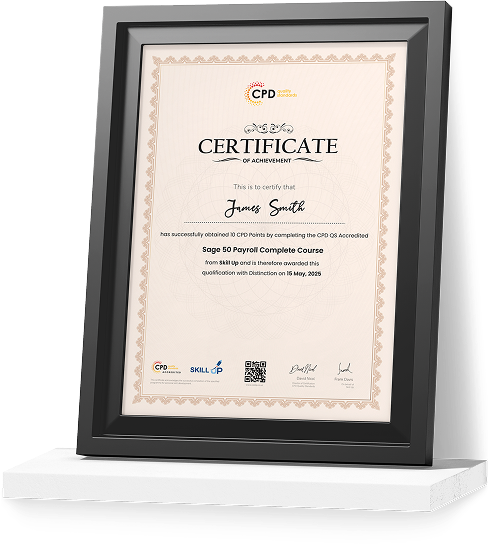
Learners can obtain a certificate accredited by CPD Quality Standards (CPD-QS), supporting professional development and career progression.
SKILL UP Brand Recognised Certificate
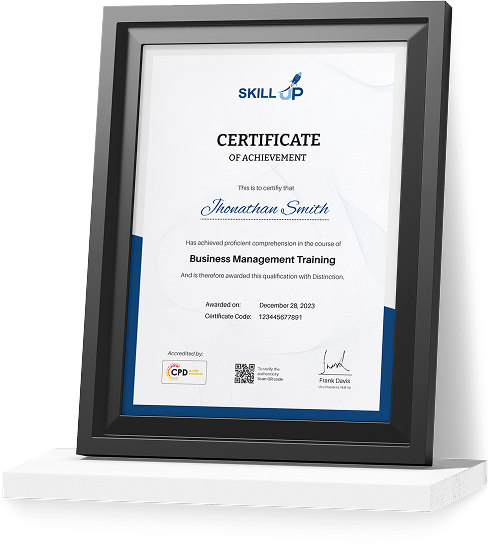
Learners will also receive a SKILL UP Certificate of Completion confirming successful completion of this training course.
Both certificates support administrative career progression and workplace credibility.
Earn Your Accredited Certificate with Transcript
Save 20% with the coupon code SKILL20
Show Your Certified Identity with a CPD-QS Certificate
Perfect for employers, clients, or academic verification.
Career Path
- Junior PHP Developer – Develop and maintain PHP-based websites and web applications. Typical UK salary: £25,000–£35,000.
- Backend Web Developer – Build server-side functionality, databases, and application logic. Typical UK salary: £30,000–£50,000.
- Full Stack PHP Developer – Work across both front-end and back-end development environments. Typical UK salary: £35,000–£60,000.
- Web Application Developer – Create dynamic, database-driven business applications. Typical UK salary: £30,000–£55,000.
- Software Developer – Design, build, and maintain software solutions across industries. Typical UK salary: £35,000–£65,000.
- Freelance PHP Developer – Deliver custom websites, e-commerce platforms, and web applications for clients. Earnings vary based on experience and project scope.
Frequently Asked Questions
PHP and MySQL web development means building dynamic, database-driven websites and web applications. PHP handles server-side programming, while MySQL stores, manages, and retrieves data for features such as login systems, forms, admin panels, and CRUD applications.
Yes. PHP and MySQL remain valuable for backend web development because many websites, CMS platforms, business systems, and e-commerce applications still use them. Learning PHP, MySQL, PDO, CRUD operations, and secure coding can support junior PHP developer and backend developer career paths.
PHP and MySQL work together to create complete web applications. PHP processes user actions, while MySQL manages the data behind the application. Mastering both helps you build practical projects such as registration systems, dashboards, content systems, and database-driven websites.
This PHP and MySQL course is ideal for beginners who want structured backend web development training. It covers PHP fundamentals, MySQL databases, Object-Oriented Programming, AJAX, PHPMailer, authentication, validation, and secure database connections step by step.
Yes. With consistent practice, beginners can build a strong PHP foundation in around three months. This course supports that journey by covering PHP syntax, functions, forms, file handling, MySQL queries, CRUD operations, OOP concepts, and real-world web application features.
Yes. PHP is useful for careers in web development, backend programming, full stack development, and freelance website projects. PHP and MySQL skills can help learners prepare for roles such as Junior PHP Developer, Backend Web Developer, and Web Application Developer.
Ultimate PHP & MySQL Web Development Course & OOP Coding Reviews
Excellent
98%
Would Recommend89
Certified Learners100%
Authentic Reviews
A well-organised and highly valuable course with clear, easy-to-understand guidance throughout. I’ve gained knowledge that’s directly relevant to my day-to-day responsibilities. It’s given me greater confidence in applying these skills professionally.
Engaging content delivered in a straightforward and structured format. The examples were realistic and helped reinforce key concepts effectively. I would certainly recommend it to colleagues looking to upskill
Comprehensive, insightful and professionally presented from start to finish. The course materials were clear and well supported. A worthwhile investment for anyone serious about career development
Curriculum
-
Introduction
00:02:00
-
Setup On Windows
00:15:00
-
Setup On Mac
00:11:00
-
Setup On Linux
00:12:00
-
Online Code Editor
00:03:00
-
Basic File Syntax
00:05:00
-
Printing (echo)
00:06:00
-
Comments
00:05:00
-
Variables
00:06:00
-
Variable Data Types
00:07:00
-
Variable Naming
00:03:00
-
Constants
00:02:00
-
Arrays
00:05:00
-
Associative Arrays
00:06:00
-
Multidimensional Arrays
00:04:00
-
if Statement
00:06:00
-
if…else Statement
00:02:00
-
if…elseif…else Statement
00:05:00
-
Switch Statement
00:06:00
-
while Loop
00:06:00
-
do…While Loop
00:03:00
-
for Loop
00:03:00
-
foreach Loop
00:05:00
-
Break Statement
00:02:00
-
Continue Statement
00:02:00
-
Basic Function
00:03:00
-
Passing Function Arguments
00:03:00
-
Passing Function Arguments By Reference
00:04:00
-
Default Argument Value
00:02:00
-
Function Returning Values
00:05:00
-
Dynamic Function Calls
00:03:00
-
Variable Scope
00:04:00
-
Simple HTML Form
00:07:00
-
GET vs POST
00:05:00
-
$_SERVER [“PHP_SELF”]
00:07:00
-
Validating Form Data With PHP
00:07:00
-
Required Fields
00:05:00
-
Display Error Messages
00:05:00
-
Validate Name
00:03:00
-
Validate Email
00:03:00
-
Validate URL
00:07:00
-
Keep The Values In The Form
00:04:00
-
Read File (readfile())
00:02:00
-
Open, Read & Close A File (fopen(), fread(), fclose())
00:04:00
-
Read Single Line (fgets())
00:03:00
-
Check End-Of-File (feof())
00:02:00
-
Read Single Character (fgetc())
00:02:00
-
Write To File (fwrite())
00:03:00
-
Configure php.ini File For File Uploading
00:02:00
-
Front End HTML Upload Form
00:04:00
-
PHP Upload Script
00:15:00
-
Check If File Exists
00:03:00
-
Limit File Size
00:05:00
-
Limit File Type
00:04:00
-
MySQL vs MySQLi vs PDO
00:05:00
-
Creating A Database & Table (phpMyAdmin)
00:06:00
-
Connecting To A Database
00:06:00
-
Get Data Using SELECT Query
00:10:00
-
WHERE Property For Filtering
00:03:00
-
LIKE Property For Pattern Search
00:02:00
-
Sorting Results Using ORDER BY Property
00:01:00
-
Using JOINS
00:08:00
-
Insert Data Using INSERT Query
00:04:00
-
Get ID Of The Last Inserted Row
00:02:00
-
Insert Multiple Rows
00:05:00
-
Update Data Using UPDATE Query
00:03:00
-
Delete Data Using DELETE Query
00:02:00
-
Delete All Rows In A Table Using TRUNCATE Query
00:02:00
-
Delete Table Using DROP Query
00:02:00
-
Limit Data Selections Using LIMIT, ROWNUM
00:04:00
-
Create Table Using CREATE Query
00:03:00
-
Clone/Duplicate Table
00:03:00
-
Alter Table
00:05:00
-
Create Database
00:02:00
-
Drop Database
00:02:00
-
SQL Injection & Prepared Statements
00:09:00
-
What Is XML?
00:02:00
-
What Is SimpleXML?
00:02:00
-
Parse XML String
00:08:00
-
Parse XML File
00:02:00
-
Get Node Values
00:02:00
-
Get Node Values of Specific Elements
00:03:00
-
Get Node Values – Loop
00:03:00
-
Get Attribute Values
00:02:00
-
What Is The XML Expat Parser?
00:02:00
-
Initializing The XML Expat Parser
00:10:00
-
Load and Output XML Using DOM Parser
00:02:00
-
Looping Through XML Using DOM Parser
00:03:00
-
What Is AJAX?
00:02:00
-
Load Simple Data Using AJAX Front End
00:08:00
-
Load Simple Data Using AJAX Back End
00:05:00
-
Load Data From A Database Using AJAX
00:08:00
-
Send A Plain Text Email
00:04:00
-
Send A HTML Email
00:06:00
-
Email Attachments
00:17:00
-
PHPMailer Setup
00:03:00
-
Send Email Using PHPMailer
00:04:00
-
Send HTML Email Using PHPMailer
00:04:00
-
Email Attachments Using PHPMailer
00:02:00
-
What Is Object Oriented Programming (OOP)?
00:03:00
-
Basic Class With Variables
00:04:00
-
Functions
00:05:00
-
Constructor
00:04:00
-
Destructor
00:02:00
-
Inheritance
00:06:00
-
Multi Class Inheritance
00:03:00
-
Function Overriding
00:03:00
-
Public vs Private vs Protected
00:05:00
-
Interfaces
00:04:00
-
Constants
00:03:00
-
Abstract Class
00:06:00
-
Static Keyword
00:03:00
-
Final Keyword
00:02:00
-
Initiating Parent Constructor
00:02:00
-
die() Function
00:02:00
-
Custom Error Handler
00:04:00
-
Triggering An Exception
00:03:00
-
Exception Handling
00:05:00
-
Create Database & Table
00:04:00
-
User Class & Database Connection
00:15:00
-
Register User Form
00:09:00
-
Inserting User Data Into Database
00:10:00
-
Registration Form Field Validation
00:12:00
-
Securing User Password
00:03:00
-
Check If Username or Email Already Exists
00:11:00
-
Retain Data After Failed Registration
00:03:00
-
Validate an Integer Within a Range
00:04:00
-
Validate IPv6 Address
00:03:00
-
Validate URL – Must Contain QueryString
00:03:00
-
Remove Characters With ASCII Value > 127
00:04:00
-
Including & Requiring External PHP Files
00:05:00
-
Resource
-
Assignment – Ultimate PHP & MySQL Web Development & OOP Coding
-
Order Your Certificate
Offer Ends in
-
Duration:10 hours, 6 minutes
-
Access:1 Year
-
Units:134


9 Reviews

TAKE ALL COURSES FOR £99