
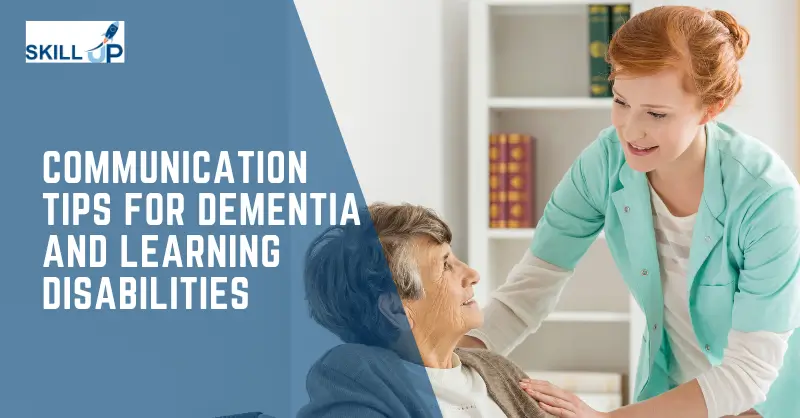
Good communication in care is rarely about finding the perfect words. It is about recognising what the person needs in that moment and adjusting how you speak, listen, and respond. What feels simple to one person may be confusing or overwhelming to another. Noise, rushed speech, or too much information can quickly turn a normal interaction into a stressful one. This is especially important in dementia and learning disability care, where communication difficulties can affect understanding, confidence, behaviour, emotional safety, and choice.
Communication is not a small detail. It shapes trust, dignity, cooperation, and how safe a person feels with you. In practice, this means allowing time, using repetition, recognising distress as communication, being aware of body language, and avoiding making conversations feel like a test.
This guide goes beyond quick tips. It explains why communication breaks down and how to respond in a calmer, clearer, and more person-centred way so the person feels understood, included, and respected.
Why Communication Matters More Than People Think
In health and social care, communication is often seen as passing on information, but it shapes the entire care experience. A person may not understand every word, yet they notice tone, pace, and body language. A calm approach can reduce fear, while a rushed or patronising one can increase confusion and resistance.
This is especially important in dementia and learning disability care, where communication affects understanding, confidence, relationships, and behaviour. Communication should be seen as part of the care itself.
Many behaviours, such as repetition, refusal, or distress, are not random. They are often attempts to communicate unmet needs, and good communication helps us recognise and respond to them.
How Dementia Can Change Communication
Dementia is often seen as a memory-related condition, but it can significantly impact communication in many different ways. A person living with dementia may face challenges in word finding, understanding conversations, concentrating, and organising thoughts. They may also struggle with emotional processing, reading social cues, and following the flow of a discussion. These communication difficulties can affect daily interactions with family, carers, and healthcare professionals.
Word-Finding Difficulties
One of the most common signs is difficulty finding the right words. A person may pause frequently, use incorrect words, repeat familiar phrases, or stop mid-sentence. This can lead to frustration, especially when others try to rush or complete their sentences.
Slower Processing Time
Understanding spoken language often takes longer. A delayed response does not mean the person has not heard; instead, they may need extra time to process and understand what has been said before replying.
Difficulty with Long Sentences
Complex or lengthy sentences can be confusing. Information may be forgotten halfway through a sentence, making short, clear, and simple communication much more effective.
Repetition in Conversation
Repeating questions or stories is very common in dementia. This usually happens due to memory loss or a need for reassurance and comfort in familiar communication patterns.
Emotional Understanding
Even when words are not fully understood, emotional tone and body language are still recognised. Calm, patient, and respectful communication improves understanding and reduces distress.
Changing Communication Ability
Communication skills may fluctuate daily depending on fatigue, stress, illness, or environment. Sudden confusion does not always indicate progression of dementia.

How Communication Needs May Differ in Learning Disabilities
Communication in learning disabilities requires a more individual approach than many short guides suggest. Some people communicate through speech, while others rely on gestures, symbols, pictures, routines, or signs. Some understand more than they can express, and some may agree simply to avoid pressure or embarrassment. Clear, concise communication, observation, and tools like Makaton or Widgit can help.
Not One Group, Not One Method
There is no single communication style. Support should begin with the person—their pace, preferences, and what helps them understand best.
Simplicity With Respect
Plain language is important, but it must remain respectful. Adults should be spoken to as adults, not in a way that feels childish or dismissive.
Processing and Pressure
Some people need more time to respond. Silence can support understanding better than rushing or repeating.
Communication Beyond Speech
Meaning is often shown through expression, posture, tone, and behaviour. Careful observation helps you understand what the person is communicating, even without words.
The Core Principles of Better Communication
Before looking at specific techniques, it helps to keep a few broad principles in mind. These are the foundations that make communication more supportive across both dementia care and learning disability support.
1. Get Attention First
Do not begin speaking while the person is distracted, looking elsewhere, or overwhelmed by something around them. Gently get their attention first. A conversation that begins properly is much more likely to succeed.
2. Slow the Pace
A rushed interaction quickly becomes an inaccessible interaction. Good communication often feels slower than ordinary conversation. That is not wasted time. It is the support the person needs.
3. Use Clear, Manageable Language
Say one thing at a time. Keep key points short. Avoid overloading the sentence with too many ideas or steps.
4. Protect Emotional Safety
If the person feels they are being tested, corrected, or told off, communication often gets worse. They may stop trying, become defensive, or withdraw.
5. Be Flexible
Sometimes speech is enough. Sometimes pictures, gestures, written keywords, routine prompts, or demonstration work better. Good communication adapts rather than insisting on one method.
6. Listen Beyond Words
The source material you shared repeatedly stressed active listening, eye contact, not interrupting, and noticing non-verbal messages. That matters because people often communicate discomfort, confusion, or fear before they explain it clearly.

Practical Communication Tips for Dementia Care
Start Before You Speak
Effective dementia communication starts with your approach. Move calmly, stand in front of the person, and gently use their name. Allow time for recognition. Also check sensory needs like glasses or hearing aids, as untreated issues may look like confusion.
Use Short, Clear First Sentences
Keep your sentences simple to reduce confusion. Avoid giving too much information at once. Break instructions into small steps such as: “It’s time for lunch,” “Let’s stand up,” and “Then we will go to the dining room.” This improves understanding and reduces anxiety.
Speak with Specific and Familiar Words
Use clear and familiar language. For example, instead of saying “She will come later,” say “Your daughter Sarah is visiting this afternoon.” This supports orientation and reduces misunderstanding.
Pause and Give Time to Respond
After asking a question, pause and allow time to respond. People with dementia may need extra processing time, so avoid repeating or changing the question too quickly.
Support Understanding with Visual Cues
Use gestures, objects, and facial expressions to support communication. Keeping your face visible and calm can significantly improve understanding.
Avoid Memory Testing Questions
Avoid phrases like “Do you remember?” or repeated “why” questions, as these can cause frustration or anxiety.
Respond to Emotions, Not Just Facts
Focus on emotions first. Even if something is incorrect, provide reassurance before correcting.
Use Familiar Triggers for Engagement
Use photos, favourite songs, or personal objects to encourage engagement. Tools like “This Is Me” profiles or Talking Mats support person-centred communication.
Practical Communication Tips for Learning Disabilities Support
Use Plain Language, Not Stripped-Down Language
Plain language should still sound natural. The aim is not to remove personality from speech. It is to make the meaning easier to follow.
Break Things Into Steps
Many communication problems are really about too much information arriving at once. One clear step at a time often works far better than a full sequence.
Check Understanding in a Better Way
“Do you understand?” is often not enough. A person may say yes out of politeness or uncertainty. It is often better to ask them to show, point, choose, or tell you the next step in their own way.
Use Visual Support Thoughtfully
Pictures, symbols, visual timetables, easy-read materials, and written prompts can all help, but only if they suit the person. The tool should make communication easier, not just look professional.
Respect Their Established Communication Style
If a person usually uses gestures, signs, or a communication aid, do not push them towards longer speech just because it seems more familiar to staff. Good support works with the person’s preferred method.
Stay Observant
Watch for changes in expression, movement, and behaviour. Communication often happens before the spoken response appears.
The Role of the Environment
Many communication problems are not caused only by language. They are caused by the setting.
A television in the background, bright lighting, several people talking, a noisy corridor, poor seating position, masks, or physical discomfort can all make communication much harder. Your source material referred to hearing loss, visual barriers, noisy rooms, and PPE as very real obstacles.
Before assuming the person is not following the conversation, ask:
- Is the room too noisy?
- Can they see me clearly?
- Can they hear well enough?
- Are there too many people present?
- Are they tired, cold, or uncomfortable?
- Does this setting feel unfamiliar or unsettling?
Sometimes the best communication technique is not a better sentence. It is switching off the television, moving to a quieter space, sitting at eye level, or waiting until the person is more comfortable.

When Communication Starts Breaking Down
Even skilled carers have moments when the conversation starts to fail. The person may look lost. They may become upset. They may say something that shows they misunderstood the situation several minutes earlier. At that point, adding more words often makes it worse.
A more helpful response is usually this:
Pause
Stop adding information.
Simplify
Reduce the message to one clear point.
Reassure
Address the person’s emotional state first if needed.
Change the Method
Move from speech to gesture, visual cue, written word, or demonstration.
Try Again Calmly
Do not speak louder as if volume alone will solve it.
This matters because communication support is not only about ideal conversations. It is also about what you do when the interaction is already under pressure.
Distress, Agitation, and Behaviour as Communication
This is a key area to understand. Sometimes the clearest communication is distress, not words. A person may pace, resist care, repeat concerns, or withdraw. These are often signs of unmet needs such as pain, confusion, or discomfort. The question shifts from stopping behaviour to understanding what the person is trying to express.
Possible messages include:
| Behaviour You See | What It Might Mean | What You Should Do |
|---|---|---|
| Repeating questions | Needs reassurance or cannot retain the answer | Respond calmly, repeat consistently, use visual reminders |
| Refusing care | Fear, confusion, discomfort, or loss of control | Slow down, rephrase, offer choice, reduce pressure |
| Agitation or pacing | Anxiety, overstimulation, or unmet need | Reduce noise, create a calm space, and reassure gently |
| Calling out repeatedly | Loneliness, distress, or need for attention | Acknowledge presence, provide comfort, stay visible |
| Withdrawal or silence | Overwhelm, fatigue, or uncertainty | Give time, reduce pressure, use gentle prompts |
| Pushing away help | Lack of understanding or emotional discomfort | Explain simply, demonstrate, approach more slowly |
| Sudden distress | Pain, confusion, fear, or sensory overload | Stop task, reassure, check for physical causes |
What Not to Say
Certain phrases can quickly make communication worse.
| Avoid Saying | Say Instead | Why It Works Better |
|---|---|---|
| “I already told you.” | “That’s okay, let’s go through it again.” | Reduces frustration and pressure |
| “Don’t you remember?” | “Let me help you with that.” | Avoids shame and anxiety |
| “That didn’t happen.” | “I can see why that feels real to you.” | Validates feelings instead of correcting harshly |
| “You’re wrong.” | “Let’s look at this together.” | Keeps trust and cooperation |
| “Why are you doing that?” | “Can I help you with something?” | Removes blame and confusion |
| “Calm down.” | “You’re safe, I’m here.” | Provides reassurance instead of command |
The reference material also touched on so-called therapeutic lying or “white lies”, where strict factual correction would only create repeated distress. That area should always be handled carefully and consistently, but the wider lesson is clear: protecting the person from unnecessary emotional harm is often more helpful than insisting on factual correction in every single moment.

Repeated Questions, Silence, Refusal, and Other Difficult Moments
Repeated Questions
Repeated questions are common in dementia care. The source text explained that repetition may reflect memory difficulty, but also anxiety, the need for reassurance, or the wish to stay connected.
That is why visible frustration rarely helps. A short, calm answer given consistently usually works better. Sometimes a written reminder, visual cue, or gentle redirection can also help.
Silence
Silence does not always mean there is nothing there. The person may still be processing. They may be unsure how to respond. They may be tired, overwhelmed, or anxious about getting it wrong. Filling every silence too quickly can interrupt rather than support communication.
Refusal of Care
Refusal is often misunderstood. It may look like opposition, but it can be linked to fear, pain, embarrassment, confusion, modesty, or poor timing. The reference material mentioned examples where the wording used by carers made a difference to whether the person accepted support.
Supportive wording matters. Shared wording matters. Permission matters.
For example, “Shall we wash your face together?” may feel easier to accept than a more abrupt instruction.
Clear Endings Matter Too
This is something many blogs leave out. Your source material noted that vague endings such as “See you later” can create uncertainty, while clearer endings such as “I’ll come back after lunch” are easier to understand.
That kind of detail matters because communication does not only need a good start. It also needs a clear finish.
Communication Tools That Genuinely Help
Sometimes the most useful communication support is not in your words but in the practical tools around you.
Helpful options may include:
- communication passports
- visual timetables
- easy-read information
- life story books
- memory boxes
- pictures and symbols
- written keywords
- Talking Mats
- Makaton or Widgit-based support where appropriate
- notes, calendars, and reminder cards
The point is not to use every tool available. The point is to use the one that genuinely fits the person.
A communication passport, for example, can be especially valuable for new staff because it may explain:
- how the person prefers to communicate
- what tends to upset them
- what helps calm them
- whether they need extra time
- whether hearing, vision, or sensory issues affect communication
- what signs show pain or overload
That kind of information often makes communication more effective than any generic advice ever could.

Supporting Family Members and Care Teams
Good communication improves when everyone supports the person in a consistent way. If one carer is calm and another is rushed or corrective, the person may feel unsettled.
Families often hold valuable insights, such as comforting phrases, routines, and early signs of stress. This knowledge should be central to person-centred communication. At the same time, families may need support to understand that repetition or distress is part of the condition, not deliberate behaviour.
Stronger care comes from shared understanding—what works, what causes difficulty, and how to communicate more consistently—so the person feels secure and understood.
Get valuable training, UK-focused support, and the skills employers want. No experience needed.
Join 50+ graduates who landed tech jobs with our industry-focused training programme designed for beginners.
Explore Now - Our Job Ready ProgrammeFrequently Asked Questions (FAQs)
What are the best dementia communication techniques?
Speak slowly, use short clear sentences, maintain eye contact, reduce noise, and give enough time to respond. Calm body language, reassurance, and focusing on feelings are also important.
What communication difficulties do people with dementia experience?
People may struggle with finding words, following conversations, remembering information, and understanding busy environments. They may also find it hard to express needs or emotions clearly.
How do you talk to someone with dementia who is angry?
Stay calm, lower your voice, avoid arguing, and offer reassurance. Try to understand the cause, such as fear, confusion, or discomfort.
Why is non-verbal communication important?
Facial expressions, eye contact, tone, and body language help when words are difficult. They reduce anxiety and help the person feel safe.
How should carers communicate with someone who has dementia?
Use simple sentences, speak slowly, give time to respond, avoid memory-testing questions, and keep routines familiar while reducing distractions.
What are the best communication strategies for learning disabilities?
Use plain language, one idea at a time, check understanding, and support with pictures, symbols, or easy-read materials. Allow extra processing time.
How do you communicate better in dementia and learning disability care?
Use calm tone, simple words, and clear body language. Reduce noise, give time, and adapt to the individual to improve understanding and reduce distress.






All Courses
Personal Development
Employability
Career Bundle
Management
Free QLS Certificate
IT & Software
Business
Technology
Health & Care
Quality Licence Scheme Endorsed Courses
Health & Safety
Training
Marketing
Job Ready Programme
Design
Accounting & Finance
Health and Fitness
Healthcare and Medical
Animal Care
Psychology
Microsoft Office
Teach & Education
I.T
HR and Leadership
Counselling and Therapy
Teaching & Child Care
Health and Social Care
Electrical & Electronics
Law
Food Nutrition
programming
Administration & Office Skills
Education
Language
Engineering
Cooking & Baking
Law & Criminology
Accounting
QLS Bundle
Office Skills
Awareness
Photography
Finance
Lifestyle
Diet and Nutrition
Makeup & Beauty
Therapy
Sports
First Aid
Accounting & Bookkeeping
Mathematics
Excel
Web Design
Top Rated Course
Diet and Fitness
Counselling
Agriculture
Networking & Design
General Education
Biotechnology
Audit
Economics
Lifestyle & Recreational
Adobe Photoshop
Travel and Tourism
Categories

Awarded By