
What do you call it when a patient needs hospital-level assessment, tests, and treatment — but not an overnight stay?
In the UK healthcare system, it is often described as ambulatory care. At its simplest, ambulatory care means care delivered without admission. In the NHS, however, it reflects a broader way of organising services. Clinicians can assess, diagnose, treat, and safely discharge patients on the same day where appropriate. For that reason, the term is closely linked to same-day emergency care (SDEC), the model now commonly used by NHS England.
The term can still feel unclear. Some use ambulatory care to mean outpatient treatment, while others think of hospital-based ambulatory units. Some also refer to SDEC without using the name. These ideas overlap but are not identical. This guide explains ambulatory care in the UK in clear terms and outlines how the model works in practice.
What Ambulatory Care Means in Plain English
The plainest ambulatory care definition healthcare UK is straightforward: it is care that happens without an overnight admission. NHS guidance explains this clearly. If you attend a hospital or clinic for treatment, diagnosis, or a procedure and do not stay overnight, you are treated as an outpatient or a day patient. That gives you the broad shape of ambulatory care right away.
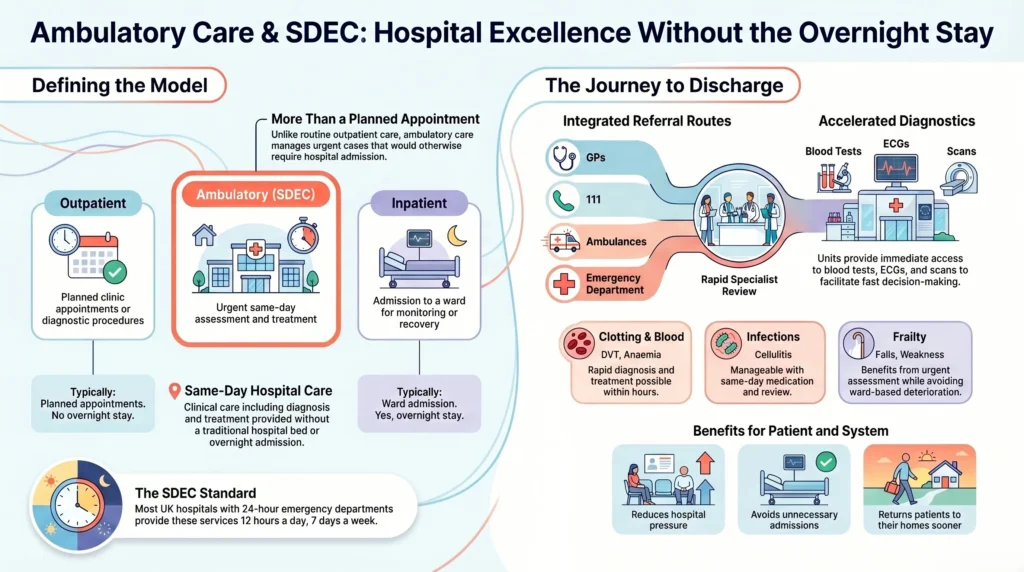
A longer and more useful definition comes from NHS improvement resources. It quotes the Royal College of Physicians, which describes ambulatory care as clinical care that may include diagnosis, observation, treatment, and rehabilitation not provided within the traditional hospital bed base or within traditional outpatient services, and which can be delivered across the primary-secondary care interface. That definition matters because it shows ambulatory care is not just “an appointment where you go home”. It is also a model of care that sits between the old categories of outpatient visit and inpatient admission.
So when someone asks what ambulatory care is, the best answer is not a short dictionary line. It is this: ambulatory care is healthcare designed around same-day assessment, treatment, and discharge where it is safe and appropriate. It avoids defaulting to an overnight hospital stay.
Why the Term Confuses So Many People
Part of the confusion comes from the fact that the term is used in more than one way. In a broad sense, it can refer to a wide range of non-overnight healthcare, including outpatient clinics, day-patient procedures, diagnostics, and follow-up services. In urgent hospital care, however, the term is much more closely linked to ambulatory emergency care and same-day emergency care. NHS England says the national SDEC model builds on previous improvement work in AEC services and aims to provide a consistent approach to urgent patient pathways.
That means two people can both say “ambulatory care” and mean slightly different things. One may be thinking of a planned clinic appointment. Another may be thinking of a same-day medical assessment unit for acute illness. Both point to non-overnight care, but the service model, urgency, staffing, and patient journey are not the same. That is why a good ambulatory care explained UK healthcare guide has to do more than repeat the words “no overnight stay”. It also needs to show where the term sits inside the real NHS pathway.
What Ambulatory Care Means in the NHS
In current NHS language, Ambulatory Care most often points to same-day emergency care (SDEC). NHS England’s service pages and service specification both define SDEC as a model for patients who would otherwise have been admitted to hospital. Instead, specialists assess, diagnose, and treat them on the same day of arrival. The service specification adds that the model was adopted nationally in 2019. It is now a widely accepted alternative to admission for suitable patients who can be seen, treated, and discharged on the same day.
That is an important detail because it makes clear that what is ambulatory care in the NHS is not exactly the same thing as a routine outpatient clinic. NHS England explicitly says SDEC is not an elective outpatient service. Instead, it forms part of a wider urgent and emergency care system and aims to ensure patients are seen by the right team the first time, without unnecessary ward admission.
In other words, when hospitals talk about ambulatory care today, they are often talking about something very practical: how to give urgent hospital care without automatically using an inpatient bed. Another reason the model has become so important is its role across NHS hospitals with emergency departments. NHS England’s SDEC page says all hospitals with a type 1, 24-hour emergency department should provide SDEC services at least 12 hours a day, 7 days a week.

Ambulatory Care vs Outpatient Care vs Inpatient Care
This is one of the most useful distinctions to make, because it answers several search questions at once.
| Type of Care | What It Usually Means in the UK | Overnight Stay? |
|---|---|---|
| Outpatient care | Planned clinic appointment, review, treatment, diagnosis, or procedure | No |
| Ambulatory care | Wider no-overnight model of care; in urgent NHS practice, this often means SDEC/AEC | No |
| Inpatient care | Admission to a ward for treatment, monitoring, or recovery | Yes |
NHS guidance says that if you have an appointment in a hospital or clinic and do not need to stay overnight, you are treated as an outpatient or a day patient. By contrast, inpatient care means staying in a hospital overnight or longer for treatment, monitoring, or recovery. Meanwhile, NHS England says SDEC is for patients who would otherwise have been admitted, but can instead be assessed, diagnosed, treated, and discharged the same day.
The simplest way to explain ambulatory care vs outpatient care UK is this: outpatient care is usually planned, while ambulatory care is broader and may include urgent same-day hospital treatment. The simplest way to explain the difference between inpatient and ambulatory care UK is even shorter: inpatient care uses a bed overnight; ambulatory care tries to avoid that where clinically safe.
Types of Ambulatory Care Services in the UK
A lot of top-ranking pages list “types of ambulatory care” but do not make the list feel very real. In UK practice, ambulatory care is best understood in two overlapping groups.
The first group is planned for non-overnight care. This includes outpatient clinics, day-patient services, diagnostic appointments, reviews, and procedures that do not require admission. NHS guidance on outpatients and day patients reflects exactly that sort of activity.
The second group covers urgent same-day hospital care. This is where SDEC and AEC sit. NHS England says some of the many types of SDEC treatment include medical, surgical, acute frailty, and specialist services such as paediatrics and gynaecology.
So, in practice, ambulatory care services UK can include:
- Outpatient clinics and day-patient treatment.
- Diagnostic outpatient services.
- Hospital rapid-access reviews.
- Ambulatory emergency care units.
- Same-day emergency care pathways.
- Frailty pathways and selected speciality-led same-day services.
That is why ambulatory care services in UK hospitals can vary from trust to trust. One hospital may emphasise a medical SDEC unit. Another may integrate frailty, surgical, and speciality services more explicitly. A third may use different local branding while still following the same core principle: treat as much as possible on the same day, and use an overnight bed only when the patient genuinely needs one.
What Happens in an Ambulatory Care Unit
This is the part readers usually want next. Once they understand the term, they want to know what actually happens in the unit.
An ambulatory care unit in the UK is designed for people who need urgent hospital assessment but may not need a ward bed. NHS England describes the SDEC model as a system where clinicians assess, diagnose, and treat patients quickly, without admission, so they can go home the same day if it is clinically safe.
Trust-level examples make this clearer. UCLH explains that its Ambulatory Emergency Care service provides same-day access to urgent assessment and treatment. It is for patients referred by a healthcare professional who might otherwise be seen in the emergency department. The aim is to complete care within a few hours and avoid unnecessary admission. Guy’s and St Thomas’ describes its medical SDEC unit in similar terms and focuses on people with acute illness who need urgent hospital input but are well enough to travel to and from the service.
A typical ambulatory care patient journey in the UK often follows a clear pathway. A GP, ambulance crew, NHS 111, a community team, or the emergency department may refer the patient. On arrival, clinicians take observations and carry out an initial assessment. They then arrange any urgent tests required, such as blood tests, ECG, urine tests, scans, or specialist review. Treatment may begin immediately if needed.
By the end of the visit, the patient will usually go home with advice or follow-up, return later for short-interval care, or be admitted if the clinical team decides a bed is necessary. As a result, the model reduces delays and supports faster decision-making.
What Conditions Are Commonly Treated?
There is no one national list that every SDEC or ambulatory care unit follows, but NHS England says SDEC spans medical, surgical, acute frailty, and specialist pathways. Trust pages then show the kinds of presentations commonly managed in these units.
UCLH’s Emergency Day Unit highlights a wide range of conditions, including headaches, low-risk chest pain, anaemia, abnormal blood test results, deep vein thrombosis, and infections. Guy’s and St Thomas’ lists acute medical problems across several areas, including anaemia, diabetes, DVT, cellulitis, acute kidney injury, and selected cardiac, respiratory, and urinary presentations.
Common Conditions Treated in Ambulatory Care
| Condition Type | Examples Seen in UK Ambulatory Care | Why Suitable for Same-Day Care |
|---|---|---|
| Chest Pain (low-risk) | Non-cardiac or low-risk cardiac chest pain | Needs urgent assessment, but often safe without admission |
| Blood Conditions | Anaemia, abnormal blood test results | Can be investigated and managed within hours |
| Clotting Issues | Deep vein thrombosis (DVT) | Requires rapid diagnosis and treatment, but not always admission |
| Infections | Cellulitis, mild to moderate infections | Can be treated with the same-day medication and review |
| Neurological Symptoms | Acute headaches, dizziness | Often require tests, but not overnight monitoring |
| Kidney & Urinary Issues | Acute kidney injury, urinary problems | Manageable with monitoring and short-term treatment |
| Respiratory Conditions | Mild breathing issues, infections | Can be assessed and stabilised quickly |
| Frailty & Elderly Care | Falls, weakness, general deterioration | Needs urgent assessment but benefits from avoiding admission |
The key point is not just the condition itself, but whether the patient can be safely assessed, treated, and discharged on the same day.
More importantly, the list alone is not the key point. It is the logic behind them. These are patients who need prompt hospital assessment and often rapid diagnostics, but who may still be clinically appropriate for same-day discharge. The model is not “minor illness care”. It is urgent hospital care delivered differently.

Who Is Suitable for Ambulatory Care?
This is another part many shorter blogs skip, but it matters because ambulatory care is not a catch-all route for every patient.
NHS England’s service specification says the overarching principle of SDEC is that urgent and emergency care teams can rapidly assess, diagnose, and treat patients without admission to a ward, if it is clinically safe to do so. That phrase matters. It is about selection and suitability, not speed for its own sake.
Trust-level guidance makes the same point more practically. Guy’s and St Thomas’ says patients in its medical SDEC must be well enough and able to travel to and from the department. UCLH’s service description also makes clear that ambulatory emergency care is designed for referred patients who can be managed over a few hours and discharged home, not for everyone who turns up unwell.
So, who is usually suitable? Broadly speaking, it is patients who:
- Need urgent hospital-level assessment or treatment.
- May once have been admitted by default.
- Are stable enough for same-day management
- Can travel to and from the service, or otherwise fit the service criteria.
- Do not need immediate ongoing ward-level monitoring or resuscitation-based care.
The flip side matters too. Unstable patients who need close ongoing monitoring, a high level of intervention, or care outside the service criteria still need the emergency department, inpatient care, or both. That is why same day emergency care NHS pathway is not a shortcut around clinical judgement. It is a way of organising urgent care more intelligently.
How Ambulatory Care Connects With Community and Home-Based Services
One of the more useful gaps to fill is the connection between ambulatory care and what happens outside the hospital.
Many people picture ambulatory care as something that begins and ends inside the hospital. In reality, the NHS uses it as part of a much wider admission-avoidance and flow model. NHS England says patients can be referred or booked into SDEC through several routes, including emergency departments, direct GP referral, ambulance services, and NHS 111.
There is also an important link with community services. NHS England says urgent community response (UCR) teams provide urgent care to people in their homes, help avoid hospital admissions, and enable people to live independently for longer. It adds that older people and adults with complex health needs can get fast access within two hours to a range of health and social care professionals, including physiotherapy, occupational therapy, medication prescribing and review, and practical support.
That does not mean ambulatory care and home care are the same thing. Instead, they form part of the same broader movement in UK healthcare: stop treating overnight admission as the default answer. Instead, assess patients quickly, match them to the right service early, and use hospital beds for the people who truly need them. In some cases, that means SDEC. Elsewhere, it means urgent community support at home. Across many systems, the two services need to work closely together.
That is one reason the ambulatory care role in modern NHS services is bigger than a single ward or department. It is tied to how the NHS is trying to improve urgent care flow, reduce avoidable admissions, and keep more treatment closer to the patient’s normal life.

Why Ambulatory Care Matters in Modern NHS Care
The NHS keeps investing in this model because it answers several problems at once.
For patients, it can mean quicker assessment, fewer unnecessary admissions, shorter stays, and a more focused route into the right team. NHS England’s public SDEC page says the model aims to benefit both patients and the healthcare system by reducing waiting times and hospital admissions, where appropriate.
For hospitals, the value is just as clear. The service specification says the aim is to reduce pressure on the inpatient bed base and ensure teams directly refer or redirect patients to SDEC wherever possible. NHS improvement resources also describe same-day emergency care as a transformational change in care delivery that can improve patient flow, improve patient experience, and reduce acute hospital admissions.
There is also a systems benefit that can be easy to miss. SDEC supports earlier senior clinical decision-making and can help patients avoid attending other urgent care services inappropriately, such as the emergency department or urgent treatment centre, when a more suitable same-day pathway is available. That is part of why the NHS describes it as the right care, in the right place, at the right time.
Put simply, Ambulatory Care matters because it reflects a modern NHS reality: many patients need urgent, specialist, hospital-level care, but they do not always need an overnight stay. When the system can tell the difference quickly and safely, both patients and services benefit.
Get valuable training, UK-focused support, and the skills employers want. No experience needed.
Join 50+ graduates who landed tech jobs with our industry-focused training programme designed for beginners.
Explore Now - Our Job Ready ProgrammeFrequently Asked Questions (FAQs)
What Is Ambulatory Care in the UK?
Ambulatory care in the UK means treatment provided without an overnight hospital stay. In urgent NHS settings, it often refers to same-day emergency care (SDEC).
What Is the Definition of Ambulatory Care in Healthcare?
Ambulatory care is healthcare delivered without using an overnight hospital bed. It can include assessment, diagnosis, treatment, observation, and follow-up care.
What Is Another Name for Ambulatory Care?
In urgent hospital care, ambulatory care is often called same-day emergency care (SDEC). An older term sometimes used is ambulatory emergency care (AEC).
What Does Ambulatory Care Include?
It can include outpatient clinics, day procedures, diagnostic tests, follow-up appointments, and urgent same-day hospital treatment without overnight admission.
What Is the Difference Between Ambulatory Care and Outpatient Care?
Outpatient care is usually planned clinic-based care, while ambulatory care is a broader non-overnight model that can also include urgent same-day hospital treatment.
What Happens in an Ambulatory Care Unit?
Patients usually receive same-day assessment, tests, treatment, and specialist review. They may then go home, return for further review, or be admitted if needed.
What Are the Benefits of Ambulatory Care?
Main benefits include faster assessment, fewer unnecessary admissions, shorter stays, better patient flow, and improved patient experience.





All Courses
Personal Development
Employability
Career Bundle
Management
Free QLS Certificate
IT & Software
Business
Technology
Health & Care
Quality Licence Scheme Endorsed Courses
Health & Safety
Training
Marketing
Job Ready Programme
Design
Accounting & Finance
Health and Fitness
Healthcare and Medical
Animal Care
Psychology
Microsoft Office
Teach & Education
I.T
HR and Leadership
Counselling and Therapy
Teaching & Child Care
Health and Social Care
Electrical & Electronics
Law
Food Nutrition
programming
Administration & Office Skills
Education
Language
Engineering
Cooking & Baking
Law & Criminology
Accounting
QLS Bundle
Office Skills
Awareness
Photography
Finance
Lifestyle
Diet and Nutrition
Makeup & Beauty
Therapy
Sports
First Aid
Accounting & Bookkeeping
Mathematics
Excel
Web Design
Top Rated Course
Diet and Fitness
Counselling
Agriculture
Networking & Design
General Education
Biotechnology
Audit
Economics
Lifestyle & Recreational
Adobe Photoshop
Travel and Tourism
Categories

Awarded By