

Have you ever noticed that two people can receive the same service, yet one feels genuinely cared for while the other feels processed?
That difference usually comes down to Person Centred Care. In the UK, the four commonly cited principles are dignity, compassion and respect; coordinated care; personalised care; and support for people to recognise and develop their strengths and abilities so they can live an independent and fulfilling life. Put simply, good care should fit the person, not force the person to fit the system.
That is why this topic matters so much in health and social care. People are not checklists, diagnoses, or room numbers. They have routines, beliefs, fears, goals, families, histories, and preferences. UK guidance from NHS England, CQC, and the Care Act framework all point in the same direction: care should reflect what matters to the individual and involve them in decisions about support and treatment.
In this guide, you will get a clear answer to what the 4 principles of person-centred care in the UK are. You will also get a simple explanation of what Person Centred Care means, practical examples from real settings, and key points many people miss. These include statutory duties, confidentiality, family involvement, shared decision-making, and the balance between safety and independence.

What Person Centred Care Means
A simple person-centred care definition in the UK is care that is planned and delivered around the individual’s needs, preferences, strengths, and goals. It should not be built around routines, convenience, or a one-size-fits-all process. NHS England describes personalised care as giving people choice and control over the way their care is planned and delivered. That approach is based on what matters to them and on their individual strengths and needs.
This sounds simple, but it changes a great deal in practice. Staff should not only ask, “What support does this person need?” They should also ask, “How do they want that support to work?” and “What kind of life are they trying to maintain?” The Care Act guidance in England says the core purpose of adult care and support is to help people achieve the outcomes that matter to them. The focus should stay on the person’s own needs and goals.
Person-centred care also means seeing the whole person. CQC says care, support, and treatment should meet people’s needs and preferences. It should also take account of their strengths, abilities, aspirations, culture, unique backgrounds, and protected characteristics. That makes person-centred care in health and social care UK much more than being polite. It is about individuality, voice, dignity, and real involvement.
The 4 Principles of Person Centred Care
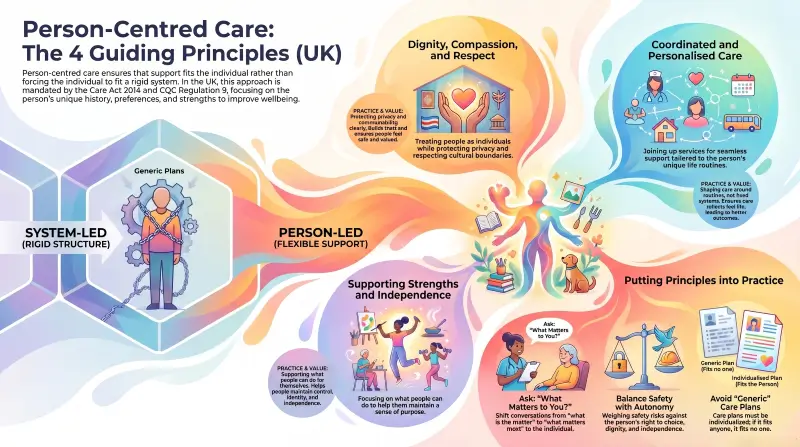
The four principles most often used in UK guidance come from a Health Foundation framework referenced by the Local Government Association. They are: dignity, compassion and respect; coordinated care; personalised care; and support for strengths, abilities, independence, and fulfilment.
1. Dignity, Compassion, and Respect
The first principle is the foundation of everything else. If care is efficient but makes someone feel ignored, embarrassed, or powerless, it is not person-centred in any meaningful sense. CQC’s guidance says providers must make sure care is based on an assessment of needs and preferences, and its assessment framework says people should be treated as individuals with respect for their communication needs, personal circumstances, culture, and preferences.
In daily care, dignity and respect appear in very ordinary moments. You can see it in the way staff speak to someone. It also shows in whether they explain what they are doing, protect privacy during personal care, and knock before entering. Another part of it is taking time to understand what makes that person feel comfortable or distressed. SCIE’s dignity guidance is clear on this point. Privacy is a major part of caring with dignity, and losing bodily privacy is an automatic attack on dignity.
2. Coordinated Care, Support, or Treatment
The second principle is about joined-up support. Many people do not receive care from just one professional or one service. They may move between hospital, GP, community services, social care, pharmacy, family carers, and support workers. NHS England says personalised care takes a whole-system approach, integrating services around the person across health, social care, public health, and wider services.
This matters because poor coordination usually lands on the person. They end up repeating the same information. They may carry the stress of chasing professionals or trying to fix gaps they did not create. Good coordinated care reduces confusion and helps make support safer and smoother. It also shows more respect for the person’s time, energy, and wellbeing. The Local Government Association also links person-centred care to greater choice, control, and a more joined-up system.
3. Personalised Care, Support, or Treatment

This is the principle most people think of first. CQC Regulation 9 says care and treatment must be appropriate, meet people’s needs, and reflect their preferences. It also says providers must work in partnership with the person, support informed decisions, and involve them, or someone lawfully acting on their behalf, in planning, management, and review.
So person-centred care does not mean “give everyone friendly care.” It means support should be shaped around the person’s own life. Two people with the same diagnosis may want very different routines, priorities, and outcomes. One may value privacy most. Another may want family involvement. Someone else may want support that maximises independence, even if it takes longer. Personalised care takes those differences seriously instead of flattening them into a standard service pattern.
4. Strengths, Abilities, Independence, and Fulfilment
The fourth principle is often the one that makes person-centred care feel truly empowering. It is not only about meeting needs. It is also about helping people keep control, build confidence, and continue doing what they can do for themselves. According to the Local Government Association framework, person-centred care should support people to recognise and develop their own strengths and abilities. This helps people live an independent and fulfilling life.
CQC’s assessment framework reinforces the same idea by linking person-centred care to strengths, abilities, aspirations, and choice. In practice, this means not taking over automatically just because it is quicker. It means asking what the person can still do, what matters most to them, and how support can enable rather than replace them. That is especially important in care homes, home care, rehabilitation, dementia care, and long-term support.
The 4 Principles of Person Centred Care at a Glance
| Principle | What It Means in Practice | Why It Matters in Real Care |
|---|---|---|
| Dignity, Compassion, and Respect | Treating people as individuals, protecting privacy, communicating clearly, and respecting culture, preferences, and personal boundaries | Builds trust, protects dignity, and ensures people feel safe, valued, and understood |
| Coordinated Care | Joining up services across healthcare, social care, and support systems so information flows and care feels seamless | Reduces stress, prevents repetition, and improves safety and continuity of care |
| Personalised Care | Shaping care around the person’s needs, goals, routines, and preferences rather than a fixed system | Ensures care reflects real life, not standard processes, leading to better outcomes |
| Strengths, Independence, and Fulfilment | Supporting what people can do for themselves, encouraging confidence, and promoting meaningful daily living | Helps people maintain control, identity, and a sense of purpose |
The 8 Core Values Often Linked to Person Centred Care
Alongside the four principles, many UK care workers also learn the person-centred values through Care Certificate Standard 5. Skills for Care lists these as individuality, rights, choice, privacy, independence, dignity, respect, and partnership. It describes them as guiding principles that put the individual receiving care or support at the centre of everything staff do.
These values help translate a broad principle into everyday action. “Personalised care” can sound abstract. “Choice”, “privacy”, and “partnership” are easier to recognise in real life. Am I offering a real choice here? Am I protecting private information? Am I working with the person and not just around them? Those are the kinds of questions person-centred values encourage.
Why Person Centred Care Matters in UK Health and Social Care
First, it matters because it improves the experience of care. NHS England says personalised care gives people more choice and control. It also creates a different relationship between people and professionals. As a result, health and wellbeing can improve while care becomes more joined up.
Second, it matters because it leads to better decisions. NICE defines shared decision-making as a joint process in which a healthcare professional works together with a person to reach a decision about care, using both evidence and the person’s own preferences, beliefs, and values. When that happens well, care is more realistic, more acceptable to the person, and more likely to reflect what they actually want.
Third, it matters because it protects dignity and rights. CQC links person-centred care not only to preferences and needs, but also to consent, involvement, legal authority, and the Mental Capacity Act where relevant. SCIE also makes clear that privacy, confidentiality, and respect for personal relationships are central to dignified care.
What Person Centred Care Looks Like in Practice
In a hospital, person-centred care examples in the UK might include explaining treatment options in plain language, checking understanding, asking what matters most to the patient, and involving them in decisions about next steps. NICE’s shared decision-making guidance supports exactly that kind of joint approach.
Within a care home setting, person-centred care means more than recording a resident’s name and clinical needs. It means understanding personal history, religious or cultural needs, communication style, family relationships, likes, dislikes, fears, routines, and aspirations. CQC says people’s personal, cultural, social, and religious needs should be understood and met. It also says communication needs should be supported so people can engage in their care.

For domiciliary care, person-centred practice may involve adjusting how support is delivered so it fits the person’s morning routine, comfort level, and sense of independence. In rehabilitation or recovery, it might mean encouraging the person to do part of a task themselves instead of taking over completely. In dementia care, it often means using knowledge of the person’s life story, triggers, familiar habits, and preferences to reduce distress and preserve identity. CQC also says assessments should include emotional, social, cultural, religious, and spiritual needs, not just physical ones.
Family and carers also have an important place, but not in a way that erases the individual. CQC says providers must work within the Mental Capacity Act and consult carers, families, or advocates where appropriate. At the same time, SCIE stresses privacy, confidentiality, and the person’s own wishes. Good person-centred care works with families carefully and appropriately, not automatically.
Safety, Comfort, Wellbeing, and Choice
One of the most important parts of person-centred care is balance. A person’s safety matters, but so do comfort, dignity, privacy, relationships, and freedom. SCIE’s dignity guidance points out that real care practice often involves weighing safety against intrusion, confidentiality against safeguarding, and privacy against the need for support.
That is why person-centred care for elderly patients UK or person-centred care for dementia patients UK is not simply about doing whatever feels safest from the organisation’s point of view. Instead, it is about asking a better question. How do we support this person well, reduce harm, and still preserve as much control, dignity, and identity as possible? NICE and CQC both support this kind of person-involved decision-making rather than a purely service-led approach.

Statutory Duties and UK Guidance
This is a point many short blog posts skip, but it matters. In England, person-centred working is not just a nice idea. The Local Government Association points to several statutory duties and frameworks around person-centred care, including the Care Act 2014 and CQC Regulation 9.
CQC Regulation 9 requires care and treatment to be appropriate, meet needs, and reflect preferences. It also requires collaborative assessment, involvement in care planning and review, support for informed decisions, and lawful handling of issues around consent and capacity.
The Care Act statutory guidance says the core purpose of adult care and support is to help people achieve the outcomes that matter to them, with the person’s own needs and goals at the centre. That gives person-centred care, health and social care UK a clear policy foundation, not just a training-room slogan.
How to Apply Person Centred Care Day to Day
For person-centred care principles for care workers UK, the most useful starting point is often the simplest one. Ask better questions. Not just “What help do you need?” but also “What matters to you?”, “How would you like this done?”, “What would make today easier?”, and “What do you want to keep doing for yourself?” NHS England’s personalised care approach is grounded in exactly this shift. The focus moves towards conversations based on what matters to the person.
A practical day-to-day checklist can help:
- Learn the person’s preferences, routines, values, and communication needs.
- Involve them in decisions as far as they wish and are able.
- Explain options clearly and support informed choice.
- Protect privacy and confidentiality in ordinary interactions.
- Work with family, carers, or advocates appropriately.
- Support independence instead of taking over by default.
- Review care when needs, wishes, or circumstances change.
Good documentation matters too. A vague care plan rarely supports person-centred care. CQC says assessments should include all relevant needs. Reviews should happen regularly and whenever needed, including when people transfer between services or their goals change. A useful care plan tells staff how support should happen for that person, not just what task needs doing

Common Mistakes to Avoid
One common mistake is confusing friendliness with person-centred care. Warmth matters, but friendliness alone is not enough. Real person-centred practice includes involvement, consent, choice, privacy, communication support, and care that reflects the person’s actual preferences and circumstances.
Another mistake is relying on generic care plans. If the plan could apply to almost anyone, it probably is not person-centred enough. CQC expects care to reflect individual needs, preferences, culture, and communication needs, not just service routines.
A third mistake is letting safety wipe out autonomy. SCIE’s dignity guidance shows that good care often requires careful judgement between safety and intrusion. Person-centred care does not ignore risk, but it does resist unnecessary restriction when less intrusive options are available.
Get valuable training, UK-focused support, and the skills employers want. No experience needed.
Join 50+ graduates who landed tech jobs with our industry-focused training programme designed for beginners.
Explore Now - Our Job Ready ProgrammeFrequently Asked Questions (FAQs)
What Are the 4 Principles of Person Centred Care in the UK?
The 4 principles are dignity, compassion and respect; coordinated care; personalised care; and support for people to build strengths and live independently.
What Is Person Centred Care in the UK?
Person-centred care means planning care around the person’s needs, preferences, strengths, and goals rather than around a fixed routine.
Why Is Person Centred Care Important in Health and Social Care?
It is important because it helps people feel respected, involved, and better supported while improving care quality through more individualised support.
What Are the 8 Core Values of Person Centred Care?
The 8 core values are individuality, independence, privacy, partnership, choice, dignity, respect, and rights.
What Does Person Centred Care Look Like in Practice?
In practice, it means treating people as individuals, involving them in decisions, respecting communication and cultural needs, and tailoring support to daily life.
How Do Care Workers Apply Person Centred Care Every Day?
Care workers apply it by listening carefully, offering real choices, protecting privacy, supporting independence, and working in partnership with the person.
What Is CQC Regulation 9 on Person Centred Care?
Regulation 9 says care must be appropriate, meet needs, reflect preferences, and involve people in planning and reviewing their care.






All Courses
Personal Development
Employability
Career Bundle
Management
Free QLS Certificate
IT & Software
Business
Technology
Health & Care
Quality Licence Scheme Endorsed Courses
Health & Safety
Training
Marketing
Job Ready Programme
Design
Accounting & Finance
Health and Fitness
Healthcare and Medical
Animal Care
Psychology
Microsoft Office
Teach & Education
I.T
HR and Leadership
Counselling and Therapy
Teaching & Child Care
Health and Social Care
Electrical & Electronics
Law
Food Nutrition
programming
Administration & Office Skills
Education
Language
Engineering
Cooking & Baking
Law & Criminology
Accounting
QLS Bundle
Office Skills
Awareness
Photography
Finance
Lifestyle
Diet and Nutrition
Makeup & Beauty
Therapy
Sports
First Aid
Accounting & Bookkeeping
Mathematics
Excel
Web Design
Top Rated Course
Diet and Fitness
Counselling
Agriculture
Networking & Design
General Education
Biotechnology
Audit
Economics
Lifestyle & Recreational
Adobe Photoshop
Travel and Tourism
Categories

Awarded By