
The Quick Answer on Phlebotomist Salary
If you are searching for a Phlebotomist Salary, you are probably not looking for a random average and nothing else. You are trying to work out whether the pay is decent, whether the NHS pays better than private clinics, and whether the salary grows once you have some experience behind you.
That is where a lot of salary pages fall short. They give you a number, but not much of a picture.
And the picture matters.
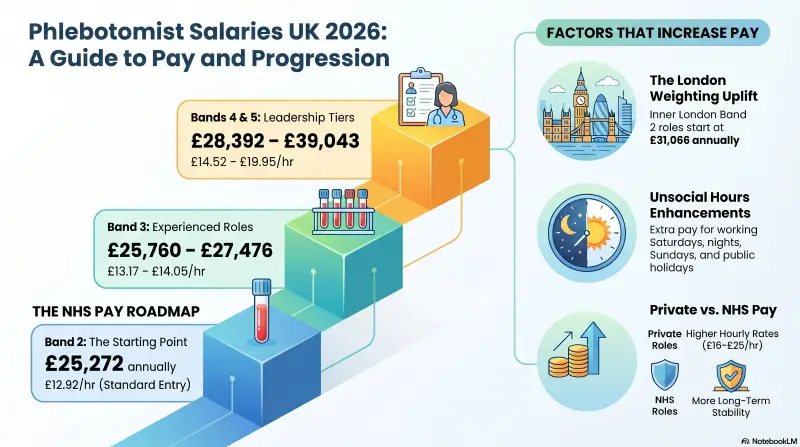
A newly hired phlebotomist in a standard NHS post is not earning the same as someone in a Band 3 role, someone working enhanced shifts, or someone who has moved into a senior or lead post. The official 2026/27 NHS pay scales in England put Band 2 at £25,272 a year or £12.92 an hour, while Band 3 runs from £25,760 to £27,476, or £13.17 to £14.05 an hour from 1 April 2026. The National Careers Service gives a wider career range of about £24,000 for starters to about £30,000 for experienced phlebotomists.
So the honest answer to how much a phlebotomist earns in the UK 2026 is this: many people start in the mid-£20,000s, but the better-paid roles come from band progression, location, shift pattern, and moving into more senior work. That is a much more useful answer than a single average on its own.
What a Phlebotomist Actually Does
Salary makes more sense when you understand what the role really involves.
A phlebotomist collects blood samples from patients for testing and analysis, but the job is not only about drawing blood. The National Careers Service says the role also includes explaining procedures, reassuring patients, applying dressings, labelling samples, and recording information accurately. It also notes that phlebotomists may work evenings, weekends, and bank holidays on shifts.
That matters because pay often reflects scope. A basic outpatient post is not always the same as a role that covers wards, GP services, community clinics, or supervision. Current NHS job adverts for senior phlebotomist posts show wider duties such as supporting junior staff, covering more than one service area, and helping oversee day-to-day department work. In other words, the salary starts to move once the job stops being purely routine.
NHS Phlebotomist Salary in 2026
For most people, the NHS is the clearest place to start because the pay framework is transparent.
NHS Employers says that from 1 April 2026, the Agenda for Change rates in England put Band 2 at £25,272 and Band 3 at £25,760 to £27,476. That is the core answer behind searches like NHS phlebotomist salary UK, NHS band 2 phlebotomist salary UK, band 3 phlebotomist salary UK, and phlebotomy pay scale UK, explained.
Live NHS job listings in March 2026 back that up. Current search results show standard phlebotomist posts advertised at £25,272 a year, while some still show the older £24,465 figure because they were posted before the April uplift took effect. That is an important detail because many older salary pages still circulate outdated numbers.
The same search results also show that not every phlebotomy-related post is identical. Some roles are part-time, some are community-based, some are cross-site, and some are already moving into higher band territory. That is why the phrase average phlebotomist salary UK can be a little misleading unless you pair it with band, setting, and experience.

Salary Table: NHS Pay Bands Most Relevant to Phlebotomy
The clearest way to understand phlebotomy pay is to see the band structure in one place. Based on the published 2026/27 NHS England pay scales, these are the bands most relevant to phlebotomy and phlebotomy progression.
| NHS Band | Annual Salary | Hourly Rate | What It Usually Means for Phlebotomy |
|---|---|---|---|
| Band 2 | £25,272 | £12.92 | Entry-level or standard phlebotomist roles |
| Band 3 | £25,760 to £27,476 | £13.17 to £14.05 | More experienced phlebotomist roles or broader duties |
| Band 4 | £28,392 to £31,157 | £14.52 to £15.93 | Senior phlebotomist or supervisory progression |
| Band 5 | £32,073 to £39,043 | £16.39 to £19.95 | Lead-level or team management roles |
Current NHS vacancies support that progression pattern, with Senior Phlebotomist posts appearing at Band 4 and Phlebotomy Lead roles appearing at Band 5.
What Changes Phlebotomist Pay the Most
Once you know the banded figures, the next question is obvious: what actually moves the pay up?
The biggest factors are usually:
- Your band.
- Your location.
- Your shift pattern.
- Your experience level.
- Whether you stay in a routine post or move into senior, training, or lead work.
The official NHS pay scales explain the band differences, while current NHS job adverts show that broader roles can mean broader pay. The National Careers Service also supports this by showing a starter-to-experienced salary range rather than one fixed figure.
This is why phrases such as entry-level phlebotomist salary UK, trainee phlebotomist salary UK, senior phlebotomist salary UK NHS, and phlebotomy career salary progression UK can all point to different numbers. The job title may stay close, but the value of the role changes once you take on more independence, more complexity, or more leadership.
London, Weekends, and Part-Time Pay
Location can change the picture more than many people expect, and London is the clearest example.
NHS Employers publishes Higher Cost Area Supplement rates, and for inner London, the 2026/27 scales move Band 2 to £31,066 a year or £15.89 an hour, while Band 3 rises to £31,554 to £33,270, or £16.14 to £17.01 an hour. So if you are checking phlebotomist salary in London, UK, the uplift is real, and it is one of the simplest ways the same band can produce a noticeably different salary.
Shift timing matters too. The NHS Terms and Conditions of Service Handbook says unsocial hours payments apply for Saturdays, weekday nights, Sundays, and public holidays. For Bands 2 and 3, the handbook shows that Saturdays and weekday nights attract an uplift, while Sundays and public holidays attract a larger one. That is why weekend phlebotomist pay UK NHS can be much better than the plain hourly rate in the band table.
Part-time pay is more straightforward. NHS jobs are generally advertised on the same band but on a pro rata basis if the post is part-time. So if you are searching for part-time phlebotomist salary UK, the question is usually not “is there a separate scale?” but “how many hours will I be paid for, and do those hours include enhancements?”
Private and Agency Phlebotomist Pay
This is the point where salary advice often becomes vague, because private pay is not organised like NHS pay.
The NHS gives you a band, a scale, and a published rate. Private and agency work is far less standardised. Current listings show some private phlebotomist roles advertised as depending on experience, while freelance or contract nurse/phlebotomist roles can show £16 to £25 an hour, depending on experience and performance. That suggests private and agency pay can be higher on paper, but also much more variable.

So if you are comparing private phlebotomist salary UK, private clinic phlebotomist salary UK, agency phlebotomist pay UK, or phlebotomist salary NHS vs private UK, the most honest answer is this: NHS pay is easier to predict, while private and agency roles may offer stronger hourly rates but less consistency. A higher-looking hourly figure is not always a better long-term package if the hours, extras, or security are less reliable. That last point is an inference from how current adverts are structured, rather than a single published national pay rule.
How to Become a Phlebotomist
Most people do not search for salary in isolation. They want to know whether the role is realistic for them.
The National Careers Service says there are no set entry requirements to become a trainee phlebotomist. It lists four common routes: college, an apprenticeship, working towards the role, or applying directly. It also notes that some people start as healthcare assistants and move across through experience and training.
That is one reason phlebotomy appeals to people trying to enter healthcare without a long degree pathway. There are formal routes too. The official Healthcare Science Assistant Level 2 apprenticeship is listed as a 14-month programme for routine technical and scientific support in hospitals, GP surgeries, and other healthcare settings. It is not labelled “phlebotomist apprenticeship” in the course title, but it is highly relevant to the wider support-workforce route into clinical settings.
So if you are looking up beginner phlebotomist salary UK with no experience or entry level healthcare phlebotomy salary UK, the realistic answer is that many people enter through Band 2 or equivalent support roles and build from there rather than arriving with a high starting salary on day one.
How Salary Progression Works

Phlebotomy is not a career where the first salary figure tells the whole story.
The National Careers Service says that with experience, you could become a senior phlebotomist and take on more complex work, or move into team leader or manager roles. Current NHS vacancies support that progression. In 2026, senior phlebotomist roles are appearing at Band 4, while phlebotomy lead roles are appearing at Band 5. That is the clearest real-world answer to searches such as senior phlebotomist salary UK NHS, highest paying phlebotomy jobs UK, and NHS phlebotomy band progression salary UK.
If your goal is to increase your pay, the practical routes are not mysterious. Move from Band 2 to Band 3, build experience in busier or broader services, consider less sociable shifts if they suit you, and look for senior, training, or lead posts once you have enough depth behind you. That is really what increasing a phlebotomist’s salary UK means in practice.
Is Phlebotomy Worth It in 2026?
For the right person, yes — but not because the starting pay is dazzling.
Phlebotomy makes sense if you want a patient-facing healthcare role, a relatively accessible entry route, and a clear NHS pay structure. It also makes sense if you are looking for a stepping stone into wider healthcare work, because the role builds clinical confidence, patient contact, and practical experience. The National Careers Service profile and current NHS recruitment both support that picture.
If, on the other hand, you are looking for a role with a very high starting salary, phlebotomy may not be the most exciting option on paper. But if you are looking for a realistic way into healthcare with room to grow, it is much stronger than a single salary figure might suggest. That is why the better question is not “Is the first wage impressive?” but “Does this role open the right door?”
Get valuable training, UK-focused support, and the skills employers want. No experience needed.
Join 50+ graduates who landed tech jobs with our industry-focused training programme designed for beginners.
Explore Now - Our Job Ready ProgrammeFrequently Asked Questions (FAQs)
How Much Do Phlebotomists Make in the UK?
The phlebotomist’s salary in the UK is usually best seen as a range. Typical pay often starts around £24,000 and can rise towards £30,000 depending on experience, location, and employer.
How Much Does NHS Pay a Phlebotomist?
NHS phlebotomist pay in England is usually linked to Band 2 or Band 3. From April 2026, Band 2 pays £25,272, while Band 3 pays £25,760 to £27,476.
How Much Do Phlebotomists Make per Hour in the UK?
In England, 2026/27 NHS hourly rates are £12.92 for Band 2 and £13.17 to £14.05 for Band 3. Extra pay may apply for weekends or unsociable hours.
Are Phlebotomists in High Demand in the UK?
Yes. Phlebotomists remain in demand across hospitals, GP services, community care, and healthcare support settings.
What Is the Future Outlook for Phlebotomists?
The outlook is positive because blood testing remains essential for diagnosis, screening, monitoring, and treatment.
Can Anyone Be a Phlebotomist in the UK?
There is no single fixed national route, but training is still needed. People often enter through direct application, college, apprenticeships, or healthcare support role
How Can I Make More Money as a Phlebotomist?
The clearest routes are gaining experience, moving up bands, taking senior roles, working in higher-paying areas, and picking up enhanced shifts.





All Courses
Personal Development
Employability
Career Bundle
Management
Free QLS Certificate
IT & Software
Business
Technology
Health & Care
Quality Licence Scheme Endorsed Courses
Health & Safety
Training
Marketing
Job Ready Programme
Design
Accounting & Finance
Health and Fitness
Healthcare and Medical
Animal Care
Psychology
Microsoft Office
Teach & Education
I.T
HR and Leadership
Counselling and Therapy
Teaching & Child Care
Health and Social Care
Electrical & Electronics
Law
Food Nutrition
programming
Administration & Office Skills
Education
Language
Engineering
Cooking & Baking
Law & Criminology
Accounting
QLS Bundle
Office Skills
Awareness
Photography
Finance
Lifestyle
Diet and Nutrition
Makeup & Beauty
Therapy
Sports
First Aid
Accounting & Bookkeeping
Mathematics
Excel
Web Design
Top Rated Course
Diet and Fitness
Counselling
Agriculture
Networking & Design
General Education
Biotechnology
Audit
Economics
Lifestyle & Recreational
Adobe Photoshop
Travel and Tourism
Categories

Awarded By