More people than ever are asking a simple but powerful question: how can I work for myself? In the UK, rising living costs, flexible work culture, and digital tools have made self-employment a realistic option rather than a risky dream. According to the Office for National Statistics, over 4.3 million people in the UK are self employed, working across digital, creative, service, and local industries.
However, self-employment is not just about quitting a job. It is about choosing the right self-employed job ideas, understanding how self-employment works, and building income step by step. Some people want a full-time business, while others want part-time self-employed jobs to boost income.
This guide breaks down 41 profitable self-employment ideas that work in the UK today. Moreover, it explains what self-employment means, how to start, and which self-employed business ideas suit different skills and lifestyles.
What Is Self Employment?
Self-employment means working for yourself rather than being employed by a company. In simple terms, you earn income directly from your work or business, and you are responsible for your own taxes.
In the UK, HMRC defines self-employed people as those who:
- Run their own business
- Take responsibility for profits and losses
- Control how, when, and where they work
For example, a freelance graphic designer in Manchester or a self-employed cleaner in Birmingham both count as self-employed workers.
However, self-employment does not always mean running a large company. Many self employed jobs from home, such as virtual assistance or freelance writing, start small and grow over time.
Self Employed vs Employed: Key Differences
Being self-employed gives you control, but it also brings responsibility.
Employees receive regular wages, paid holidays, and sick pay. In contrast, self-employed workers manage their own income, holidays, and benefits. However, self-employment often offers higher earning potential and flexibility.
For example, a self-employed web developer in London may earn more per project than an employed developer, although income can vary month to month. Therefore, planning and budgeting are essential.
How to Become Self Employed in the UK
Starting self-employment in the UK is simpler than many people think.
First, you must register as self-employed with HMRC, usually within three months of starting work. Moreover, if you earn over £1,000 per year from self-employment, you must file a Self Assessment tax return.
In addition, you may need:
- Public liability insurance
- A business bank account
- Relevant licences (for example, childcare or private hire driving)
Once registered, you can focus on choosing the right self employment ideas and building steady income.
Best Profitable Self Employment Ideas in the UK
Below are 41 proven self employed job ideas, grouped by industry. Each option includes a real UK context and earning potential.
Defining Self-Employment and Sole Trader Status
Most people starting out will register as a “Sole Trader.” This is the simplest way to trade. You keep all your business’s profits after tax but are personally liable for any losses. Self-employed business ideas often start here because the setup is fast and free via the HMRC website.
Alternatively, you might set up a Limited Company, which offers more protection but involves more paperwork.In the current economic climate, top self-employment opportunities are no longer limited to traditional trades. With the UK’s digital economy now worth over £600 billion, a new wave of self-business jobs has emerged, allowing professionals to reclaim their time and financial independence.
Whether you are looking to leave the corporate grind or simply want to earn extra on the side, the transition to being your own boss has never been more accessible. By focusing on high-demand niches—such as AI consultancy, sustainability auditing, or specialised tuition—you can build a resilient career that isn’t tied to a single employer’s whims.
How to Become a Self Employed
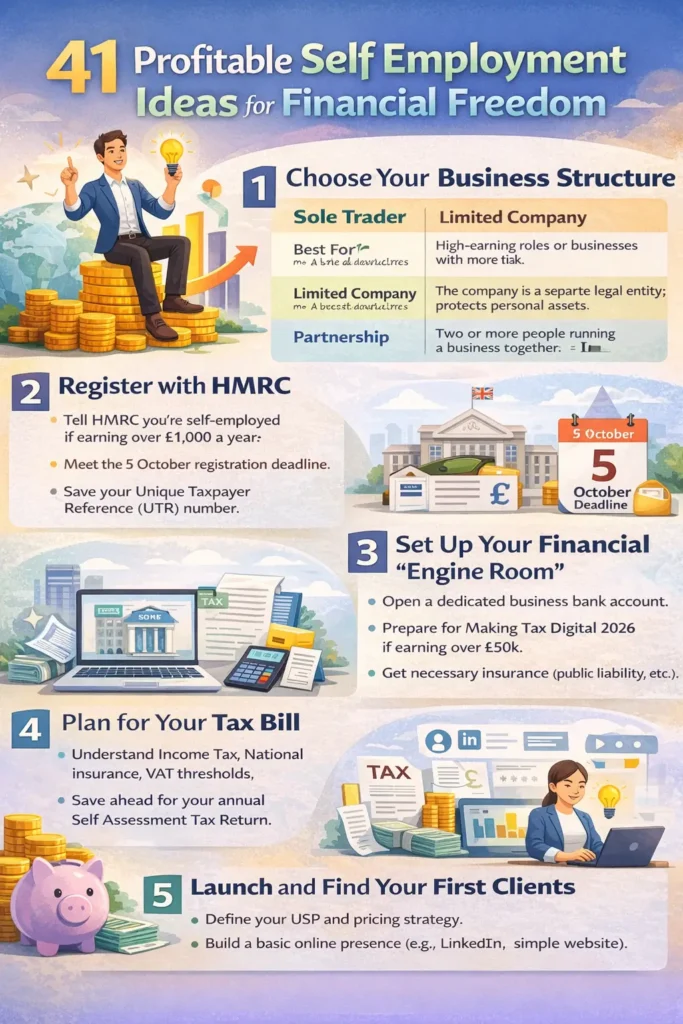
1. Choose Your Business Structure
Before you register, decide how you want to operate. Most people start as a Sole Trader, but as your self-business jobs grow, you might consider other options.
Business Structure Comparison
| Structure | Best For | Key Fact |
|---|---|---|
| Sole Trader | Individuals, freelancers, and small side hustles | Simplest to set up; you and the business are one legal entity |
| Limited Company | High-earning roles or businesses with more risk | The company is a separate legal entity that protects personal assets |
| Partnership | Two or more people running a business together | Shared responsibility and profits; each partner pays their own tax |
2. Register with HMRC (The Legal Step)
You must tell HMRC you are self-employed to ensure you pay the correct tax and National Insurance.
- The £1,000 Rule: You only must register if your gross income from self-employment exceeds £1,000 in a tax year.
- The Deadline: You must register by 5 October in your business’s second tax year. For example, if you start your top self-employment career in January 2026, you must register by 5 October 2026.
- The UTR: Once registered, HMRC will send you a 10-digit Unique Taxpayer Reference (UTR). Keep this safe; you’ll need it for every tax return.
3. Set Up Your Financial “Engine Room”
To turn self-work ideas into a stable income, you need organised systems.
- Open a Business Bank Account: Even as a sole trader, keeping your business income separate from personal spending is a “pro move” for scannable records.
- Making Tax Digital (MTD) 2026: Starting in April 2026, if you earn over £50,000, you are legally required to keep digital records and use MTD-compatible software (like Xero or FreeAgent) to send quarterly updates to HMRC.
- Insurance: Consider Public Liability insurance if you work with the public, or Professional Indemnity if you provide advice or creative services.
4. Plan for Your Tax Bill
When you are self-employed, tax isn’t taken out of your “paycheque” automatically. You pay it annually (or twice a year) through Self Assessment.
- Income Tax: You get a standard Personal Allowance (usually £12,570), after which you pay 20%, 40%, or 45%, depending on your bracket.
- National Insurance (2025/26 Rates):
- Class 2: Treated as paid if your profits are over £6,845 (to protect your State Pension record).
- Class 4: 6% on profits between £12,570 and £50,270.
- VAT: You must register if your turnover exceeds £90,000 in any 12-month period.
5. Launch and Find Your First Clients
Once the legalities are sorted, focus on the top self-employment opportunities by:
- Defining your Unique Selling Proposition (USP).
- Setting your pricing (day rates vs. fixed project fees).
- Building a simple digital presence (LinkedIn profile or a basic website).
Why Move to Self-Employed Business Jobs?
The primary driver for most Brits is flexibility. Instead of being tied to a 9-to-5 desk in a London high-rise, you can choose your hours. Therefore, you can build a career that fits your lifestyle. Moreover, the “side hustle” culture in the UK has proven that top self-employment careers often start as small experiments in the evening before turning into full-time roles.If you are wondering how to secure the top self-employed jobs in today’s market, the key is to stop trading time for money and start selling your expertise. Many of the most successful self-business jobs in 2026 focus on “fractional” roles—where you provide high-level strategy to multiple companies simultaneously.
Fitness, Health & Coaching Self-Employed Jobs
Personal Training
Personal training is one of the most popular good self employed jobs UK. Trainers work in gyms, clients’ homes, or online. Moreover, many UK trainers earn £30–£60 per session. With loyal clients, income becomes predictable.
Pilates Instructor
Pilates instructors are in high demand, especially among older adults and office workers. Many instructors work part-time while building a full client base.
Massage Therapist
Self-employed massage therapists work in clinics, gyms, or from home studios. However, insurance and proper qualifications are essential.
Life Coaching
Life coaching focuses on mindset, career, or confidence. With online sessions, this is one of the most flexible self-work ideas available.
Health & Wellness Career Ideas
| Job Idea | Estimated Annual Income | Startup Cost | Skill Level | Suitable for Beginners |
|---|---|---|---|---|
| Personal Trainer | £25,000 – £60,000 | Medium | Medium | Yes |
| Pilates Instructor | £22,000 – £45,000 | Medium | Medium | Yes |
| Massage Therapist | £24,000 – £55,000 | Medium | Medium | Yes |
| Life Coach | £30,000 – £80,000 | Low | Medium | Yes |
Online & Digital Self Employment Ideas (Work From Home)
Blogging
Blogging remains one of the most scalable self employment opportunities. UK bloggers earn through ads, affiliates, and digital products. However, results take time.
Affiliate Marketing
Affiliate marketing allows you to earn commission by promoting products. Moreover, it works well alongside blogging or social media.
Freelance Writing
Freelance writers are in demand across UK marketing agencies, blogs, and businesses. Many writers charge £0.10–£0.30 per word.
Editing and Proofreading
Editors help improve written content for businesses, authors, and students. This is one of the best self-employed jobs from home for detail-focused people.
Virtual Assistance
Virtual assistants support businesses with admin, email, and scheduling. Moreover, many UK VAs earn £20–£35 per hour.
Social Media Management
Businesses need help managing Instagram, LinkedIn, and TikTok. Therefore, social media management is a strong self-employed business idea.
CV & Resume Writing
UK jobseekers often struggle with CVs. Professional CV writers provide tailored documents and interview support.
Translation Services
If you speak more than one language, translation is a valuable self-employed job with steady demand.
Online & Remote Job Ideas
| Job Idea | Estimated Annual Income | Startup Cost | Skill Level | Suitable for Beginners |
|---|---|---|---|---|
| Blogger | £10,000 – £100,000+ | Low | Medium | Yes |
| Affiliate Marketer | £12,000 – £120,000+ | Low | Medium | Yes |
| Freelance Writer | £28,000 – £65,000 | Low | Medium | Yes |
| Editor / Proofreader | £25,000 – £55,000 | Low | Medium | Yes |
| Virtual Assistant | £22,000 – £45,000 | Low | Low | Yes |
| Social Media Manager | £28,000 – £60,000 | Low | Medium | Yes |
| CV / Resume Writer | £25,000 – £55,000 | Low | Medium | Yes |
| Translator | £26,000 – £60,000 | Low | High | No |
Creative & Design-Based Self Employed Business Ideas
Freelance Graphic Designer
Designers work on logos, branding, and marketing materials. Many operate as sole traders or limited companies.
Logo Design
Logo design is a niche but profitable self employed job idea, especially for startups and small businesses.
Web Development
Web developers build and maintain websites. Moreover, UK freelancers can earn £300–£600 per day.
App Development
App developers work with startups and businesses. Although technical, this is one of the highest-paying self-employed business ideas.
Videography
Videographers create content for weddings, businesses, and social media. Demand continues to grow.
Photography
Photography suits events, portraits, or product shoots. Many photographers start part-time.
Creative & Digital Career Ideas
| Job Idea | Estimated Annual Income | Startup Cost | Skill Level | Suitable for Beginners |
|---|---|---|---|---|
| Graphic Designer | £30,000 – £70,000 | Medium | Medium | Yes |
| Logo Designer | £28,000 – £65,000 | Medium | Medium | Yes |
| Web Developer | £45,000 – £90,000 | Low | High | No |
| App Developer | £50,000 – £120,000 | Low | High | No |
| Videographer | £30,000 – £65,000 | High | Medium | No |
| Photographer | £22,000 – £55,000 | High | Medium | Yes |
Teaching, Education & Knowledge-Based Self Employment
Tutoring
Online tutoring is booming in the UK. Tutors earn £20–£50 per hour teaching GCSEs, A-levels, or languages.
Create and Sell Online Courses
Courses allow experts to earn passive income. Moreover, platforms like Teachable and Thinkific support UK creators.
Consulting
Consultants advise businesses in HR, IT, marketing, or finance. This is one of the most profitable self-employed ideas for experienced professionals.
Grant Writing
Grant writers help charities and organisations secure funding. Demand is steady, especially in the non-profit sector.
Education & Consulting Career Ideas
| Job Idea | Estimated Annual Income | Startup Cost | Skill Level | Suitable for Beginners |
|---|---|---|---|---|
| Tutor | £24,000 – £60,000 | Low | Medium | Yes |
| Online Course Creator | £20,000 – £100,000+ | Low | Medium | Yes |
| Consultant | £50,000 – £120,000 | Low | High | No |
| Grant Writer | £35,000 – £70,000 | Low | High | No |
Local Service-Based Self Employment Opportunities
Private Hire Driver
Private hire drivers working with Uber or Bolt remain popular self job ideas, especially in cities.
Cleaning Business
Cleaning is one of the easiest ideas for self-employment to start with low costs.
Childcare (Childminder)
Registered childminders work from home and support working parents.
Eldercare Services
With an ageing population, eldercare is a growing self-employment opportunity.
Dog Training or Grooming
Pet services are thriving in the UK, especially in suburban areas.
Makeup Artist
Makeup artists work in weddings, fashion, and media.
Interior Decorating
Interior decorators help homeowners refresh spaces without full renovations.
Service-Based Business Ideas
| Job Idea | Estimated Annual Income | Startup Cost | Skill Level | Suitable for Beginners |
|---|---|---|---|---|
| Private Hire Driver | £28,000 – £45,000 | Medium | Low | Yes |
| Cleaning Business Owner | £25,000 – £65,000 | Low | Low | Yes |
| Childminder | £20,000 – £40,000 | Low | Medium | Yes |
| Eldercare Provider | £24,000 – £50,000 | Low | Medium | Yes |
| Dog Trainer / Groomer | £22,000 – £45,000 | Medium | Medium | Yes |
| Makeup Artist | £25,000 – £60,000 | Medium | Medium | Yes |
| Interior Decorator | £30,000 – £70,000 | Medium | Medium | Yes |
Business, Finance & Operations Self Employed Jobs
Bookkeeping
Bookkeepers support small businesses using Xero or QuickBooks. This is one of the most stable self-employed business ideas.
Project Management
Freelance project managers work on short-term contracts, often earning high daily rates.
Personal Shopping
Personal shoppers help busy professionals and elderly clients.
Travel Consulting
Travel consultants plan bespoke trips. Moreover, niche travel is growing.
Professional & Lifestyle Service Careers
| Job Idea | Estimated Annual Income | Startup Cost | Skill Level | Suitable for Beginners |
|---|---|---|---|---|
| Bookkeeper | £28,000 – £55,000 | Low | Medium | Yes |
| Project Manager (Freelance) | £45,000 – £85,000 | Low | High | No |
| Personal Shopper | £22,000 – £50,000 | Low | Low | Yes |
| Travel Consultant | £25,000 – £55,000 | Low | Medium | Yes |
Food, Events & Lifestyle Self Employment Ideas
Catering Business
Caterers serve weddings, events, and offices. Food hygiene training is essential.
Personal Chef
Personal chefs prepare meals for families or individuals.
Event Coordinating
Event coordinators manage logistics for weddings and corporate events.
Food & Events Business Ideas
| Job Idea | Estimated Annual Income | Startup Cost | Skill Level | Suitable for Beginners |
|---|---|---|---|---|
| Caterer | £30,000 – £80,000 | High | Medium | No |
| Personal Chef | £28,000 – £65,000 | Medium | Medium | No |
| Event Coordinator | £30,000 – £70,000 | Medium | Medium | Yes |
E-Commerce & Product-Based Self Employment
E-commerce Store
Selling products online via Shopify or Etsy is a popular self employed job idea.
Dropshipping
Dropshipping reduces upfront costs, although competition is high.
Selling Digital Products
Digital products include templates, planners, and guides.
Crafts Seller
Handmade products sell well on Etsy and at local markets.
E-commerce & Online Selling Business Ideas
| Job Idea | Estimated Annual Income | Startup Cost | Skill Level | Suitable for Beginners |
|---|---|---|---|---|
| E-commerce Store Owner | £20,000 – £100,000+ | Medium | Medium | Yes |
| Dropshipper | £15,000 – £120,000+ | Low | Medium | Yes |
| Digital Product Seller | £18,000 – £90,000 | Low | Medium | Yes |
| Crafts Seller | £15,000 – £50,000 | Low | Low | Yes |
Property & Asset-Based Self Employment
Short-Term Leasing
Short-term lets can be profitable, although UK regulations vary by council.
Property & Rental Business Ideas
| Job Idea | Estimated Annual Income | Startup Cost | Skill Level | Suitable for Beginners |
|---|---|---|---|---|
| Short-Term Rental Operator | £20,000 – £80,000+ | High | Medium | No |
How to Choose the Right Self Employment Idea
Choosing the right self employment ideas depends on skills, income goals, and lifestyle. However, starting small reduces risk. Many people begin with part time self employed jobs before going full-time.
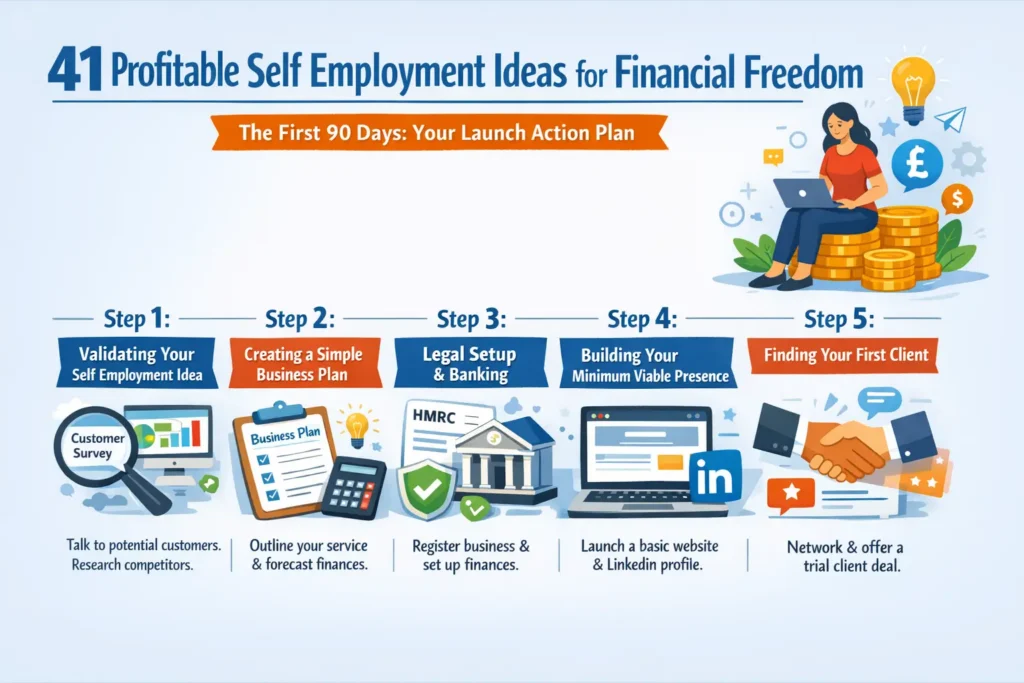
First 90 Days: Your Launch Action Plan
An idea is just a dream without action. This simple plan will get you from zero to your first sale.
Step 1: Validating Your Self Employment Idea
Don’t assume there’s demand. Talk to ten potential customers. Ask if they’d pay for your service. Research competitors on Google and social media. This step saves you months of wasted effort.
Step 2: Creating a Simple Business Plan & Financial Forecast
You don’t need a fifty-page document. Simply write down: what you’re selling, who will buy it, how you’ll reach them, and your startup costs. Then, project your income and expenses for the first year. This is your roadmap.
Step 3: Legal Setup, Insurance, and Banking
Register as a sole trader with HMRC online. Choose a business name and check it’s not trademarked. Open a dedicated business bank account (Starling and Monzo offer great free options). Get relevant insurance, like public liability.
Step 4: Building Your Minimum Viable Presence
You don’t need a £5,000 website. Start with a simple one-page site from Carrd or a professional LinkedIn profile. Get a business email address (not Gmail). These signals of professionalism help win trust.
Step 5: Finding Your First Client or Customer
Start with your network. Tell everyone you know what you’re doing. Offer a discounted rate or a pilot project to your first few clients in exchange for a testimonial. Your first job is often the hardest to get.
How to Work for Myself: A 5-Step UK Checklist
If you are ready to take the leap, here is a practical roadmap to get started.
- Validate Your Idea: Don’t quit your job tomorrow. Start your self-employment idea as a side hustle. Ensure people are actually willing to pay for what you offer.
- Register with HMRC: You must tell HMRC you are self-employed. Most people do this by registering for Self Assessment.
- Open a Business Bank Account: Even as a sole trader, keeping your business and personal money separate makes life much easier come tax season.
- Set Up Your Workspace: Whether it is a dedicated garden office or a corner of your dining table, you need a space where you can focus.
- Market Yourself: Use LinkedIn, local Facebook groups, or a simple website to tell the world you are open for business.
Quick Comparison: Potential Earnings & Startup Costs
| Self-Employment Idea | Estimated Yearly Income (UK) | Startup Cost | Skill Level |
|---|---|---|---|
| AI Workflow Architect | £55k – £105k | Low (Laptop / Software) | High (Tech) |
| Senior Tech Concierge | £30k – £50k | Very Low | Moderate |
| Fractional HR Compliance | £45k – £80k | Low | High (Legal) |
| Micro-Local Delivery | £25k – £40k | Moderate (E-bike) | Low |
| ADHD Workplace Coach | £40k – £70k | Low | Moderate (Certs) |
Common Mistakes New Self Employed People Make
Many new self-employed workers underprice services, ignore tax planning, or skip contracts. Therefore, learning basics early prevents stress later.
Final Thoughts
Self-employment is not always easy, but it offers freedom, control, and growth. Moreover, with the right self-employed job ideas, many people build stable incomes and flexible lifestyles.
If you are asking how to work for myself, the best time to start is now. Choose one idea, take small steps, and build momentum. Financial freedom often begins with a single decision.
Get valuable training, UK-focused support, and the skills employers want. No experience needed.
Join 50+ graduates who landed tech jobs with our industry-focused training programme designed for beginners.
Explore Now - Our Job Ready ProgrammeFrequently Asked Questions (FAQs)
What is self-employed work in the UK?
It means working for yourself and managing your own taxes and income.
What are the best self-employed jobs the UK offers?
Digital services, tutoring, consulting, and trades perform well.
Can I be self-employed and employed at the same time?
Yes, many people combine employment with self-work ideas.
How much tax do self-employed people pay?
Tax depends on profit, including Income Tax and National Insurance.
What is the easiest self-employment to start from home?
Freelance writing, virtual assistance, and online tutoring.





All Courses
Personal Development
Employability
Career Bundle
Management
Free QLS Certificate
IT & Software
Business
Technology
Health & Care
Quality Licence Scheme Endorsed Courses
Health & Safety
Training
Marketing
Job Ready Programme
Design
Accounting & Finance
Health and Fitness
Healthcare and Medical
Animal Care
Psychology
Microsoft Office
Teach & Education
I.T
HR and Leadership
Counselling and Therapy
Teaching & Child Care
Health and Social Care
Electrical & Electronics
Law
Food Nutrition
programming
Administration & Office Skills
Education
Language
Engineering
Cooking & Baking
Law & Criminology
Accounting
QLS Bundle
Office Skills
Awareness
Photography
Finance
Lifestyle
Diet and Nutrition
Makeup & Beauty
Therapy
Sports
First Aid
Accounting & Bookkeeping
Mathematics
Excel
Web Design
Top Rated Course
Diet and Fitness
Counselling
Agriculture
Networking & Design
General Education
Biotechnology
Audit
Economics
Lifestyle & Recreational
Adobe Photoshop
Travel and Tourism
Categories

Awarded By