

Medical administrators in UK GP surgeries and hospitals handle appointment requests, patient records and sensitive information every day. A small booking mistake or careless response can affect patients, making accuracy, communication and confidentiality essential.
That is why employers ask practical medical administrator interview questions. They want to know how you handle difficult patients, manage a busy reception, organise tasks and recognise when a concern needs attention from a healthcare professional.
Confidentiality is equally important. Under UK GDPR, health information receives additional protection, as explained in the Information Commissioner’s Office (ICO) guidance.
Whether you are preparing for admin job interview questions or healthcare-specific admin interview questions, this guide provides realistic model answers, practical examples and STAR-method tips.
You can also strengthen your knowledge through Skill-Up’s Clinical Coding & Medical Administration course before applying for healthcare administration roles.
Considering medical administration training?
Explore medical terminology, patient records, confidentiality, healthcare IT and clinical coding.
What Questions Are Asked in a Medical Administrator Interview?
The most common medical administrator interview questions focus on communication, patient care, appointment booking, confidentiality, teamwork and organisational skills. Employers want to understand how you would manage everyday responsibilities while helping patients feel comfortable and supported.

For example, you might be asked how you would deal with an upset patient, handle several appointment requests at once or correct a mistake in a medical record. These practical questions help interviewers assess your judgement, attention to detail and ability to stay calm under pressure.
If you are applying to an NHS hospital or GP surgery, you may also face questions about NHS values, patient privacy, safeguarding and working with healthcare professionals. Employers want staff who understand that good administration contributes to safe and efficient patient care.
You may recognise some questions from general admin interview questions and answers, but medical administration interviews often focus more closely on confidentiality and patient wellbeing.
Quick tip: Prepare two or three genuine examples from previous jobs, volunteering or education. Use the STAR method to explain what happened, what you did and what you achieved. Even without healthcare experience, relevant skills and a willingness to learn can help you make a positive impression.
How to Answer Medical Administrator Interview Questions Using STAR

The STAR method helps you explain your experience:
- Situation: What was happening?
- Task: What did you need to do?
- Action: What steps did you take?
- Result: What happened afterwards?
Use STAR for questions about past experience. For questions about what you would do, explain your steps and when you would ask for help.
30 Medical Administrator Interview Questions and Model Answers
These medical administrator interview questions are suitable for candidates applying to GP surgeries, NHS hospitals, outpatient clinics and private healthcare services.
The first 12 questions focus on motivation, patient care and essential office skills.
General Medical Administration Interview Questions
1. Tell me about yourself.
Model answer:
“I am an organised and friendly person with strong communication and computer skills. I enjoy helping people and keeping daily tasks running smoothly. I am interested in medical administration because it combines office work with supporting patients. I would bring patience, accuracy and a willingness to learn.”
2. Why do you want to work as a medical administrator?
Model answer:
“I want a career where my organisational skills make a real difference. Medical administrators help patients access services and support busy healthcare teams. I would enjoy managing appointments, keeping records accurate and making patients feel welcome.”
For more background on daily responsibilities, explore What Does a Medical Administrator Do? Duties in GP Surgeries and Hospitals.
3. Why do you want to work for the NHS?
Model answer:
“I respect the NHS commitment to helping people and treating everyone fairly. I understand that administration staff also contribute to patient care. I would follow the organisation’s procedures, work well with colleagues and treat every patient with dignity.”
Before your interview, read the six NHS values, including compassion, respect and working together for patients.
These values can also strengthen your answers to general admin interview questions.
Patient Communication and Customer Service Questions
4. How would you handle an angry patient at reception?
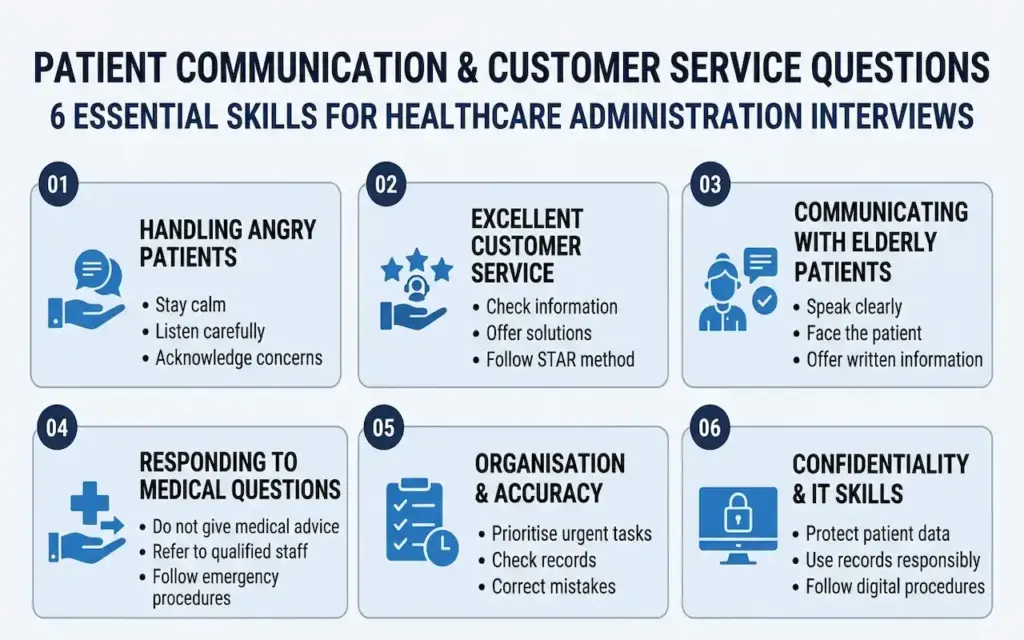
Model answer:
“I would stay calm, listen without interrupting and acknowledge their concern. I would check what help I could offer within my role and explain the next steps clearly. If the issue involved a clinical concern or could not be resolved safely, I would contact the appropriate colleague.”
5. Describe a time you provided excellent customer service.
STAR model answer:
Situation: “A customer was upset because their booking had been changed.”
Task: “I needed to resolve the problem politely.”
Action: “I listened, checked the booking details and offered available alternatives.”
Result: “The customer accepted a new booking and thanked me for helping.”
This example can be adapted for healthcare admin job interview questions, even if your experience comes from retail or hospitality.
6. How would you communicate with an elderly patient who has hearing difficulties?
Model answer:
“I would face the patient, speak clearly and avoid rushing. I would ask how they prefer to communicate and offer written information where appropriate. I would also check that they understood the instructions while protecting their privacy.”
7. What would you do if a patient asked for medical advice?
Model answer:
“I would explain politely that I cannot give medical advice. I would follow the practice’s procedures to direct their concern to a qualified healthcare professional. If they appeared seriously unwell, I would follow the emergency escalation procedure immediately.”
This is an important distinction between general administration questions for interview and questions for patient-facing healthcare roles.
Organisation, Accuracy and Confidentiality Questions
8. How do you manage several tasks at once?
Model answer:
“I check which tasks are urgent, particularly those affecting patient safety. I then organise the remaining work by deadline and importance. I use a task list, keep colleagues informed and ask for support if priorities change.”
9. How would you protect confidential patient information?
Model answer:
“I would access records only when needed for my authorised work, check who is requesting information and follow workplace privacy rules. I would never discuss patient details in public areas or share records without proper authority.”
The ICO’s guidance on special category data explains why health information requires additional protection.
Confidentiality is a key topic in admin interview questions and answers for healthcare.
10. Tell us about a time you spotted a mistake.
STAR model answer:
Situation: “While checking an office spreadsheet, I noticed two records with different dates.”
Task: “I needed to confirm the correct information.”
Action: “I checked the original documents and informed my supervisor.”
Result: “The error was corrected before the report was sent.”
This demonstrates accuracy without claiming clinical experience.
11. How would you deal with a double-booked appointment?
Model answer:
“I would check the booking system and confirm the details before making changes. I would explain the situation politely, follow the clinic’s booking policy and involve the relevant team if needed. I would avoid making promises about clinical priority.”
12. What computer skills do you have?
Model answer:
“I am comfortable using email, documents, spreadsheets and digital booking systems. I understand the importance of entering information accurately. If the employer uses software I have not worked with before, I would complete the required training and follow local procedures.”
You can develop relevant background knowledge through Skill-Up’s Clinical Coding & Medical Administration course, which covers medical terminology, filing systems, confidentiality and healthcare IT.
You can also explore Common Medical Abbreviations in the UK (A–Z List) to prepare for unfamiliar terms or read Skill-Up’s medical receptionist career guide.
Remember, medical administrator interview questions are not simply a memory test. Employers want to understand how you think, communicate and act responsibly. Use these admin questions and answers for interview practice, but make each answer truthful to your own experience.
NHS, GP Surgery and Difficult-Situation Questions
13. How would you handle an urgent patient request?
“I would stay calm, collect authorised information and follow the organisation’s process. I would not diagnose. If there were immediate safety concerns, I would alert the appropriate clinical colleague.”
14. What if two patients needed help at once?
“I would acknowledge both, deal first with any urgent safety issue and ask a colleague for support while protecting privacy.”
15. How would you respond to a safeguarding concern?
“I would listen, avoid investigating, follow the safeguarding procedure, report it promptly and record facts accurately.”
16. What if confidential information was discussed publicly?
“I would protect the patient’s privacy, raise the issue and follow local reporting procedures.” The NHS Constitution says staff should protect confidential information and raise genuine concerns about risks to patients or confidentiality.
These medical administrator interview questions go beyond ordinary admin job interview questions because privacy matters. They also complement general admin interview questions.
Teamwork and Problem-Solving Questions
17. Tell us about a time you worked under pressure.
STAR: Situation: Reception was busy. Task: Keep work moving. Action: I prioritised urgent requests and asked for help. Result: Urgent tasks were completed first.
18. Describe a disagreement with a colleague.
“I would listen, explain my view calmly and focus on a solution. If needed, I would involve the manager.”
19. What if a clinician gave you several urgent tasks?
“I would clarify deadlines and priorities, organise the work and explain if everything could not be completed at once.”
20. Tell us about a time you improved an admin process.
Use a real example and explain the problem, action and result. The National Careers Service STAR method recommends STAR for interview examples.
21. Why should we hire you?
“I bring organisation, clear communication and attention to detail. I understand the importance of supporting patients professionally.”
These administration questions for interview test judgement as well as office ability. Keep admin interview questions and answers truthful and relevant.
Systems, Records and Accuracy Questions

22. What would you do if you spotted an error in a patient record?
“I would not guess or change information without authority. I would follow the correction process and tell the appropriate colleague.”
23. How do you keep patient data secure?
“I would access only information needed for my work, use secure systems and follow local procedures.”
Health data is classed as special category data under UK GDPR and requires additional protection. The ICO updated its special-category-data guidance in October 2026. Read the ICO guidance.
24. What healthcare software have you used?
“I would name systems I have genuinely used. If not, I would be honest and show I can learn quickly.”
25. How do you keep your work accurate?
“I check names, dates and key details before saving or sending information.”
26. How would you learn unfamiliar medical terms?
“I would use approved workplace resources, ask when unsure and never guess.”
Common Medical Abbreviations in the UK (A–Z List) can also support your preparation.
These medical administrator interview questions make admin questions and answers for the interview more relevant to healthcare.
Considering medical administration training?
Explore medical terminology, patient records, confidentiality, healthcare IT and clinical coding.
Final Questions and Interview Preparation

27. What are your strengths?
Choose two or three strengths, such as organisation, communication or accuracy, and give evidence.
28. What is a weakness you are improving?
Choose a genuine, manageable weakness and explain how you are improving it.
29. Where do you see yourself in a few years?
Focus on building healthcare administration experience.
30. Do you have any questions for us?
Ask, “What training is provided?”, “Which systems does the team use?” or “What would success look like in the first three months?”
Before the interview, review the job description, prepare STAR examples and research the employer. For NHS roles in England, revisit NHS values such as respect, compassion and working together for patients.
When comparing admin job interview questions with healthcare admin interview questions, read What Does a Medical Administrator Do? Duties in GP surgeries and hospitals and Skill-Up’s medical receptionist career roadmap. The published Skill-Up guide covers medical reception, patient communication, confidentiality and routes into wider healthcare administration.
Conclusion
A successful medical administrator interview is about more than giving the right answers. Employers want to see that you can welcome patients, manage appointments accurately, protect confidential information and stay calm when the workplace gets busy.
The best way to prepare for medical administrator interview questions is to practise real workplace situations and reflect on your own experience. Use the STAR method to explain how you have handled challenges, supported others or managed competing tasks. Even experience from retail, customer service or volunteering can help demonstrate your strengths.
Remember, your answers should sound natural, not memorised. Show employers that you understand the importance of patient care, teamwork and attention to detail.
If you want to build your knowledge before applying, Skill-Up’s Clinical Coding & Medical Administration course can help you develop a stronger understanding of healthcare administration.
Frequently Asked Questions (FAQs)
How do I answer medical administrator interview questions with no healthcare experience?
Use examples from retail, hospitality, volunteering, study or office work. Focus on organisation, communication and confidentiality.
2. What should I revise?
Review the job advert, values, confidentiality basics and common terms. Skill-Up’s Clinical Coding & Medical Administration course can build background knowledge in areas including medical terminology, clinical coding and digital healthcare systems; it does not guarantee employment.
What are the most common medical administrator interview questions?
Common medical administrator interview questions cover patient communication, appointment scheduling, confidentiality, teamwork and computer skills. Employers may ask how you would handle an upset patient, manage a busy reception or protect patient records. Prepare clear examples that show your organisational skills and ability to remain calm under pressure.
What are the three most important skills for a medical administrator?
The three key skills are communication, organisation and attention to detail. Medical administrators need to speak politely with patients, manage appointments efficiently and maintain accurate records. Confidentiality, teamwork and basic digital skills are also essential in GP surgeries, hospitals and healthcare clinics.
Why should we hire you as a medical administrator?
A strong answer connects your skills to the employer’s needs. For example: “I am organised, patient and confident communicating with different people. I understand the importance of accurate records and protecting confidential information. I would work hard to support the healthcare team and provide a helpful service to patients.”
What questions should I ask at the end of a medical administrator interview?
You could ask, “What does a typical working day look like?”, “Which appointment and patient record systems does the team use?” or “What training is available for new staff?” These questions show genuine interest in the role and help you understand the employer’s expectations.
All Courses
Personal Development
Employability
Career Bundle
Management
Free QLS Certificate
IT & Software
Business
Technology
Health & Care
Quality Licence Scheme Endorsed Courses
Health & Safety
Training
Marketing
Job Ready Programme
Design
Accounting & Finance
Health and Fitness
Healthcare and Medical
Animal Care
Psychology
Microsoft Office
Teach & Education
I.T
HR and Leadership
Counselling and Therapy
Teaching & Child Care
Health and Social Care
Electrical & Electronics
Law
Food Nutrition
programming
Administration & Office Skills
Education
Language
Engineering
Cooking & Baking
Law & Criminology
Accounting
QLS Bundle
Office Skills
Awareness
Photography
Finance
Lifestyle
Diet and Nutrition
Makeup & Beauty
Therapy
Sports
First Aid
Accounting & Bookkeeping
Mathematics
Excel
Web Design
Top Rated Course
Diet and Fitness
Counselling
Agriculture
Networking & Design
General Education
Biotechnology
Audit
Economics
Lifestyle & Recreational
Adobe Photoshop
Travel and Tourism
Categories

Awarded By