

Medical terms can seem complicated until you know how their different parts work together. A word such as tachycardia might look unfamiliar, but understanding its components makes the meaning easier to recognise.
This medical terminology list explains common prefixes, suffixes, root words and their meanings, with practical examples. Whether you’re studying healthcare, exploring medical administration or simply building your vocabulary, it offers a straightforward starting point.
Quick Answer: Medical terminology uses specialised words to describe body structures, symptoms, conditions and procedures. Many terms contain a prefix that modifies meaning, a root that identifies the main concept, and a suffix that describes a condition or process. For example, gastritis means inflammation of the stomach lining.
Table of Contents
How Medical Terminology Is Built
Medical words often come from Greek or Latin. Knowing their basic structure helps you recognise unfamiliar expressions.
Prefixes, Roots, Suffixes and Combining Vowels
Most medical terminology can be understood through four components:
- Prefix: Appears before the root and changes its meaning, such as hyper- meaning excessive or above normal.
- Root word: Carries the central meaning, often referring to a body part or function.
- Suffix: Appears at the end and may identify a condition, procedure or speciality.
- Combining vowel: Connects word parts, often using the letter o, as in cardi/o.
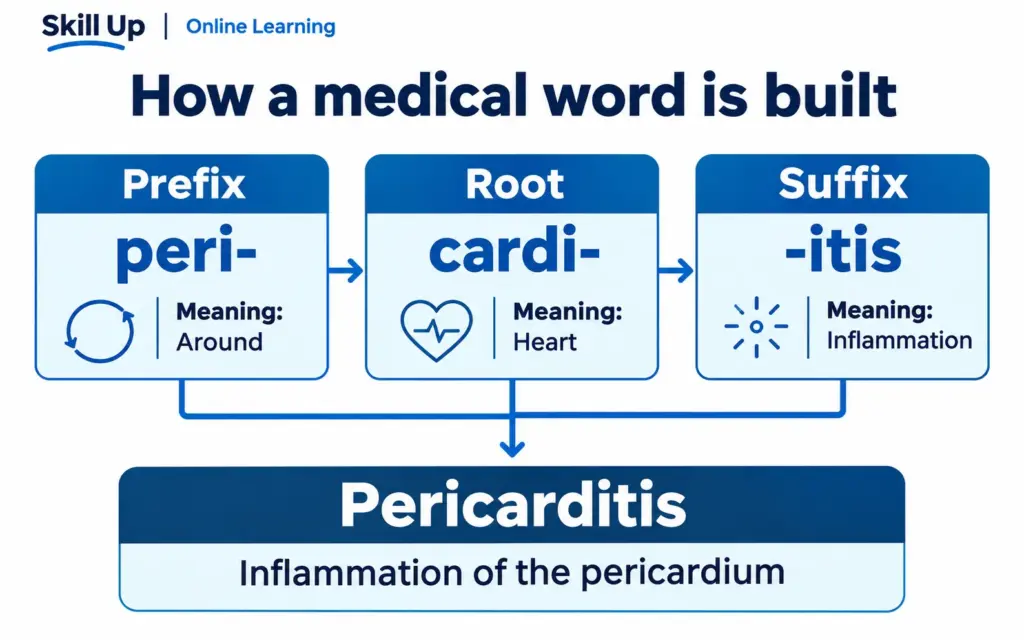
For example, pericarditis combines peri- (around), cardi- (heart) and -itis (inflammation). It means inflammation of the pericardium, the sac surrounding the heart.
The NHS medical terminology learning resource explains these word-building principles.
Not every medical term contains all four components.
Common Medical Prefixes and Their Meanings
Common Medical Prefixes and Their Meanings
| Prefix | Meaning | Medical Example |
|---|---|---|
| Hyper- | Excessive or above normal | Hyperglycaemia – high blood glucose |
| Hypo- | Low, below normal or deficient | Hypoglycaemia – low blood glucose |
| Tachy- | Fast or rapid | Tachycardia – abnormally fast heart rate |
| Brady- | Slow | Bradycardia – unusually slow heart rate |
| Dys- | Difficult, impaired or abnormal | Dysphagia – difficulty swallowing |
| A-/An- | Without or absence of | Apnoea – temporary stopping of breathing |
| Peri- | Around | Pericardium – sac surrounding the heart |
| Endo- | Within or inside | Endoscopy – examination inside the body |
| Intra- | Within | Intracranial – within the skull |
| Inter- | Between | Intercostal – between the ribs |
| Sub- | Under or below | Subcutaneous – beneath the skin |
| Poly- | Many or excessive | Polyuria – excessive urine production |
| Oligo- | Few or little | Oliguria – reduced urine production |
Prefixes become easier to remember when studied in contrasting pairs.
For example, hyperglycaemia and hypoglycaemia concern blood glucose, but their prefixes indicate opposite conditions. Similarly, tachycardia and bradycardia describe different heart-rate patterns.
These medical terminology examples show why recognising the beginning of a word can provide an important clue to its meaning. However, the complete term must still be understood in context.
Common Medical Suffixes and Their Meanings
Suffixes appear at the end of medical words. They frequently identify inflammation, pain, disease, surgical procedures or medical specialities.
Medical Suffixes List With Examples
Common Medical Suffixes and Their Meanings
| Suffix | Meaning | Medical Example |
|---|---|---|
| -itis | Inflammation | Gastritis – inflammation of the stomach lining |
| -ectomy | Surgical removal | Appendicectomy – removal of the appendix |
| -otomy | Surgical incision into | Tracheotomy – incision into the trachea |
| -ostomy | Surgically created opening | Colostomy – opening from the colon through the abdominal wall |
| -algia | Pain | Neuralgia – nerve pain |
| -scopy | Visual examination | Endoscopy – examination inside the body |
| -logy | Study of | Cardiology – medical speciality concerned with the heart and its disorders |
| -megaly | Enlargement | Cardiomegaly – enlarged heart |
| -oma | Tumour or mass, depending on context | Lipoma – benign fatty tumour |
| -osis | Condition or process; meaning varies | Cyanosis – bluish discolouration of skin or mucous membranes |
| -pathy | Disease or disorder | Neuropathy – nerve disorder |
| -plasty | Surgical repair or reconstruction | Rhinoplasty – surgery to reshape the nose |
| -penia | Deficiency or reduction | Leukopenia – reduced white blood cell count |
Some suffixes look similar but have distinctly different meanings.
For instance, -ectomy indicates surgical removal, whereas -otomy indicates an incision. Meanwhile, ‘ostomy’ describes the creation of an opening.
Remember that a suffix provides a clue, not necessarily a complete definition. For example, -oma does not automatically mean cancer, and ‘-osis’ has different meanings across medical terms.
If you want to develop your vocabulary through structured study, Skill Up’s medical terminology training covers medical language alongside related healthcare subjects.
Medical Root Words and Their Meanings
Medical root words carry the central meaning of many clinical expressions. They often identify a body part, tissue or biological function.
A combining form includes a root and a connecting vowel. For example, cardi/o relates to the heart, while neur/o relates to nerves.
Common Medical Roots for Body Parts and Functions
Organs and body systems
- Cardi/o: Heart, as in cardiology.
- Neur/o: Nerve, as in neurology.
- Gastr/o: Stomach, as in gastritis.
- Hepat/o: Liver, as in hepatitis.
- Nephr/o: Kidney, as in nephrology.
- Pulmon/o: Lung, as in pulmonary.
- Enter/o: Intestine, as in enteritis.
Tissues and body structures
- Oste/o: Bone, as in osteoporosis.
- Arthr/o: Joint, as in arthritis.
- Dermat/o: Skin, as in dermatitis.
- My/o: Muscle, as in myopathy.
- Haemat/o: Blood, as in haematology.
Other useful medical roots
- Rhin/o: Nose, as in rhinitis.
- Ot/o: Ear, as in otitis.
- Ophthalm/o: Eye, as in ophthalmology.
These examples illustrate how one root can appear in several related words.
Take cardi/o. It appears in cardiology, the medical speciality concerned with the heart, and cardiomegaly, which means an enlarged heart.
Understanding the root helps you recognise the subject of each word, even when the suffix changes.
Learners interested in how medical vocabulary relates to body structures may also find medical terminology and anatomy training useful for further study.
Common Medical Terms and Meanings
Not every medical expression becomes obvious simply by separating its components. Some words are best learnt as complete terms.
The following common medical terminology covers symptoms, conditions, investigations and clinical descriptions.
Common Conditions, Symptoms and Procedures
Symptoms and clinical signs
- Dyspnoea: The medical term for breathlessness or difficult breathing.
- Oedema: Swelling caused by excess fluid in body tissues.
- Dysphagia: Difficulty swallowing food, drinks or saliva.
- Cyanosis: Bluish discolouration of skin or mucous membranes associated with reduced oxygenation.
- Pyrexia: An elevated body temperature, commonly called a fever.
Conditions and clinical findings
- Anaemia: A condition in which haemoglobin levels are lower than normal.
- Hypertension: High blood pressure.
- Hypotension: Low blood pressure.
- Dermatitis: Inflammation of the skin.
- Arthritis: Inflammation affecting one or more joints.
- Tachycardia: An abnormally fast heart rate.
- Bradycardia: An unusually slow heart rate.
Investigations and procedures
- Biopsy: Removal of a tissue or cell sample for examination.
- Endoscopy: Examination inside the body using an endoscope.
- Appendicectomy: Surgical removal of the appendix.
- Radiography: Producing images using X-rays.
- Electrocardiography: Recording the heart’s electrical activity.
General clinical language
- Acute: A condition with a sudden onset or relatively short course.
- Chronic: A condition that persists or continues over a long period.
- Diagnosis: Identification of a disease or condition.
- Prognosis: The expected course or likely outcome of a condition.
- Benign: Non-cancerous, particularly when describing tumours.
- Malignant: Cancerous, with the potential to invade surrounding tissues.
These terms may appear in healthcare correspondence, medical reports and other clinical documentation.
For learners interested in how terminology connects with patient records, clinical coding and medical terminology offers a related area of study.
Medical Terms That Are Easy to Confuse
A small difference in spelling can produce a very different meaning.
Hyperglycaemia versus hypoglycaemia: Hyperglycaemia means high blood glucose, while hypoglycaemia means low blood glucose.
Dysphagia versus dysphasia: ‘Dysphagia’ refers to difficulty swallowing. Dysphasia refers to an impairment affecting language.
Acute versus chronic: Acute generally describes sudden onset or a short course, whereas chronic indicates a longer-lasting condition. Neither word alone tells you how serious an illness is.
Recognising these differences is especially useful when reading unfamiliar medical vocabulary.
How to Break Down an Unfamiliar Medical Term
Once you recognise common word parts, you can approach unfamiliar terms more systematically.
A Simple Word-Building Example
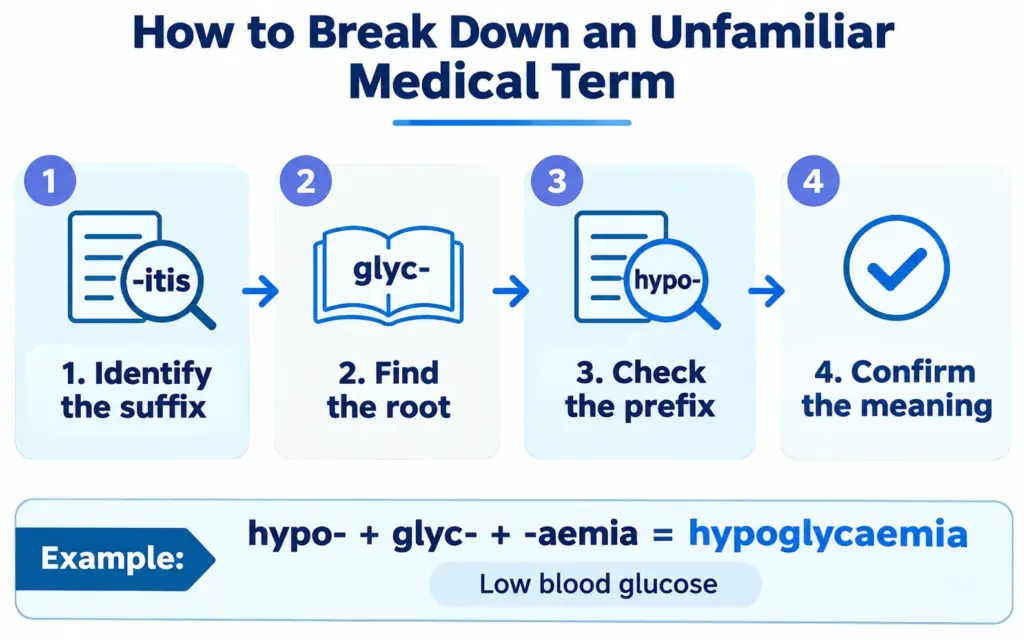
Consider hypoglycaemia, which means low blood glucose.
- Identify the suffix: -aemia indicates a blood-related condition.
- Find the root: ‘glyc-‘ relates to sugar or glucose.
- Check the prefix: ‘hypo-‘ means ‘low’ or ‘below normal’.
- Combine the meanings: The word describes a condition involving low blood glucose.
This breakdown is consistent with the explanation in Sheffield Children’s NHS guidance on hypoglycaemia.
The same approach can help with other medical terms, although you should always confirm the complete definition.
Recognising medical vocabulary is also a useful foundation for exploring clinical coding and medical administration, where understanding clinical documentation is relevant to further learning.
Medical Terminology in UK Healthcare

Medical terminology appears in GP correspondence, hospital reports, referral letters and healthcare records.
Understanding medical terminology also supports some medical administrator responsibilities, particularly when handling correspondence and organising healthcare documentation.
According to NHS guidance on medical secretary skills, medical secretaries need to use medical terminology as part of their work.
Those interested in administrative learning can also consider medical secretary and terminology training.
Medical terms are different from abbreviations, which shorten words or expressions. A separate guide to common medical abbreviations in the UK can help readers understand shortened terms used in healthcare correspondence.
Understanding terminology supports communication, but clinical interpretation and decisions must remain with appropriately qualified professionals.
How to Remember Medical Terminology

You don’t need to memorise hundreds of unrelated words at once. Focus on recognising patterns.
- Group similar endings: Study words containing -itis together.
- Learn contrasting prefixes: Compare hyper- with hypo-.
- Use flashcards: Write a medical term on one side and its meaning on the other.
- Practise word breakdowns: Identify the root before checking the definition.
- Review regularly: Revisit unfamiliar words using reliable medical references.
Short, consistent practice helps you become more familiar with how medical vocabulary is constructed.
Clinical Coding & Medical Administration
Covers medical terminology, record management and introductory clinical coding — online, at your own pace.
Frequently Asked Questions About Medical Terminology
Start by learning frequently used prefixes, suffixes and medical roots instead of memorising hundreds of complete words. Group terms with similar components, such as gastritis, dermatitis and arthritis, which share the suffix -itis. Create flashcards containing meanings and examples, then practise breaking down unfamiliar words. For UK healthcare learners, using realistic examples from referral letters and clinical correspondence can help connect terminology with practical situations.
Medical terminology helps administrative staff recognise specialised language used in GP correspondence, hospital records and clinical reports. For example, a medical secretary may encounter terms such as cardiology, biopsy or hypertension when preparing documents or handling correspondence. Understanding these words supports accurate communication and record handling. However, administrative staff should not interpret diagnoses or offer clinical advice unless they are appropriately qualified and authorised to do so.
A combining vowel is a letter used to connect word parts and make certain medical terms easier to pronounce. The letter o is particularly common. For example, cardi/o/logy combines the root relating to the heart with the suffix meaning study of. Combining vowels are not required in every term. Understanding when they appear helps beginners recognise medical word structures more accurately during healthcare studies and terminology training.
A medical root carries the central meaning of a word, often referring to a body part or biological function. A suffix appears at the end and may describe a condition, procedure or medical speciality. For example, gastr- refers to the stomach, while -itis means inflammation. Together, they form gastritis, meaning inflammation of the stomach lining. Recognising these components makes medical terminology easier to study and remember.
Common medical prefixes include hyper- (high or excessive), hypo- (low), tachy- (fast) and brady- (slow). These prefixes help describe conditions and changes in normal body functions. For example, hyperglycaemia means high blood glucose, while hypoglycaemia means low blood glucose. Recognising these differences can help healthcare learners and administrative staff understand unfamiliar vocabulary in medical documents, although clinical interpretation requires appropriate professional knowledge.
All Courses
Personal Development
Employability
Career Bundle
Management
Free QLS Certificate
IT & Software
Business
Technology
Health & Care
Quality Licence Scheme Endorsed Courses
Health & Safety
Training
Marketing
Job Ready Programme
Design
Accounting & Finance
Health and Fitness
Healthcare and Medical
Animal Care
Psychology
Microsoft Office
Teach & Education
I.T
HR and Leadership
Counselling and Therapy
Teaching & Child Care
Health and Social Care
Electrical & Electronics
Law
Food Nutrition
programming
Administration & Office Skills
Education
Language
Engineering
Cooking & Baking
Law & Criminology
Accounting
QLS Bundle
Office Skills
Awareness
Photography
Finance
Lifestyle
Diet and Nutrition
Makeup & Beauty
Therapy
Sports
First Aid
Accounting & Bookkeeping
Mathematics
Excel
Web Design
Top Rated Course
Diet and Fitness
Counselling
Agriculture
Networking & Design
General Education
Biotechnology
Audit
Economics
Lifestyle & Recreational
Adobe Photoshop
Travel and Tourism
Categories

Awarded By