
Login

Mechanical Engineering: Machine Dynamics for Mechanical Engineers

Special Offer | 5 in 1 Training Bundle | CPD Accredited | 1 Free PDF Certificate | Instant Access
5
19 Reviews

stds41 Students

Overview

A Mechanical Engineering course focused on machine motion behaviour equips learners with analytical capability for dynamic systems used within industrial equipment. This Mechanical Engineering course introduces force interactions, inertia effects, vibration response, rotating assemblies, and stability evaluation through mathematical modelling. Learners examine how dynamic loads influence machine reliability, operational safety, and efficiency. The Mechanical Engineering course structure connects theory with computational analysis to interpret motion characteristics in mechanical assemblies. By following industry-aligned methods, this Mechanical Engineering course prepares participants to evaluate performance, diagnose instability, and predict system response under variable operating conditions.

Course Description

This Mechanical Engineering course presents an in-depth study of machine motion behaviour relevant to modern engineering applications. Within this Mechanical Engineering course, learners analyse kinematics, dynamic force transmission, oscillatory motion, and rotational system behaviour using analytical techniques. Mathematical modelling forms the foundation for interpreting real-world machine behaviour, enabling accurate prediction of response under variable operating conditions. The Mechanical Engineering course content aligns with industrial standards used within manufacturing, energy, transport, and automation sectors.

The curriculum of this Mechanical Engineering course emphasises vibration theory, dynamic balancing, resonance control, and stability assessment. Learners explore single and multi-degree systems, damping characteristics, and frequency-domain evaluation methods. This Mechanical Engineering course integrates computational analysis with physical interpretation to assess fatigue risks, noise propagation, and structural response. Analytical simulations support performance evaluation for rotating machinery, engines, turbines, and transmission components.

Advanced topics within this Mechanical Engineering course address nonlinear dynamics, transient response, and condition monitoring principles. Learners investigate diagnostic indicators used to evaluate machine health, fault development, and operational limits. By applying predictive techniques, this Mechanical Engineering course supports informed engineering decisions that improve reliability, efficiency, and safety. Graduates complete this Mechanical Engineering course equipped to interpret dynamic behaviour across complex mechanical systems used within contemporary industrial environments.

Course List in this Bundle

  • ➽ Course 01: Mechanical Engineering
  • ➽ Course 02: Manual Handling Training
  • ➽ Course 03: PUWER Training
  • ➽ Course 04: Professional Electrical Engineering Course for High Voltage Generation
  • ➽ Course 05: Digital Electric Circuits & Intelligent Electrical Devices

Learning Outcome

Certificate of Achievement

Earn Your Accredited Certificate with Transcript

Save 20% with the coupon code SKILL20
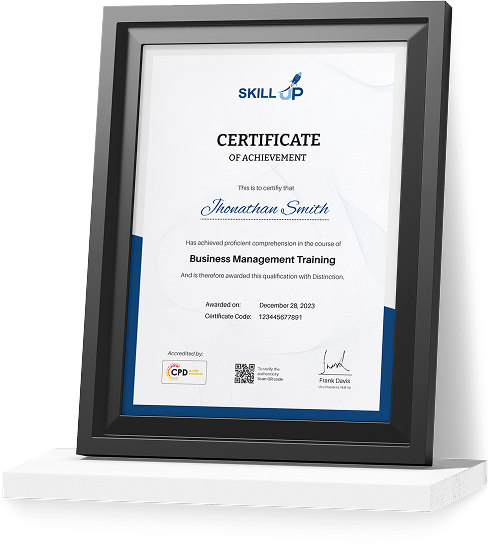
Show Your Certified Identity with a CPD-QS Certificate

Perfect for employers, clients, or academic verification.

Why Choose Us?

Career Path

Curriculum

top