

The First Question Most TAs Ask
If you already work as a teaching assistant, there usually comes a point when the same thought starts coming back: is HLTA actually the next step, or is it just a more impressive title for roughly the same work?
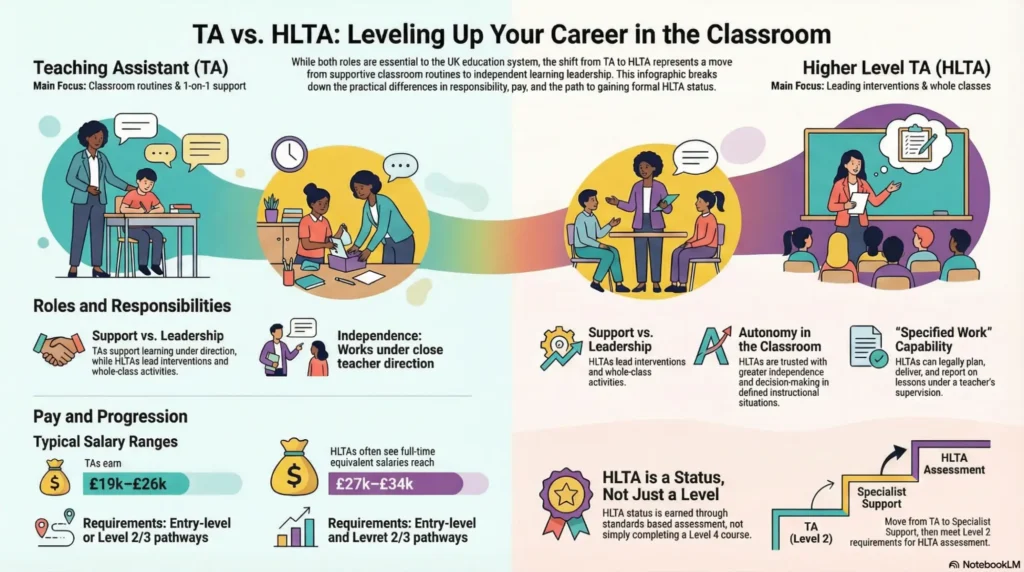
The honest answer is that it is usually a real step up. Not because the badge sounds better, but because the role often comes with more trust, more responsibility, and a stronger classroom presence. A teaching assistant mainly supports learning under a teacher’s direction. A higher-level teaching assistant works at a more advanced level and may lead planned learning, run interventions, and cover classes in defined situations. Teaching assistants typically earn about £19,000 to £26,000 a year, while current HLTA vacancies commonly show full-time equivalent salaries in the high-£20,000s to low- or mid-£30,000s.
That is why the HLTA vs TA question matters so much. It is not only about salary. It is about what schools expect from you, how independently you can work, and whether the role opens better long-term options. For some people, TA is exactly the right fit. However, for others, HLTA is the point where school support work starts to feel like a serious career path with more room to grow.
What a Teaching Assistant Actually Does
A teaching assistant role is often described in a way that sounds much smaller than it really is.
In everyday school life, a TA may listen to reading, support a child during phonics, help a small maths group stay focused, prepare classroom resources, reinforce instructions, support behaviour, or work one-to-one with a pupil who needs more help than the teacher can give in the middle of a busy lesson. National Careers describes teaching assistants as staff who support teachers in the classroom and help children with reading, writing, and learning activities. It also lists classroom assistant and learning support assistant as related titles, which is why those labels often overlap in job adverts.
As a result, TA work is far more important than many people first assume. A strong teaching assistant helps the classroom feel steadier, calmer, and more accessible. They help pupils stay engaged, help teachers keep lessons moving, and often become the adult pupils turn to when they need extra reassurance or a simpler explanation. That is one reason teaching assistant roles are such a common first step into education support.
A TA often helps with:
- One-to-one pupil support.
- Small-group learning.
- Behaviour and attention support.
- Lesson preparation.
- Classroom organisation.
- SEND support.
- Helping pupils stay engaged and confident.
That list may sound broad, and it is. In fact, a TA role is broad. However, that is also what makes it a strong foundation if you want to build experience before moving into a more senior support post later on.
What an HLTA Really Is

HLTA stands for higher-level teaching assistant, but the word “higher” matters more than people sometimes realise.
This is not usually just a case of doing the same work for a slightly better salary. Tes explains that HLTAs do the things regular teaching assistants do, but with an increased level of responsibility, including teaching classes on their own and covering planned absences. The HLTA standards also show that the role is tied to a standards-based status route in England, rather than being simply a school’s internal “senior TA” label.
In practice, an HLTA is often trusted to work more independently, take groups or classes forward, deliver interventions, and support learning in a more visible way across the school day. That is why the role tends to feel like a step into higher-level classroom practice rather than just a standard support job with a different title.
HLTA vs TA: The Main Difference in Plain English
The easiest way to understand HLTA vs TA is this:
A TA supports teaching. An HLTA supports teaching at a higher level and may lead parts of it.
That sounds simple, but it explains the shift very well. A TA usually works within a tighter framework set by the teacher. An HLTA is more likely to be trusted with greater autonomy, broader responsibilities, and more classroom decision-making in agreed situations.
In other words, the move from TA to HLTA is not just “more work”. Instead, it is a different kind of work. A TA helps learning happen more smoothly. An HLTA may be expected to help move learning forward more directly. That is why so many people see teaching assistant progression to HLTA as the real turning point in school support careers.
At a Glance
| Area | Teaching Assistant | Higher Level Teaching Assistant |
|---|---|---|
| Main Focus | Supports teaching and classroom routines | Supports teaching at a higher level and may lead learning |
| Independence | Usually works under close teacher direction | Greater autonomy in defined situations |
| Whole-Class Work | More limited | More likely to lead planned whole-class activity |
| Route Into Role | Experience and useful school-based or Level 2/3 pathways | Experience plus HLTA standards and assessment |
| Pay Picture | Usually lower | Usually higher |
The table gives the short version. The classroom difference is what makes it feel real.
What Changes in the Classroom
This is where the comparison becomes easier to picture.
Imagine a primary literacy lesson. A TA might support a group of children who need help understanding the task, encourage them to stay focused, and let the teacher know who found the activity difficult. An HLTA might take a separate group through a planned literacy session, adjust the pace, respond to difficulties as they arise, and contribute evidence about how the pupils got on. That is the shift from support around the lesson to support that begins to shape how learning is delivered. This kind of whole-group and whole-class work also appears in current HLTA job adverts, which describe the role as delivering specified work with individuals, groups, and whole classes under the direction of a qualified teacher.
In Practical Terms, an HLTA May
- Lead a planned intervention
- Take a class during planned teacher absence
- Deliver part of a lesson sequence
- Support assessment evidence
- Work across one-to-one, group, and whole-class settings
- Carry a stronger independent classroom presence
That does not make an HLTA the same as a teacher. Even so, it does mean the role usually has more classroom weight than a standard TA post.
What HLTAs Can Legally Do
This is where a lot of confusion comes from.
People often hear that HLTAs can “teach” or “take a class”, which is broadly true, but the formal position is more precise. The Education (Specified Work) (England) Regulations 2012 define specified work as planning, preparing, delivering, assessing, and reporting on education. They also say that non-qualified staff may carry out specified work only when they support the work of a qualified teacher, work under that teacher’s direction and supervision, and where the headteacher is satisfied they have the right skills and experience.
So, in plain language, that means an HLTA is not a replacement for a qualified teacher. An HLTA can take on higher-level classroom duties, but within a clear professional framework. This is why HLTA feels different from TA work while still stopping short of full teacher responsibility. It is also why questions such as “Can an HLTA replace a teacher?” need a careful answer rather than a yes-or-no shortcut.

HLTA Status, Qualifications, and the Level 4 Confusion
This is one of the biggest sticking points for people researching the role.
HLTA is a status, not simply the name of a qualification. The HLTA standards say candidates must demonstrate the standards through their practice, and one of those standards requires a nationally recognised Level 2 qualification or above in English/literacy and mathematics/numeracy. The HLTA FAQ and supporting guide also make clear that candidates need those certificates before they can proceed properly through the preparation and assessment process.
This is why the phrase “HLTA qualification level 4” can be misleading if it is not explained properly. A Level 4 course may help you prepare or strengthen your professional profile, but it does not automatically give you HLTA status. The simplest way to remember it is this:
- A course can help you prepare.
- A qualification can support progression.
- HLTA status is formally awarded through standards-based assessment.
That distinction matters because many people search for HLTA training course options when what they really need is clarity about status, standards, and the assessment route.
How to Become an HLTA
The route is practical rather than purely academic.
Most people move into HLTA after building school experience first. Tes says candidates need recognised literacy and numeracy at Level 2 or above, classroom experience, preparation for assessment, and a school-based assessment process. The HLTA materials also say candidates cannot move forward until the literacy and numeracy evidence has been verified.
A realistic progression path looks like this:
- Start as a TA or in a similar classroom support role.
- Build strong experience with pupils, groups, and everyday classroom routines.
- Make sure you meet the literacy and numeracy requirements.
- Prepare against the HLTA standards.
- Complete the assessment route.
That is why HLTA is usually a progression step rather than an entry-level role. Schools want to see that you can already handle the pace, judgment, and professionalism that come with more independent classroom work.
HLTA vs TA Pay: What the Figures Really Mean
Pay is one of the first things people want to know, but it needs a bit of unpacking.
National Careers gives teaching assistants a typical salary range of about £19,000 to £26,000 a year. Current TA vacancies broadly support that picture, with live examples showing Level 2 roles around £23,286.88 to £24,302.40 actual annual pay.
HLTA pay usually sits higher. Current HLTA listings show examples such as Grade 6 or 7 roles at £28,598 to £31,537 full-time equivalent, or £32,061 to £34,434 FTE, with actual annual salaries of roughly £21,421 to £23,622 or £24,014 to £25,792 depending on grade. Some posts are listed hourly, such as £14.82 to £16.62 an hour.
So yes, HLTAs generally earn more than TAs. But the better answer is that the real difference depends on how the contract is written. The full-time equivalent figure can look much stronger than the actual annual pay once term-time-only working is factored in.
What Affects Support Staff Pay
This is the part people often wish someone had explained earlier.
The number in the advert is not always the amount you will actually receive. Support staff roles are often term-time only, and the SEN teaching assistant National Careers profile says advertised pay is often shown as full-time equivalent while actual pay depends on the hours worked.
The NEU also notes that some HLTAs work on split contracts, doing higher-level work for part of the week and more general support work for the rest. That helps explain why two jobs with “HLTA” in the title can still look quite different once you read the details.
Before comparing salaries, check:
- Is the salary shown as FTE or actual pay?
- Is the role term-time only?
- Is the post part-time?
- Is the advert using an hourly rate?
- Is it a pure HLTA role or a mixed TA/HLTA role?
Those details matter just as much as the top-line figure.
Which Role Makes More Sense for You?
This depends less on which title sounds better and more on where you are in your own progression.
TA May Suit You Better If:
- You are new to school support work.
- You want classroom experience first.
- You prefer a more guided role while building confidence.
- You are still figuring out whether teaching, SEND support, or another path suits you best.
HLTA May Suit You Better If:
- You already have solid classroom experience.
- You want more independence.
- You are ready for greater accountability.
- You want a clearer step up in responsibility and pay
That is why the best question is not always “Which role is better?” It is “Which role fits me now, and which one fits where I want to be next?”
Career Progression: From TA to HLTA and Beyond
TA work is often the beginning of a much wider school career. National Careers presents teaching assistant work as a route into related roles, and teacher profiles make clear that classroom experience can sit alongside future teacher progression for some people.
HLTA often sits in the middle of that journey. For some people, it becomes a long-term role in its own right. For others, it helps build the confidence, classroom presence, and professional evidence needed for teacher training, specialist support roles, or wider support leadership.
A realistic school support career ladder
- Entry Teaching Assistant.
- Experienced or Level 3 Teaching Assistant.
- Specialist Support or Intervention Role.
- HLTA Assessment Route.
- Longer-Term HLTA, SEND Progression, or Teacher Training.
That is why the move from TA to HLTA matters. It is not only a pay question. It is often the point where school support work starts to feel like a genuine career track rather than just a starting job.

HLTA vs Teacher and Cover Supervisor
People often ask where HLTA sits compared with teacher and cover supervisor roles.
A teacher holds overall responsibility for teaching, curriculum, and pupil progress. National Careers says primary school teachers are responsible for the educational, social, and emotional development of children and typically work longer hours with full responsibility for class progress.
An HLTA may lead learning and cover planned absence, but still works within a support-staff structure rather than a fully qualified teaching role. A cover supervisor, on the other hand, is often there to supervise pre-set work during teacher absence. An HLTA may also cover classes, but the role is usually broader across the week because it includes interventions, support for learning, and deeper day-to-day involvement beyond simple cover. This distinction follows from the legal framework on specified work and from how schools describe HLTA duties in live vacancies.
Salary Snapshot Table
If you want one quick comparison near the end, this is the clearest summary.
| Role | Current Pay Signal | What to Watch For |
|---|---|---|
| Teaching Assistant | £19,000–£26,000 | Broad careers guide |
| Teaching Assistant Level 2 | £23,286.88–£24,302.40 actual in current examples | Contract pattern still matters |
| HLTA | High-£20,000s to mid-£30,000s FTE in current adverts | Actual annual pay may be much lower |
| Higher-Band HLTA | Around £32,061–£34,434 FTE in current examples | Grade and qualifications matter |
| HLTA Hourly Roles | About £14.82–£16.62 per hour | Useful for part-time comparison |
This gives a more realistic picture than a flat salary claim because it combines career guidance with live vacancy examples.
Get valuable training, UK-focused support, and the skills employers want. No experience needed.
Join 50+ graduates who landed tech jobs with our industry-focused training programme designed for beginners.
Explore Now - Our Job Ready ProgrammeFrequently Asked Questions (FAQs)
What Is the Difference Between HLTA and TA?
A teaching assistant supports learning under a teacher’s direction, while an HLTA works more independently and may lead activities, interventions, or whole-class support in certain situations.
What Is HLTA in Schools?
HLTA stands for Higher Level Teaching Assistant. It is a more advanced support role in schools, often involving work with individuals, groups, or whole classes. In England, it is linked to a recognised standards-based status route.
How Much Does an HLTA Get Paid?
HLTA pay is usually higher than standard teaching assistant pay, but it varies by school, location, and contract. Term-time roles may reduce annual take-home pay compared with full-time equivalent figures.
Is a Level 3 TA the Same as an HLTA?
No. A Level 3 TA usually refers to a qualification or training level, while HLTA is a higher-level school role. A Level 3 qualification may support progression, but it is not the same as HLTA status.
Do You Need a Degree to Become an HLTA?
No. A degree is not usually required. Schools typically value classroom experience, strong literacy and numeracy, and evidence that you meet the HLTA standards in practice.
Can an HLTA Teach a Class Full Time?
An HLTA may lead learning or support whole classes in defined situations, but the role is not the same as qualified teacher status and works under a teacher’s direction.
Can an HLTA Become a Teacher?
Yes. HLTA can be a strong step towards teacher training by building classroom confidence, experience, and school-based evidence.






All Courses
Personal Development
Employability
Career Bundle
Management
Free QLS Certificate
IT & Software
Business
Technology
Health & Care
Quality Licence Scheme Endorsed Courses
Health & Safety
Training
Job Ready Programme
Marketing
Design
Accounting & Finance
Health and Fitness
Healthcare and Medical
Animal Care
Psychology
Microsoft Office
Teach & Education
I.T
HR and Leadership
Counselling and Therapy
Teaching & Child Care
Electrical & Electronics
Health and Social Care
Food Nutrition
Law
programming
Administration & Office Skills
Accounting
Education
Engineering
Cooking & Baking
Language
Law & Criminology
QLS Bundle
Office Skills
Photography
Awareness
Finance
Lifestyle
Diet and Nutrition
Makeup & Beauty
Therapy
Sports
First Aid
Accounting & Bookkeeping
Mathematics
Excel
Web Design
Diet and Fitness
Top Rated Course
Counselling
Agriculture
General Education
Biotechnology
Networking & Design
Audit
Economics
Lifestyle & Recreational
Adobe Photoshop
Travel and Tourism
Categories

Awarded By