
Why Some Marine Biology Careers Pay More Than Others
Best paying marine biology jobs are not always the roles people expect. In the UK, the highest-paying marine careers are often the ones where marine biology connects with consultancy, policy, advanced data work, leadership, and senior research. That is why some marine professionals stay in modestly paid roles, while others build careers with much stronger earning potential.
This makes the topic especially important for students, graduates, and career changers. Many people picture marine biology as fieldwork, research boats, wildlife surveys, and lab-based science. However, those paths are still part of the sector, but they do not always lead to the highest salaries. In many cases, the stronger earners move into positions that combine marine knowledge with technical analysis, regulation, planning, or project leadership.
The marine sector is also broader than many people realise. It includes marine biology, oceanography, marine ecology, fisheries science, conservation, environmental consulting, coastal planning, habitat restoration, and policy work. So when people search for the best paying marine biology jobs, they are often really looking for the highest-paid career paths a marine biology background can lead to.
That is where the real opportunity lies. A marine biology degree can open the door, but salary progression usually depends on the direction you take after that. Some routes stay close to species, habitats, and fieldwork. By contrast, others move towards consultancy, research leadership, environmental decision-making, or public policy. These are often the routes that lead to the best-paying marine biology jobs in the UK.
The 15 Best Paying Marine Biology Jobs
1. Senior Marine Scientist
This is one of the clearest high-paying career paths in marine science. Senior marine scientists usually work in government, industry, research institutes, or high-level consultancy. They are valued for specialist knowledge, technical judgement, and the ability to interpret complex marine data.
What makes this role more lucrative is not the title alone. Instead, it is the level of responsibility attached to it. Senior scientists often lead research, shape projects, advise on environmental decisions, or guide technical programmes.
2. Marine Biology Lecturer
Teaching and research in higher education remain one of the strongest long-term salary routes in marine biology. A marine biology lecturer may divide their time between teaching, supervising students, publishing research, and contributing to wider academic projects.
This path tends to reward specialist knowledge, publication record, and research credibility. It suits people who enjoy the scientific side of marine biology but also want a more structured career with clearer long-term progression.
3. Marine Environmental Consultant
Marine environmental consulting is one of the most practical ways to turn marine science into stronger earnings. These roles often involve environmental impact assessment, marine licensing support, habitat surveys, technical reporting, and client-facing project work.
It is also one of the better-paid routes for people who do not want to stay purely in academic science. In practice, consultancy rewards communication, deadlines, technical writing, and commercial awareness as much as marine knowledge itself.
4. Marine Water Quality Adviser
This is the kind of role that shows where marine biology becomes more valuable financially. Water quality roles combine marine science with policy, regulation, environmental standards, and public interest decision-making.
These jobs tend to pay well because they influence real outcomes. They are not only about gathering data. They are about helping organisations decide what standards must be met and how marine environments should be protected or managed.

5. Research Associate in Marine Science
Research roles can become much stronger financially once you move beyond the basic assistant or technician level. A research associate usually works on funded projects, contributes to specialist scientific output, and may handle data analysis, publication work, or technical project delivery.
This is often a smart mid-career route for people who enjoy research but are not yet aiming for a full academic leadership role.
6. Ocean Climate Scientist
This is one of the more modern and increasingly valuable marine science careers. Ocean climate scientists work at the meeting point of marine systems, climate change, modelling, forecasting, and large-scale environmental analysis.
For people who enjoy ocean processes, coding, systems thinking, and data-heavy science, this can be one of the best-paying marine science jobs. As a result, it also tends to sit in organisations where technical specialism is well rewarded.
7. Marine Ecosystem Modeller
Marine ecosystem modelling is one of the strongest salary-boosting specialisms because it requires both marine knowledge and advanced technical skill. These roles often involve simulation, ecological forecasting, data interpretation, and applied science for policy or conservation.
This route is especially attractive for people who want to stay in science but build a more specialised, better-paid profile than general field biology often offers.
8. Blue Carbon Research Specialist
Blue carbon work is growing as marine science, climate policy, and habitat restoration become more closely linked. These roles often focus on carbon stored in marine habitats such as seagrass, salt marsh, and coastal ecosystems.
Because this area sits close to climate finance, restoration policy, and advanced ecological measurement, it can become more financially attractive than many traditional conservation roles.

9. Marine Policy Adviser
Not every marine biology graduate stays in hands-on science. Instead, some of the better-paid long-term roles sit in marine policy, environmental regulation, and planning. Marine policy advisers use evidence to shape decisions on conservation, fisheries, licensing, and coastal development.
This route suits people who enjoy writing, research, stakeholder work, and environmental decision-making. It is one of the most useful examples of how marine biology knowledge can move into public-sector influence.
10. Technical Specialist in Marine Conservation
This kind of role sits between science, strategy, and programme delivery. Technical specialists are often brought in for their expertise in marine protected areas, biodiversity evidence, fisheries, or habitat restoration.
These jobs usually pay more than general project support roles because they require strong judgement, specialist knowledge, and the ability to advise others.
11. Conservation Scientist
Marine conservation roles vary widely in salary, but conservation scientist positions are among the better-paid options in that sector. They often involve evidence gathering, ecological analysis, restoration support, or species and habitat assessment.
This is a good example of how conservation becomes better paid when it moves away from general project delivery and towards analytical or science-led responsibility.
12. Fisheries Scientist
Fisheries science remains one of the most practical and structured marine career routes. It can involve stock assessment, monitoring, policy support, sustainability planning, and regulatory science.
This area can offer solid long-term salary progression because it links scientific evidence directly to management and decision-making.
13. Oceanographer
Oceanography is one of the strongest core science routes linked to marine biology. It can involve chemical, physical, biological, or geological studies of the sea, depending on the specialism.
For people who want to stay close to science while building good long-term salary prospects, oceanography remains one of the most reliable options.

14. Marine Planner or Coastal Planning Specialist
This route often sits just outside what people first imagine when they think of marine biology, but it is highly relevant for graduates who want stronger salaries. Marine and coastal planning roles focus on how marine spaces are used, protected, and regulated.
These jobs are often better paid because they combine science with planning systems, regulation, environmental assessment, and policy.
15. Marine Restoration Project Lead
Habitat restoration is becoming a more visible part of the marine sector, particularly in seagrass restoration, coastal recovery, biodiversity projects, and ecosystem resilience. Entry roles in restoration may not sit at the top of the salary ladder, but project leadership roles can be much more attractive.
Over time, this is one of the better growth areas for people who want practical impact and a career that can move from field-based work into programme leadership.
What Salary Progression Really Looks Like
One of the biggest mistakes people make is assuming that the salary in marine biology rises in a straight line. It usually does not.
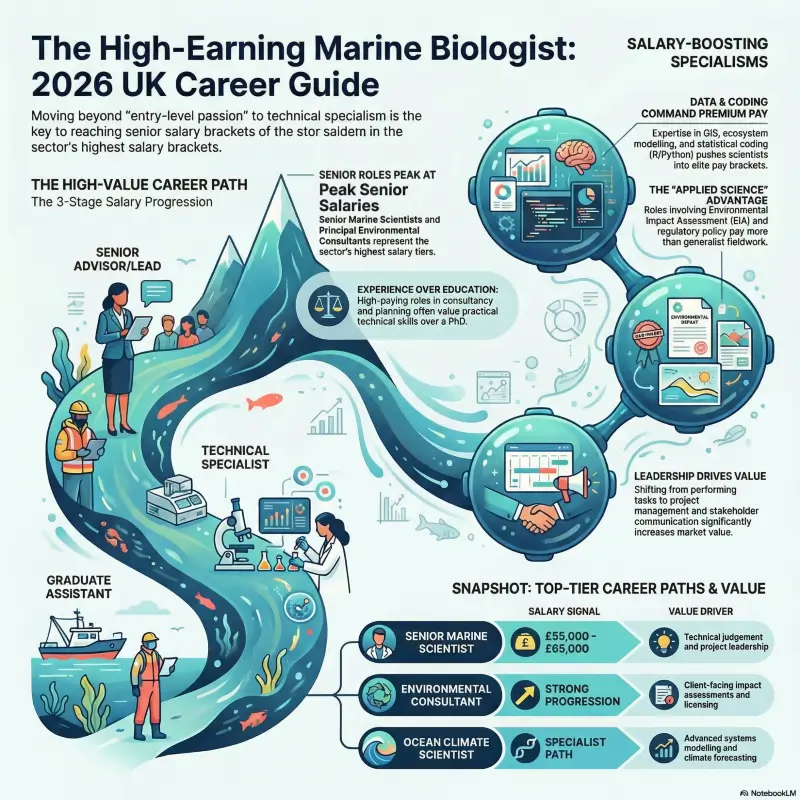
The early stage can be the hardest. At that point, graduate jobs, assistant roles, internships, and field-based positions are often modestly paid. However, the bigger jump usually comes once you move into specialist science, consultancy, modelling, policy, or technical leadership.
That is why the job title alone can be misleading. A generic “marine biologist” role may pay less than a marine consultant, policy adviser, or technical specialist with the same degree background. The highest salaries usually occur when marine science is paired with responsibility, advanced technical skills, or organisational influence.
In practice, a realistic salary path often looks like this:
- entry assistant or graduate role
- technical or research role
- specialist scientist, consultant, or policy role
- senior adviser, lecturer, programme lead, or principal consultant
Overall, that pattern is far more useful than chasing a glamorous title too early. It shows that better pay usually follows specialism and progression, not just passion.
The Best-Paid Routes for Graduates
For graduates, the smartest move is not simply to chase any role with the word “marine” in it. Instead, it is important to choose early roles that build higher-value skills.
The higher-paid graduate routes often include consultancy, technical research support, fisheries science, GIS-heavy ecology, data analysis, and structured public-sector or environmental roles. These jobs may not look as romantic as field assistant work. However, they often offer better progression and much stronger medium-term pay
If salary matters, a better graduate strategy usually includes:
- building practical experience
- learning GIS, data analysis, modelling, or impact assessment
- choosing roles with progression rather than only marine branding
- avoiding staying too long in very low-paid assistant posts
That does not mean fieldwork is a bad route. Rather, fieldwork becomes much more valuable when it leads to a stronger specialism rather than defining your whole identity.
Can You Build a Strong Marine Career Without a PhD?
Yes. However, a PhD is most helpful for academic and research-heavy routes, but it is not the only path to a good marine salary.
You can still build a strong career without a doctorate, especially in consultancy, fisheries, marine planning, environmental management, restoration, technical advisory work, and some government roles. For many people, practical experience plus strong technical skills can be more valuable than staying in academic study for too long.
If you do not want to pursue a PhD, then the best move is to build value elsewhere. Consultancy skills, GIS, statistics, marine data analysis, project delivery, report writing, and policy awareness can all significantly improve your earning potential.

Skills That Lift Marine Biology Salaries
A marine biology degree gives you the scientific base, but stronger pay usually comes from the extra skills you build around it. The best-paid roles tend to go to people who can do more than collect samples or support fieldwork. Employers pay more when marine knowledge is linked to analysis, planning, regulation, reporting, or project delivery. As a result, consultancy, policy, modelling, and senior research roles often pull ahead on salary.
GIS and Spatial Analysis
This helps you map habitats, survey sites, protected areas, and development impacts. It is especially valuable in consulting, planning, and conservation work because it turns marine data into decisions people can actually use.
Statistics and Data Analysis
Marine employers value people who can interpret results, spot patterns, and support evidence-based decisions. This becomes especially important in research, fisheries, ecology, and climate-related roles.
Coding or Modelling
These skills push you into more specialist and better-paid work. They are useful in oceanography, climate science, ecosystem modelling, and large-scale marine forecasting, where technical expertise usually brings stronger salaries.
Environmental Impact Assessment
This is one of the clearest ways to move into better-paid consultancy work. If you can assess how marine projects affect habitats, species, or coastal systems, you become much more valuable to employers working on development, planning, and regulation.
Policy and Regulatory Knowledge
Some of the stronger marine salaries sit in advisory and public-sector roles. If you understand how marine science connects with environmental rules, licensing, and policy decisions, you open the door to better-paid planning and regulatory careers.
Project Management
Once you move from doing tasks to helping plan, organise, and deliver projects, your value usually rises. This matters most in consultancy, habitat restoration, NGO programmes, and multi-partner marine projects.
Technical Writing and Reporting
Better-paid roles often involve reports, assessments, funding applications, or scientific outputs. If you can explain marine science clearly and professionally, you become far more useful in research, consulting, and policy-facing jobs.
Stakeholder Communication
Marine work often involves clients, regulators, charities, communities, and research partners. Being able to communicate clearly with different groups is a major advantage, especially in advisory, planning, and leadership roles.
The pattern is simple: salary usually rises when marine science is combined with a skill employers can use to solve bigger problems. Science gives you the foundation. Applied skills are what often turn that foundation into a better-paid career.
Salary Snapshot Table
| Role | Salary Signal | Why It Pays Well |
|---|---|---|
| Senior Marine Scientist | Strong senior salary range | Specialist expertise and leadership |
| Marine Biology Lecturer | Strong academic salary path | Teaching, research, and progression |
| Marine Water Quality Adviser | High public-sector technical value | Science, regulation, and policy |
| Marine Environmental Consultant | Strong consultancy progression | Client-facing technical work |
| Ocean Climate Scientist | Strong specialist science path | Climate and systems expertise |
| Marine Ecosystem Modeller | Higher-value technical science | Quantitative ecological work |
| Marine Policy Adviser | Good long-term policy progression | Evidence and decision-making |
| Fisheries Scientist | Practical and structured salary ladder | Science linked to management |
| Oceanographer | Strong core science career | Reliable long-term progression |
| Marine Restoration Project Lead | Better once the project responsibility grows | Field knowledge plus leadership |
FAQs on the Highest Paying Jobs in 2026
What Are the Highest-Paying Marine Biology Jobs?
The highest-paying marine biology jobs are usually senior or specialist roles rather than entry-level field posts. Common examples include senior marine scientist, marine environmental consultant, fisheries scientist, oceanographer, marine policy adviser, and research leadership roles.
How Much Does a Marine Biologist Make in the UK?
Marine biologist salaries in the UK vary by role, specialism, and experience. Entry-level jobs often start lower, while senior marine science, consultancy, and leadership roles can pay much more.
Do Marine Biologists Get Paid Well in the UK?
They can earn well, but usually after progression. Entry-level and assistant roles are often modestly paid, while stronger salaries are more common in consulting, applied science, government, and senior research.
What Jobs Can You Get After a Marine Biology Degree?
A marine biology degree can lead to roles such as marine biologist, marine scientist, oceanographer, fisheries scientist, conservation scientist, consultant, or marine policy adviser.
Is a Marine Biology Degree Worth It?
It can be worth it when used as a foundation for a specialist path. Its long-term value usually grows when combined with skills such as GIS, data analysis, modelling, or environmental assessment.
Is It Hard to Get a Job With a Marine Biology Degree?
It can be competitive, especially in entry-level conservation and field roles. Prospects usually improve when graduates widen their search and build practical or technical experience.
What Skills Increase Marine Biology Salary the Most?
The skills that most often increase salary are GIS, data analysis, statistics, modelling, environmental impact assessment, policy awareness, project management, and technical reporting.





All Courses
Personal Development
Employability
Career Bundle
Management
Free QLS Certificate
IT & Software
Business
Technology
Health & Care
Quality Licence Scheme Endorsed Courses
Health & Safety
Training
Marketing
Job Ready Programme
Design
Accounting & Finance
Health and Fitness
Healthcare and Medical
Animal Care
Psychology
Microsoft Office
Teach & Education
I.T
HR and Leadership
Counselling and Therapy
Teaching & Child Care
Health and Social Care
Electrical & Electronics
Law
Food Nutrition
programming
Administration & Office Skills
Education
Language
Engineering
Cooking & Baking
Law & Criminology
Accounting
QLS Bundle
Office Skills
Awareness
Photography
Finance
Lifestyle
Diet and Nutrition
Makeup & Beauty
Therapy
Sports
First Aid
Accounting & Bookkeeping
Mathematics
Excel
Web Design
Top Rated Course
Diet and Fitness
Counselling
Agriculture
Networking & Design
General Education
Biotechnology
Audit
Economics
Lifestyle & Recreational
Adobe Photoshop
Travel and Tourism
Categories

Awarded By