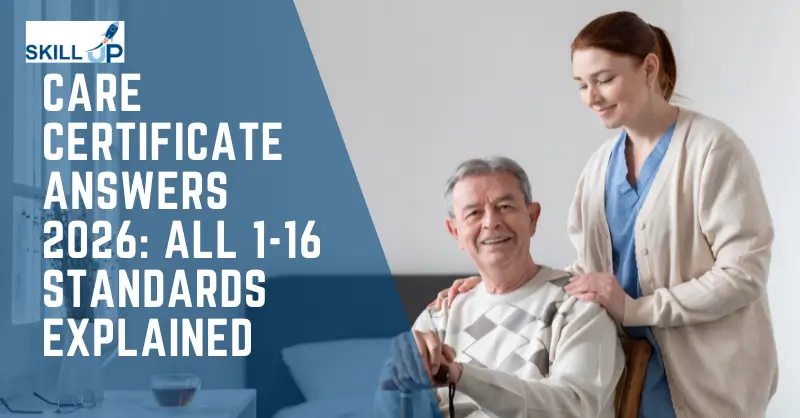
The care certificate answers serve as a guide for completing the care certificate courses. However, the induction process can often feel overwhelming, especially when you face the Care Certificate workbook.
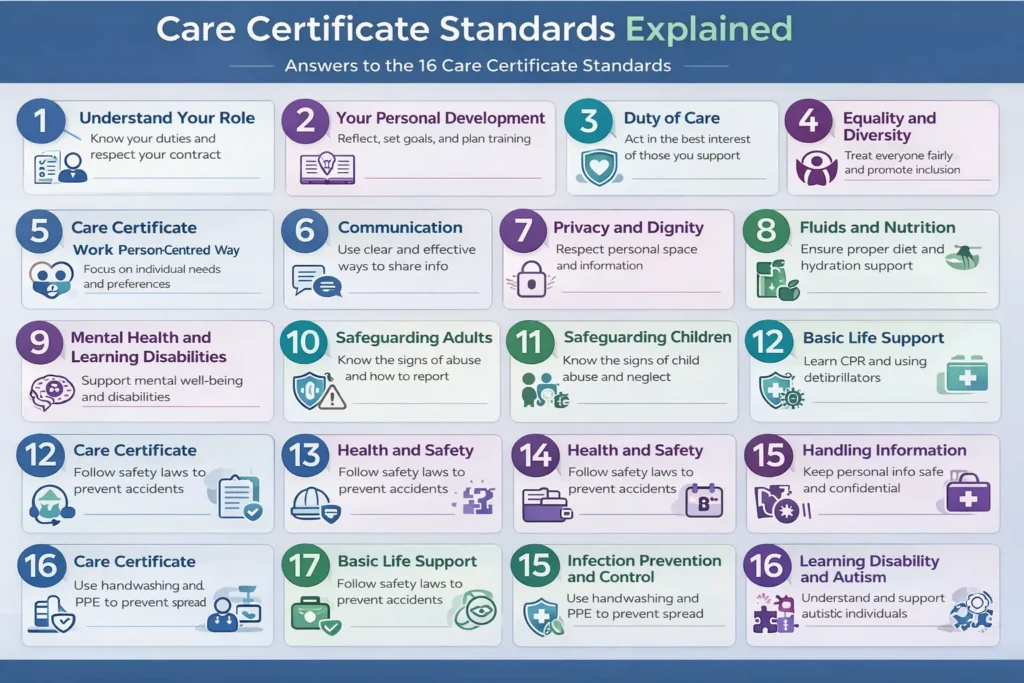
The care certificate answers: standards 1-16 provide answers to the questions you will face while completing the care certificate courses. If you are looking for care certificate answers, you are in the right place. From standard 1 care certificate workbook answers to care certificate standard answers 16, this guide provides a comprehensive look at the 16 standards of the care certificate, ensuring you have the knowledge to provide high-quality care. Each standard covers different topics. By providing the care certificate answers, the Care Skills Training’s intention is clear: to brush up your knowledge about the care certificates.
Whether you are working in an NHS care certificate programme or a private residential home, obtaining your Care Certificate is a significant step forward in your career. This guide will provide links to comprehensive answers for each of the 16 standards. Let’s check the care certificate answers of standards 1–16.
Table of Contents
The Origin and Purpose of the Care Certificate
The Care Certificate was introduced to ensure that all care workers in England have the same introductory skills and knowledge. Before its creation, training was inconsistent across the country. Therefore, a unified set of standards was required to protect the safety of vulnerable individuals.
Why the Cavendish Review Changed UK Care Training
Following the tragic events at Mid Staffordshire NHS Foundation Trust, the Government commissioned the Cavendish Review. Camilla Cavendish found that the preparation of healthcare assistants and social care support workers was often inconsistent. Consequently, she recommended a “Certificate of Fundamental Care.” This led to the development of the 15 standards care certificate we use today.
Who Needs the Care Certificate? (NHS vs. Private Sector)
The certificate is designed for “unregulated” staff. This includes Healthcare Assistants (HCAs), Adult Social Care Workers, and Support Workers. Moreover, it applies to both the nhs care certificate pathways and private sector roles. Even though it is not a formal qualification like an NVQ, the Care Quality Commission (CQC) expects to see evidence of this training during inspections.
How to Get a Care Certificate: The Step-by-Step Process
To obtain your certificate, you must complete the care certificate workbook and be assessed in the workplace. First, you will study the theory and provide care certificate questions and answers in written form. After that, a qualified assessor will observe your practice. This ensures you can apply what you have learned to real-life care scenarios.
Care Certificate Jobs and Average UK Salaries (2026)
Explore common job roles that value the Care Certificate, the most relevant standards, and typical UK salary ranges.
| Job Role | Relevant Care Certificate Standards | Average UK Salary (Per Year) |
|---|---|---|
| Care Assistant | Standards 1–7, 13–15 | £23,000 – £25,000 |
| Healthcare Assistant (HCA) | Standards 1–8, 12–15 | £24,000 – £28,000 |
| Support Worker | Standards 1–9, 14–16 | £25,000 – £28,000 |
| Senior Care Worker | Standards 1–10, 13–15 | £27,000 – £32,000 |
| Domiciliary Care Worker | Standards 1–8, 13–15 | £23,000 – £27,000 |
| Mental Health Support Worker | Standards 1–9, 14, 16 | £23,000 – £28,000 |
| Learning Disability Support Worker | Standards 1–9, 14, 16 | £23,000 – £27,000 |
| Care Team Leader | Standards 1–11, 13–15 | £28,000 – £33,000 |
| Residential Care Supervisor | Standards 1–11, 13–15 | £30,000 – £35,000 |
| NHS Band 2 Healthcare Assistant | Standards 1–12, 13–15 | £24,383 – £26,336 |
| NHS Band 3 Senior HCA | Standards 1–12, 13–16 | £24,071 – £25,674 |
Note: UK salaries shown are approximate and may change based on role, region, and employer.

Care Certificate Answers: Comprehensive Workbook Guide for All Standards
Finding the right care certificate answers pdf or online guide can save you hours of stress. Below, we break down each standard to help you understand what is required for your portfolio.
Care Certificate Standard 1 Answers: Understand Your Role
Standard 1 care certificate answers focus on your job description and how you fit into the wider team. You must describe your main duties and explain the importance of your employment contract. In addition, you need to show that you understand the relationship between your personal beliefs and your professional work. For example, you might personally disagree with a lifestyle choice, but professionally, you must remain non-judgmental.
Care Certificate Standard 2 Answers: Your Personal Development
When looking for care certificate standard 2 answers, you should focus on your Personal Development Plan (PDP). This document outlines your goals and the training you need. Furthermore, you must explain the importance of “reflective practice.” This means looking back at your work to see what went well and what could be improved. Standard 2 care certificate answers are about your commitment to lifelong learning.
Care Certificate Standard 3 Answers: Duty of Care
Care certificate standard 3 answers revolve around your legal obligation to act in the best interest of those you support. You will face dilemmas, such as an individual wanting to do something risky. Therefore, you must learn how to balance their right to take risks with your duty to keep them safe. Understanding how to handle comments and complaints is also a key part of this standard.
Care Certificate Standard 4 Answers: Equality and Diversity
In care certificate standard 4 answers, you explore how to treat everyone fairly. It is not just about treating everyone the same; rather, it is about giving everyone the same opportunities. You must be aware of protected characteristics under the Equality Act 2010. Consequently, you will learn how to challenge discriminatory behaviour in the workplace.
Care Certificate Standard 5 Answers: Work in a Person-Centred Way
Care certificate standard 5 answers focus on putting the individual at the heart of their care. You must support their preferences and history. For instance, if a resident prefers a bath in the evening instead of the morning, you should accommodate this. Promoting dignity and minimizing discomfort are vital aspects of standard 5 care certificate answers.
Care Certificate Standard 6 Answers: Communication
Care certificate standard 6 answers deal with how we exchange information. You must understand verbal communication and non-verbal cues, such as body language. Moreover, you should identify barriers to communication, such as hearing loss or environmental noise. Effective communication ensures that the individual’s needs are accurately met.
Care Certificate Standard 7 Answers: Privacy and Dignity
Maintaining standard 7 care certificate answers involves respecting an individual’s space and personal information. You should always knock before entering a room. Additionally, you must ensure that personal care is provided in a way that does not expose the person. Protecting their “dignity” means treating them with respect at all times.
Care Certificate Standard 8 Answers: Fluids and Nutrition
Care certificate standard 8 answers cover the essentials of diet and hydration. You must recognize signs of dehydration, such as dark urine or confusion. Furthermore, you should understand the importance of food hygiene. In the UK, malnutrition is a serious issue in care homes; therefore, keeping accurate records of what people eat is a priority.
Care Certificate Standard 9 Answers: Awareness of Mental Health, Dementia, and Learning Disabilities
This standard focuses on “The Social Model” of disability. Unlike the medical model, the social model suggests that people are disabled by society’s barriers rather than their condition. When providing care certificate standard 9 answers, you should explain how to support someone’s mental well-being and how to communicate effectively with those living with dementia.
Care Certificate Standard 10 Answers: Safeguarding Adults
Care certificate standard 10 answers are perhaps the most critical. You must identify different types of abuse, such as physical, emotional, or financial. Furthermore, you must know your local “whistleblowing” policy. If you see something wrong, you have a duty to report it. Standard 10 care certificate answers ensure you know how to protect those who cannot protect themselves.
Care Certificate Standard 11 Answers: Safeguarding Children
Even if you work with adults, you might encounter children. Therefore, care certificate standard 11 answers teach you how to spot signs of child neglect or abuse. You must understand that the safety of the child is always the priority. Consequently, you need to know who the “Designated Safeguarding Lead” is in your organisation.
Care Certificate Standard 12 Answers: Basic Life Support
This standard usually requires a practical demonstration. However, for the written part of care certificate standard 12 answers, you must describe the steps of CPR. You should also know how to use an Automated External Defibrillator (AED). Because this is a life-saving skill, many UK employers provide annual face-to-face training for this.
Care Certificate Standard 13 Answers: Health and Safety
Care certificate standard 13 answers cover a wide range of topics, from fire safety to moving and handling. You must understand your responsibilities under the Health and Safety at Work Act 1974. In addition, you should know how to perform a basic risk assessment to prevent accidents before they happen.
Care Certificate Standard 14 Answers: Handling Information
In the UK, the Data Protection Act 2018 and GDPR govern how we handle personal data. Care certificate standard 14 answers require you to explain how to keep records secure. For instance, you should never leave a computer logged in or a paper file on a desk where others can see it. Therefore, confidentiality is the cornerstone of this standard.
Care Certificate Standard 15 Answers: Infection Prevention and Control
Care certificate standard 15 answers have become even more important recently. You must demonstrate the correct 7-step handwashing technique. Moreover, you should know when to use PPE like gloves and aprons. Proper waste disposal, such as using “clinical waste” bins for soiled items, is also a key part of standard 15 care certificate answers.
Care Certificate Standard 16: Awareness of Learning Disability and Autism
While the original framework had 15 standards, many modern 2026 courses include a 16th module. This focuses on the specific needs of autistic individuals. Consequently, it helps care workers provide more tailored and empathetic support.
Top Resources: Care Certificate Answers PDF & Templates
Many learners search for care certificate answers pdf to help them structure their thoughts. However, it is important to use these as a guide rather than just copying them. Your answers must reflect your specific workplace and the people you care for.
Downloading the Official Skills for Care Workbook
The skills for care the care certificate workbooks are the “gold standard” for training. You can download these for free from the skills for care care certificate website. They provide the empty templates you need to fill in. If you are struggling, looking for the care certificate workbook answers online can provide helpful prompts.
How to Use Care Certificate Templates for Assessment
Using a care certificate template can help you stay organised. Many employers provide these digitally. However, make sure your template matches the 2026 standards. If your template is outdated, you might miss key information required by the CQC.
Get valuable training, UK-focused support, and the skills employers want. No experience needed.
Join 500+ graduates who landed tech jobs with our industry-focused training programme designed for beginners.
Explore Now - Our Job Ready ProgrammeFinal Summary: Your Care Career in 2026
The Care Certificate is more than just a piece of paper. It is a foundation for your entire career in health and social care. By working through the 16 standards of care certificate, you are proving that you are a safe, compassionate, and professional worker. Whether you are searching for care certificate standard 7 answers or care certificate answers standard 13, remember that the ultimate goal is the well-being of the people in your care.
The landscape of UK social care is constantly changing. Therefore, staying updated with the latest care certificate answers 2026 is the best way to ensure your skills remain relevant. Use the resources available to you, ask your manager for help, and take pride in the vital work you do every day.
FAQs about the Care Certificate (UK)
Who can assess the Care Certificate?
The Care Certificate is assessed by a trained and competent assessor, usually a manager, supervisor, or senior care worker within the organisation.
What does a Care Certificate include?
The Care Certificate includes 15 core standards covering essential care skills, values, safety, communication, and professional responsibilities.
What jobs can I get with a Care Certificate?
With a Care Certificate, you can work as a care assistant, support worker, healthcare assistant, or domiciliary carer in the UK.
What are the care standards in the UK?
UK care standards are guidelines set to ensure safe, effective, and compassionate care across health and social care services.
What is an NHS Care Certificate?
An NHS Care Certificate confirms that a healthcare support worker has met the required standards for safe and high-quality care within NHS settings.



All Courses
Personal Development
Employability
Career Bundle
Management
Free QLS Certificate
IT & Software
Business
Technology
Health & Care
Quality Licence Scheme Endorsed Courses
Health & Safety
Training
Marketing
Job Ready Programme
Design
Accounting & Finance
Health and Fitness
Healthcare and Medical
Animal Care
Psychology
Microsoft Office
Teach & Education
I.T
HR and Leadership
Counselling and Therapy
Teaching & Child Care
Health and Social Care
Electrical & Electronics
Law
Food Nutrition
programming
Administration & Office Skills
Education
Language
Engineering
Cooking & Baking
Law & Criminology
Accounting
QLS Bundle
Office Skills
Awareness
Photography
Finance
Lifestyle
Diet and Nutrition
Makeup & Beauty
Therapy
Sports
First Aid
Accounting & Bookkeeping
Mathematics
Excel
Web Design
Top Rated Course
Diet and Fitness
Counselling
Agriculture
Networking & Design
General Education
Biotechnology
Audit
Economics
Lifestyle & Recreational
Adobe Photoshop
Travel and Tourism
Categories

Awarded By