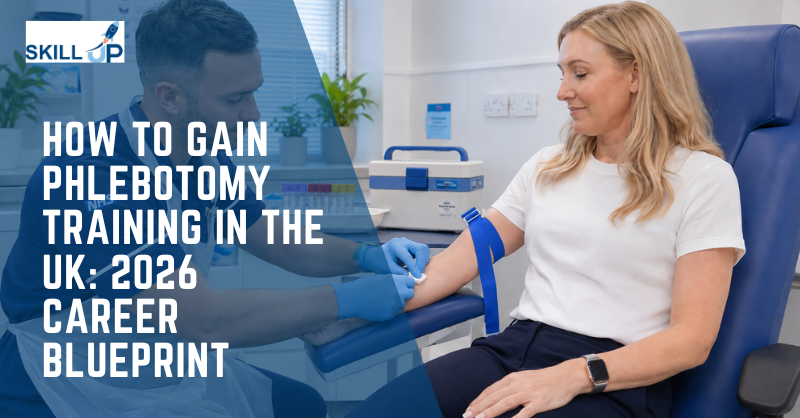
Phlebotomy Training could be your quickest route into healthcare, but are you unsure where to start, what employers expect, or whether online training is enough? You are not alone. Many beginners want a patient-facing role but feel confused by venepuncture, certificates, NHS jobs and practical experience. The Diploma in Phlebotomy Training helps you build the core knowledge, confidence and safety awareness needed before applying for phlebotomy positions.
The need for trained phlebotomists remains strong because blood tests sit at the centre of modern healthcare. NHS Jobs recently showed 70 phlebotomist jobs across the UK, while NHS Employers lists 2026/27 Band 2 pay at £25,272 and Band 3 pay from £25,760 to £27,476. The ONS also recorded 5.03 million jobs in human health and social work activities in May 2026, showing why healthcare support roles continue to offer steady career potential.
In this guide, you will learn what phlebotomy means, what phlebotomists do, how venepuncture works, what training employers expect, whether online certification is enough, how practical experience helps, and what phlebotomist salary to expect in 2026. You will also understand phlebotomy training requirements UK learners should know, including infection control, patient identification, sample labelling, DBS checks, safety rules and supervised competency.
Ready to build job-ready confidence? Start with the Diploma in Phlebotomy Training and use this guide as your roadmap into phlebotomy.
What Is Phlebotomy? Meaning, Purpose and Role in UK Healthcare
Phlebotomy means collecting blood samples from patients for testing. It may look like a small procedure, but it carries real clinical responsibility. A phlebotomist does not just “take blood”. They protect the patient, choose the right equipment, collect the correct sample, label it accurately and follow infection control rules from start to finish.
However, phlebotomy is also a human role. A patient may feel nervous, unwell, confused or afraid of needles. Therefore, your voice matters. A calm greeting can reduce anxiety. Clear explanations build trust, while a steady and respectful approach can make the whole experience safer and more comfortable.
Think about what happens after the blood tube leaves the room. That sample may help doctors check infection, anaemia, diabetes, liver function, kidney function, hormones, clotting problems or treatment response. In simple words, one carefully collected sample can support a major clinical decision.
Moreover, accuracy shapes every step. You must confirm patient details, use the correct tube, follow the right order of draw, handle samples safely and send them for testing without delay.
A proper Phlebotomy Training course helps beginners understand this wider responsibility. It connects patient care, blood collection, sample handling, infection control and workplace safety.

What Is Venepuncture? Phlebotomy vs Venepuncture Explained Simply
Venepuncture is the clinical technique of inserting a needle into a vein to collect blood for testing, donation or clinical monitoring. Although people often use venepuncture and phlebotomy together, they do not mean exactly the same thing. Venepuncture describes the blood-taking procedure itself. Phlebotomy covers the wider patient care process before, during and after blood collection. Therefore, a person who learns venepuncture must also understand consent, vein selection, infection control, sample tubes, patient identity checks and safe sharps disposal. In UK healthcare, employers may mention “venepuncture training”, “phlebotomy training” or “blood-taking competency” in job adverts. So, you should read each role carefully and understand whether it asks for the technique only or the wider phlebotomy responsibility.
Key Features of Venepuncture
Venepuncture focuses on vein access. The practitioner selects a suitable vein, prepares the skin, inserts the needle correctly and collects blood into the right tube. Therefore, accuracy matters from the first patient check to the final sample collection step.
Moreover, venepuncture requires strong infection control. The practitioner cleans the puncture site, uses sterile equipment, wears appropriate PPE and disposes of sharps safely. These steps protect the patient, the healthcare worker and the clinical environment from avoidable contamination or injury.
In addition, venepuncture involves patient communication. Some patients feel anxious, faint or afraid of needles. A calm explanation helps them understand what will happen. Clear reassurance can reduce fear, support cooperation and make the blood-taking process safer.
Finally, venepuncture supports diagnosis and treatment decisions. One blood sample can help clinicians check infection, anaemia, diabetes, organ function or medicine response. As a result, the practitioner must collect, label and handle every sample with care.
Phlebotomy vs Venepuncture
|
Key Difference |
Phlebotomy |
Venepuncture |
|
Meaning |
Phlebotomy describes the wider role of collecting blood samples and managing the full patient and sample journey. |
Venepuncture describes the specific technique of puncturing a vein to collect blood. |
|
Scope |
It includes patient checks, consent, communication, blood collection, labelling, documentation and sample transport. |
It focuses mainly on safe vein selection, needle insertion and blood withdrawal. |
|
Main Responsibility |
A phlebotomist manages the full blood collection process safely and professionally. |
A person performing venepuncture carries out the technical blood-taking procedure. |
|
Patient Care |
Phlebotomy places strong emphasis on patient comfort, confidentiality, reassurance and safety. |
Venepuncture still needs patient care, but the term mainly refers to clinical action. |
|
Documentation |
Phlebotomy includes accurate labelling, request forms, records and sample tracking. |
Venepuncture does not always describe the wider paperwork process by itself. |
|
Workplace Use |
Employers often use phlebotomy for job roles, training courses and healthcare support positions. |
Employers often use venepuncture when they refer to a specific clinical skill or competency. |
|
Training Focus |
Phlebotomy training usually covers blood collection, infection control, sample handling and professional conduct. |
Venepuncture training focuses more directly on the safe technique of accessing a vein. |
What Does a Phlebotomist Do Day to Day? Duties, Patients and Blood Samples
A phlebotomist spends the day working with people, not just needles. The role starts with patient contact and ends with safe sample delivery. You may welcome patients, confirm their identity, explain the blood test, prepare equipment, collect blood, label tubes and send samples for laboratory testing. The NHS explains that blood tests usually happen at a GP surgery or hospital, and a healthcare professional takes a small blood sample for testing. Therefore, every step matters because one careful sample can guide diagnosis, monitoring and treatment.
To understand the role clearly, look at the main duties phlebotomists handle each day:
-
Checking patient details carefully
First, the phlebotomist confirms the patient’s name, date of birth and test request. This prevents mix-ups and protects results.
-
Preparing the blood collection area
Next, they prepare tubes, needles, gloves, wipes, plasters and sharps bins. Good preparation keeps the procedure smooth.
-
Following infection control procedures
Then, they clean hands, use PPE, prepare the skin and dispose of sharps safely. Hygiene protects everyone.
-
Supporting anxious or fainting patients
Moreover, they speak calmly, explain each step and watch for dizziness, panic or fainting. Patient reassurance improves safety.
-
Handling samples safely
After collection, they check tubes, follow handling rules and send samples promptly. Safe handling protects sample quality.
-
Recording information accurately
Finally, they record collection details, sample type, time and concerns. Clear records support laboratory tracking and care decisions.
A phlebotomist’s careful work turns every blood sample into trusted information that helps clinicians make safer, faster decisions.

Why Phlebotomy Matters: How Blood Tests Support Diagnosis, Treatment and Monitoring
Phlebotomy matters because blood tests often shape the next step in a patient’s care. One small blood sample can help clinicians confirm a diagnosis, rule out a condition, monitor medication, check organ function, review pregnancy health, assess long-term disease or prepare someone for surgery. The NHS explains that blood samples go to a laboratory for testing. Therefore, accurate collection protects clinical decisions.
To understand its value, look at how blood tests support three essential areas of healthcare:
-
Diagnosis
First, blood tests help clinicians investigate symptoms and identify possible conditions. They may check infection, anaemia, diabetes, inflammation or organ function. Accurate phlebotomy gives laboratories a reliable sample to test.
-
Treatment
Next, blood tests help clinicians review whether treatment works or needs adjustment. Results may show medicine response, safety levels or side effects. Therefore, careful sample collection can influence treatment decisions.
-
Monitoring
Finally, blood tests help clinicians track long-term conditions, pregnancy health, surgery preparation and general wellbeing. Consistent labelling, documentation and handling help teams compare results accurately over time.
In phlebotomy, every careful sample helps clinicians diagnose earlier, treat smarter and monitor patients with greater confidence and safety.
Where Do Phlebotomists Work in the UK? NHS, GP Surgeries, Clinics, Labs and Mobile Services
Phlebotomists work across many UK healthcare settings, not only hospitals. The NHS employs many phlebotomists, but GP surgeries, outpatient clinics, diagnostic centres, laboratories and mobile blood testing services also need blood collection support. Step into the NHS explains that phlebotomists may work in local NHS hospitals or GP surgeries, collecting blood samples and arranging safe delivery to laboratories for testing. Therefore, this role connects patient care with laboratory science.
To see where phlebotomy can take you, look at the main healthcare settings below:
-
NHS
First, NHS phlebotomists work in hospitals, wards, outpatient departments and community services. They collect samples, support clinical teams and follow strict safety procedures.
-
GP Surgeries
Next, GP surgeries need phlebotomists for routine blood tests, medication reviews and long-term condition checks. Friendly communication matters because patients may visit regularly.
-
Clinics
Moreover, private clinics and diagnostic centres may offer planned blood tests, screenings and health checks. Phlebotomists need accuracy, clean technique and strong patient service.
-
Labs
Then, laboratory-linked roles may involve sample handling, label checks, paperwork and specimen tracking. These roles suit people who enjoy accuracy and organisation.
-
Mobile Services
Finally, mobile phlebotomists collect blood in homes, care homes, workplaces or community settings. They need planning, confidence and safe sample transport.
Phlebotomy can take you from hospitals to homes, but every setting depends on accuracy, safety and patient trust.

How to Become a Phlebotomist in the UK: Step-by-Step Route for Beginners
Becoming a phlebotomist in the UK starts with understanding the role, not just learning where to place a needle. You need theory, safety awareness, patient communication and supervised experience before employers can trust your blood-taking skills. Step into the NHS explains that beginners usually apply for trainee phlebotomist roles and then receive on-the-job training, while some healthcare support workers receive phlebotomy training at work. Therefore, your route should build knowledge first, then confidence, then evidence. The Diploma in Phlebotomy Training can support the early theory stage.
A simple beginner route looks like this:
-
Learn phlebotomy theory
First, learn what phlebotomy involves and why blood collection supports diagnosis, treatment and monitoring. You should understand patient identity checks, consent, sample tubes, labelling and safe handling. This theory helps you see phlebotomy as a healthcare responsibility, not just a technical action. As a result, you start with the right mindset.
-
Study anatomy, infection control and safety
Next, build your knowledge of veins, blood circulation, infection prevention and sharps safety. You need to know how poor hygiene, wrong equipment use or unsafe disposal can harm patients and staff. Moreover, anatomy helps you understand vein selection and possible complications. Strong safety knowledge makes you more prepared for supervised practice.
-
Practise communication skills
Then, work on calm, clear and respectful communication. Patients may feel anxious, faint, rushed or confused before a blood test. Therefore, you must explain the process, check your understanding and reassure them without making false promises. Good communication can improve cooperation and reduce avoidable stress.
-
Gain supervised practical experience
After theory, you need supervised practice in a suitable clinical environment. A trained professional should observe your technique, guide your development and confirm when you perform safely. This stage helps you connect knowledge with real patient care. Importantly, never claim practical competence without proper supervision and evidence.
-
Build a healthcare CV
Meanwhile, prepare a CV that shows reliability, communication, confidentiality and attention to detail. Include healthcare training, customer service, volunteering, care work or any role where you handle people carefully. Also mention infection control, safeguarding, data protection and patient-facing experience where relevant. A focused CV helps employers see your readiness.
-
Apply for entry-level roles
Next, search for trainee phlebotomist roles, healthcare assistant roles with phlebotomy duties, NHS bank positions, GP surgery vacancies and private clinic opportunities. Read each advert carefully because employers may use terms such as “phlebotomy”, “venepuncture” or “blood-taking competency”. Therefore, match your application to the exact wording. This improves your chance of passing shortlisting.
-
Keep evidence of competency
Finally, collect certificates, training records, supervisor sign-offs and evidence of safe practice. Employers often want proof that you can follow procedure, communicate well and handle samples correctly. Moreover, keeping evidence helps you progress into stronger healthcare roles later. In simple words, your portfolio turns training into employability.
With the right theory, supervised experience and evidence, beginners can turn phlebotomy interest into real UK healthcare opportunities.
Phlebotomy Training Routes UK: College, Apprenticeship, NHS Training and Private Courses
Phlebotomy training routes in the UK include college courses, apprenticeships, NHS workplace training and private programmes. Each route supports a different stage of learning. Some build theory, while others provide supervised clinical experience. The National Careers Service explains that learners may enter phlebotomy through direct application, college study or apprenticeships. Therefore, beginners should compare course content, entry requirements, practical elements and competency evidence before choosing a route that matches their goals.
Before deciding, consider how each option develops knowledge, experience and workplace readiness:
-
College
First, college courses introduce anatomy, infection control, patient care and healthcare procedures. They suit learners who prefer structured study. However, always check whether supervised practical training forms part of delivery.
-
Apprenticeship
Next, apprenticeships combine paid work with structured learning. They build workplace confidence and job-related skills. Therefore, check each vacancy carefully because employers set different entry requirements and competency expectations locally.
-
NHS Training
Then, NHS training may come through trainee phlebotomist, healthcare assistant or internal development roles. This route gives direct clinical exposure, but applicants must read every person’s specification carefully before applying.
-
Private Courses
Finally, private courses can strengthen venepuncture theory, safety, sample handling and communication. However, quality varies, so confirm accreditation, supervised practice, assessment methods and competency evidence before enrolling with any provider.
Choose the route that matches your stage, then build safe knowledge, supervised experience and credible evidence of workplace competency.
What Does a Phlebotomy Training Course Include? Theory, Practice, Dummy Arm Training and Competency
A strong phlebotomy training course teaches the complete patient journey, not only needle technique. Learners should understand identity checks, consent, anatomy, infection control, sample handling and workplace safety. Skills for Health explains that training should cover learning content, practical development and competency expectations. Therefore, beginners need structured theory and supervised experience before taking greater clinical responsibility. Quality training connects the patient, procedure and sample as one safe, accurate process together.
To judge course quality, focus on these four essential learning areas:
-
Theory and Anatomy
First, theory explains veins, circulation, blood function and common collection sites. Anatomy knowledge supports safer decisions. It helps learners understand why correct technique matters during each blood collection procedure safely.
-
Infection Control and Sharps Safety
Next, infection control covers hand hygiene, PPE, skin preparation, equipment cleanliness and waste disposal. Sharps safety builds careful habits. These measures reduce contamination, injuries and unnecessary workplace exposure risks overall.
-
Patient Care and Sample Handling
Then, patient care develops communication, consent and dignity. Sample handling covers tube choice, labelling, documentation and transport. Together, these skills protect patients, specimen quality and reliable laboratory results consistently and safely.
-
Dummy Arm Training and Competency
Finally, dummy arm training builds equipment control before patient contact. However, it does not prove full competence. Supervised live practice develops judgement, consistency and evidence for employer review and progression.
Good phlebotomy training combines sound knowledge, safe practice and honest competency evidence before learners progress towards patient-facing blood collection.

Phlebotomy Certificate, CPD Certificate and Certificate of Competence: What Employers Look For
A CPD certificate, a phlebotomy certificate and a certificate of competence can mean different things. That difference matters. A CPD certificate usually shows that you completed structured learning. The CPD Certification Service explains that CPD means Continuing Professional Development, which describes learning activities professionals use to develop their abilities.
However, a phlebotomy certificate may simply show that you completed a course. It may cover theory, infection control, anatomy, venepuncture knowledge and sample handling. A certificate of competence goes further. It usually shows that someone assessed your practical ability against workplace standards.
Therefore, honesty protects your CV. Say what you studied, how you studied it and whether you completed supervised practice. Employers can then judge your preparation clearly.
- A CPD certificate shows that you completed structured learning, but it may not prove that you can take blood from patients safely.
- Meanwhile, a phlebotomy certificate may confirm course completion without showing that you passed a practical assessment.
- Competence certificates usually provide stronger evidence because an assessor has observed and evaluated your practical ability.
- Employers may value CPD training when you use it to prepare for interviews or trainee roles.
- However, clinical employers may still need supervised blood draws, workplace sign-off or internal competency checks.
- Therefore, never describe yourself as competent unless you have completed assessed practice under appropriate supervision.
- On your CV, state whether your course was online, classroom-based, practical or assessed through live supervision.
- Finally, keep certificates, training records and sign-off documents organised so employers can verify your preparation quickly.
A certificate can support your application, but clear evidence of supervised competence builds stronger trust with healthcare employers.
Level 2 vs Level 3 Phlebotomy Training: Which Course Should You Choose?
Level 2 phlebotomy training usually gives beginners foundation knowledge in patient checks, infection control, communication, equipment and sample handling. By comparison, Level 3 training often explores anatomy, circulation, venepuncture, documentation and clinical risk in greater depth. However, course titles do not guarantee identical content. Skills for Health explains that learners need theory before developing practical competence through supervised opportunities. Therefore, compare outcomes, assessments, provider claims and practical elements before enrolling with confidence.
Before choosing a course, consider how each option supports your current knowledge, practical needs, employment plans and long-term career goals:
-
Level 2 Phlebotomy Training
First, Level 2 introduces safe blood collection principles. It builds awareness of patient care, hygiene, equipment and sample handling. Therefore, it may suit complete beginners preparing for trainee roles safely.
-
Level 3 Phlebotomy Training
Next, Level 3 explores anatomy, circulation, venepuncture theory and documentation more deeply. It strengthens clinical understanding. However, learners still need supervised practical experience to demonstrate safe workplace competence clearly and properly.
-
Course Type and Competency
Finally, check the delivery method and assessment carefully. Some courses teach theory only, while others include simulation or supervised practice. Confirm exactly what evidence, certification and competency sign-off you receive.
Level 2 vs Level 3 Phlebotomy Training
|
Key Difference |
Level 2 Phlebotomy Training |
Level 3 Phlebotomy Training |
|
Best For |
Suits beginners who need foundation knowledge before entering phlebotomy or healthcare support roles. |
Suits learners who want broader knowledge before applying for phlebotomy-related positions. |
|
Learning Depth |
Covers basic blood collection, patient checks, infection control and sample awareness. |
Explores anatomy, venepuncture theory, documentation, patient care and clinical risk. |
|
Confidence Level |
Helps learners understand the role and build early confidence. |
Helps learners prepare for more detailed clinical learning environments. |
|
Patient Care Focus |
Introduces communication, reassurance and basic duty of care. |
Builds a stronger understanding of consent, dignity and anxiety support. |
|
Safety Focus |
Covers hygiene, PPE, sharps awareness and safe working habits. |
Look deeper at infection prevention, sample quality and procedure accuracy. |
|
Career Use |
Supports trainee, HCA or phlebotomy assistant applications. |
Supports learners seeking stronger study evidence. |
|
Practical Element |
Maybe theory only, depending on the provider. |
May still need separate supervised practice. |
Choose training for its content, supervision and assessment quality, not simply the level printed on the course certificate at work.
How Much Does Phlebotomy Training Cost in the UK? Fees, Cheap Courses and Red Flags
Phlebotomy training costs vary because every course offers a different level of support. Online theory courses usually cost less because learners study anatomy, infection control, sample handling and patient communication remotely. However, practical courses often cost more because providers need trainers, clinical equipment, practice arms, safe spaces, materials and supervision.
Therefore, do not judge a phlebotomy course by price alone. Ask what the course fee includes. Check whether the programme covers theory, dummy-arm practice, supervised live blood draws and competency evidence. Skills for Health explains that good phlebotomy training should help learners understand safe blood collection, reduce risk and manage the patient’s response.
- Compare online and practical courses carefully because cheaper theory training may not include supervised blood-taking practice or competency assessment.
- Check whether the fee includes equipment, trainer support, dummy arm practice, live supervision, assessment and certificate documents.
- Avoid providers that promise employment, instant competence or automatic NHS acceptance without clear evidence or employer confirmation.
- Read the course page closely, especially the assessment method, practical element, certificate wording and refund conditions.
- Choose theory training if you need background knowledge before applying for trainee or healthcare assistant roles.
- Choose practical training if you need supervised experience, equipment handling and stronger evidence of workplace readiness.
- Ask whether the provider gives competency records, not just a completion certificate, if employers request practical proof.
- Finally, match the course cost to your stage, budget and goal instead of choosing the cheapest option blindly.
A good phlebotomy course should make its limits clear, support safe learning and never sell confidence as guaranteed competence.
DBS Checks, Occupational Health and Phlebotomy Safety Skills: Infection Control, Sharps Safety and Needle-Stick Prevention
Phlebotomy involves direct patient contact, blood exposure, needles and clinical sample handling. Therefore, employers may ask for more than a course certificate. They may request a DBS check, occupational health clearance, immunisation evidence, health screening, identity documents and proof of safe working knowledge. GOV.UK explains that employers may check someone’s criminal record when they work in healthcare or with children. However, these checks should not frighten beginners. They protect patients, staff and the wider healthcare environment. Treat them as professional preparation, not a barrier.
To work safely in phlebotomy, learners should understand three essential areas before entering patient-facing practice:
-
DBS and Occupational Health Checks
First, DBS checks help employers assess suitability for roles involving patients, children or adults at risk. Occupational health checks look at fitness for clinical work, immunisation status and possible workplace adjustments. Moreover, organised documents show professionalism and help recruiters process applications without unnecessary delays.
-
Infection Control
Next, infection control protects the patient, the phlebotomist and the clinical environment. A phlebotomist cleans hands, wears suitable PPE, prepares the skin and keeps equipment clean. In addition, safe waste disposal reduces contamination risk. Every hygiene step supports safer blood collection.
-
Sharps Safety and Needle-Stick Prevention
Finally, sharps safety reduces the risk of needle injuries during blood collection. A phlebotomist handles needles carefully, avoids unsafe shortcuts and disposes of sharps immediately in approved containers. Therefore, focus matters. If a needle-stick injury happens, staff must report it quickly.
Strong preparation, safe technique and organised paperwork show employers that you understand patient safety before you enter clinical practice.
Patient Identification, Consent, Order of Draw, Sample Labelling and Common Beginner Mistakes
A safe blood test starts before the needle touches the skin. The phlebotomist confirms identity, explains the procedure, gains consent and selects suitable equipment. They then follow the correct order of draw, label every sample and record the collection clearly. WHO guidance recommends matching the patient with the laboratory form, drawing tubes in sequence and checking labels carefully. Therefore, each small check protects sample quality, patient safety and clinical decisions.
To build accurate, patient-centred habits from the beginning, focus on these six essential areas:
-
Patient Identification
First, confirm the patient’s full name, date of birth and test request. Match every detail carefully. Accurate identification prevents sample mix-ups, repeat procedures and incorrect clinical decisions for affected patients.
-
Consent
Next, explain the procedure clearly and check that the patient agrees. Invite questions and respect refusal. Informed consent protects dignity, reduces anxiety and supports cooperative, patient-centred care throughout blood collection.
-
Order of Draw
Then, collect tubes in the sequence required by local laboratory policy. Different additives can contaminate later samples. Correct sequencing protects specimen quality and helps laboratories produce consistently reliable test results.
-
Sample Labelling
Afterwards, label each tube according to workplace procedure while maintaining patient identification. Check names, dates and test details. Accurate labelling links every sample to the correct laboratory testing pathway safely.
-
Documentation
Moreover, record the sample type, collection time, collector identity and any concerns. Clear documentation supports tracking and accountability. It also helps clinical and laboratory teams communicate safely and efficiently together.
-
Common Beginner Mistakes
Finally, avoid rushing, weak positioning, missed hygiene steps and incorrect equipment choices. Ask for help when uncertain. Safe beginners follow procedure, recognise limits and prioritise accuracy over personal confidence alone.
In phlebotomy, careful identification, consent, sequencing, labelling and documentation protect patients, samples and every clinical decision that follows.

Phlebotomy vs Cannulation: Which Skill Should You Learn First?
Phlebotomy and cannulation both involve veins, needles and patient care, but they serve different clinical purposes. While phlebotomy focuses on collecting blood samples for testing, cannulation places a small flexible tube into a vein to deliver fluids, medicines or blood products. Cannulation places a small tube into a vein so fluids, medicines or treatments can enter the bloodstream. Therefore, beginners usually benefit from learning phlebotomy first. It builds vein awareness, infection control, patient communication and sharps safety before learners move towards more advanced clinical procedures under employer supervision and assessed workplace training.
Before choosing your first skill, understand how each one supports a different level of clinical responsibility:
-
Phlebotomy
First, phlebotomy teaches beginners safe blood collection, patient checks, vein choice, tube selection, labelling and infection control while building confidence with needles, communication and accurate sample handling from day one.
-
Cannulation
Next, cannulation places a cannula into a vein so clinicians can give fluids, medicines, contrast dyes or treatments, so learners need supervision, workplace approval and practical assessment before independent practice.
Phlebotomy vs Cannulation
|
Key Difference |
Phlebotomy |
Cannulation |
|
Main Purpose |
Collects blood samples for testing, diagnosis, monitoring and treatment review. |
Place a cannula into a vein for fluids, medicines or treatments. |
|
Best Starting Point |
Suits beginners entering healthcare support or blood-taking roles. |
Suits clinical workers who need supervised advanced venous access skills. |
|
Clinical Focus |
Focuses on sample collection, patient checks, labelling and sample quality. |
Focuses on cannula placement, monitoring and ongoing patient safety. |
|
Patient Contact |
Usually involves short contact during a blood test or clinic round. |
May involve longer responsibility because the cannula stays in place. |
|
Risk Level |
Carries risk if checks, hygiene or sample handling go wrong. |
Carries higher risk because treatment may enter the bloodstream. |
|
Training Need |
Starts with theory, then supervised blood-taking practice. |
Needs direct supervision, workplace training and competency sign-off. |
|
Career Use |
Supports phlebotomist, HCA, clinic assistant or pathology roles. |
Supports advanced clinical support roles in healthcare settings. |
Supporting Nervous Patients, Children, Older Adults and Difficult Veins During Blood Tests
Supporting patients during blood tests takes more than technical skill. Some people fear needles, feel faint, worry about results or feel embarrassed by the procedure. Children may need simple reassurance, while older adults may need slower movement and gentler handling. Great Ormond Street Hospital explains that many children, young people and adults feel nervous about injections or blood tests. Therefore, a phlebotomist must stay calm, explain clearly and notice distress early. Good phlebotomy supports the person before it collects the sample.
To handle different patient needs safely, focus on these five essential skills:
-
Supporting Nervous Patients
First, nervous patients need calm communication, not rushed instructions. Explain what will happen in simple words, check understanding and give them time to breathe. Moreover, watch for sweating, dizziness or panic because early support can prevent fear from becoming a safety concern.
-
Caring for Children
Next, use simple language, gentle reassurance and age-appropriate distraction. Involve a parent or carer where suitable, praise cooperation and help the child feel safe.
-
Supporting Older Adults
Moreover, position older adults comfortably, support the arm and move gently. Fragile veins, thinner skin and reduced mobility require patience, respect and careful handling.
-
Managing Difficult Veins
Then, stay calm when veins feel small, deep, fragile or hard to find. Reposition safely, follow local policy and ask for senior support.
-
Handling Failed Blood Draws
Finally, stop within safe limits, explain honestly, seek help and document correctly. Safe phlebotomists protect patients instead of chasing personal confidence.
A skilled phlebotomist handles fear, fragile veins and failed attempts with calm judgement, safe limits and patient-first care.

Phlebotomist Salary, Jobs and Career Path UK 2026: NHS Pay Bands, London Wages, No-Experience Roles and Progression to Lab Technician or HCA
Phlebotomist salary, jobs and career path options in the UK depend on employer, location, experience and duties. In the NHS, many entry-level phlebotomy roles sit around Band 2, while senior roles may sit around Band 3. NHS Employers lists 2026/27 Agenda for Change pay from 1 April 2026 at £25,272 for Band 2 and £25,760 to £27,476 for Band 3. However, pay alone does not tell the full story. You should compare training, supervision, London weighting, shift patterns, pension, travel, progression and support before accepting any phlebotomy role.
Before choosing a role, look at five essential areas that shape your pay, job search and long-term progression:
-
NHS Pay Bands
First, check Band 2 roles when applying for entry-level phlebotomy posts. For 2026/27 NHS pay, compare current Band 2 and Band 3 rates through NHS Employers.
-
London Wages and Private Pay
Next, remember that London roles may include area supplements, while private clinics set different rates based on experience, workload and supervision.
-
No-Experience Roles
If you lack experience, search trainee phlebotomist, HCA, clinic assistant and phlebotomy assistant roles, then highlight transferable patient-facing skills.
-
Where to Find Jobs
Moreover, check NHS Jobs, hospital trusts, GP practices, private hospitals and clinics, using varied phlebotomy search terms to widen opportunities.
-
Career Path and Progression
Finally, phlebotomy can lead to senior phlebotomist, HCA, GP assistant, lab technician, pathology support or healthcare science assistant roles.
A strong phlebotomy career starts with fair pay, safe supervision, honest evidence and steady progression into wider healthcare roles.
Career Progression After Phlebotomy: Lab Technician, Senior Phlebotomist, HCA and Healthcare Science Routes
Phlebotomy can give beginners a strong first step into UK healthcare. It builds patient confidence, infection control awareness, accurate sample handling and calm communication. Over time, you may progress into senior phlebotomy, healthcare assistant roles, GP assistant duties, laboratory support, pathology services or healthcare science routes. However, progression depends on training, supervised experience, employer requirements and extra skills such as ECGs, observations or specimen processing. Build evidence steadily and keep learning.
|
Job Role |
Short Description |
Salary Estimation |
|
Phlebotomist |
Collects blood samples, checks patient identity, labels tubes and supports safe delivery to laboratories. |
£25,000–£31,000 |
|
Senior Phlebotomist |
Leads phlebotomy clinics, supports junior staff, checks workflow and helps maintain sample quality standards. |
£25,760–£31,157 |
|
Healthcare Assistant |
Supports nurses with patient care, observations, mobility, comfort, basic checks and ward or clinic routines. |
£25,000–£27,000 |
|
GP Assistant |
Supports general practice teams with patient admin, basic clinical tasks, records and appointment preparation. |
£25,272–£31,157 |
|
Medical Laboratory Assistant |
Receives, sorts, labels and prepares patient specimens for biomedical testing in pathology departments. |
£25,272–£27,476 |
|
Pathology Support Worker |
Helps pathology teams process samples, maintain records, manage specimen flow and support diagnostic services. |
£25,272–£27,476 |
|
Healthcare Science Assistant |
Supports testing, monitoring and clinical science services, including blood sample handling and patient-facing checks. |
£25,000–£31,000 |
|
ECG Technician |
Carries out ECG recordings, prepares patients, checks equipment and supports cardiac diagnostic pathways. |
£25,760–£31,157 |
|
Associate Practitioner |
Takes on higher-level clinical support duties in laboratories, diagnostics or healthcare science services. |
£28,392–£31,157 |
|
Biomedical Scientist |
Tests patient samples and supports diagnosis, treatment and disease prevention after approved qualifications and registration. |
£30,000–£53,000 |
Salary figures vary by employer, NHS band, region, London weighting, shift pattern and experience. Therefore, use these ranges as guidance, not as a promise.
Phlebotomy can start with one careful blood sample, then grow into a wider healthcare career through learning and evidence.
Final Thought: Become a Phlebotomist Who Puts Patient Safety First
Becoming a phlebotomist in the UK is not about mastering a needle overnight. It is about building the right mix of patient communication, infection control awareness, sample accuracy and calm judgement.
To begin, understand the role, strengthen your knowledge and seek supervised practical experience through trainee posts or healthcare settings. The Diploma in Phlebotomy Training can build your understanding of venepuncture, blood collection, patient identification, sample handling and safety responsibilities.
With evidence, a focused CV and employer-led competency checks, you can take a confident step towards safe, patient-centred phlebotomy work.
Get valuable training, UK-focused support, and the skills employers want. No experience needed.
Join 50+ graduates who landed tech jobs with our industry-focused training programme designed for beginners.
Explore Now - Our Job Ready ProgrammeFrequently Asked Questions (FAQs)
How Do I Become a Phlebotomist in the UK?
To become a rehabilitation support worker in the UK, build relevant care experience, develop communication and safeguarding knowledge, then apply for NHS, community or private roles. Employers may recruit directly, offer apprenticeships, or value recognised Level 2 or Level 3 health and social care qualifications.
Can I Become a Phlebotomist with No Experience?
Yes. Some trainee phlebotomist vacancies provide full training and do not require previous healthcare experience. However, many posts prefer venepuncture experience, communication skills and accurate record keeping. Build evidence through healthcare volunteering, support work, supervised practice and carefully targeted applications for trainee positions in hospitals.
What Qualifications Do You Need for Phlebotomy in the UK?
There are no universal UK entry requirements. The National Careers Service says two GCSEs and first aid knowledge may help, while some employers prefer healthcare qualifications. Always check each vacancy because NHS trusts, GP practices, laboratories and private clinics can set different essential criteria locally.
How Long Does Phlebotomy Training Take in the UK?
Course length varies considerably. Some introductory programmes cover theory and practical elements across two days, but workplace readiness usually requires supervised practice and competency assessment afterwards. Avoid judging quality by speed alone; compare teaching, live practice, assessment, mentoring, employer expectations and available follow-up support options.
Can You Complete Phlebotomy Training Online?
Online study can teach anatomy, infection control, patient identification, equipment and procedural theory. However, online certification alone does not prove practical competence. Safe independent blood collection normally requires supervised venepuncture practice and workplace assessment against an appropriate competency framework before an employer authorises practice safely.
Is a Phlebotomy Certificate Enough to Get an NHS Job?
Employers may request a phlebotomy certificate, venepuncture training or demonstrable competency, but requirements vary. A CPD certificate records learning; it does not automatically confirm independent clinical competence. Strong candidates can show relevant theory, supervised blood draws, safe practice, accurate documentation and workplace assessment to employers.
How Much Does Phlebotomy Training Cost in the UK?
Phlebotomy training costs vary by provider, location, delivery format and whether supervised live practice is included. Compare the full package rather than headline price. Check tutor credentials, practical assessment, certificate wording, additional fees, refund terms and whether employment or “NHS accepted” claims are properly explained.
How Much Does a Phlebotomist Earn in the UK in 2026?
UK earnings depend on employer, band, location, experience and hours. For 2026/27 in England, NHS Agenda for Change Band 2 is £25,272, while Band 3 ranges from £25,760 to £27,476. London weighting, bank shifts and private-sector rates may change total pay and actual hourly earnings.
What NHS Pay Band Is a Phlebotomist?
Many NHS phlebotomist posts sit at Band 2, while some combined, experienced or higher-responsibility roles may use Band 3. Banding depends on the job evaluation, duties and employer. Read the person specification carefully instead of assuming every phlebotomy vacancy offers the same pay scale nationally.
What Is the Difference Between Phlebotomy, Venepuncture and Cannulation?
Phlebotomy covers collecting and handling blood samples, while venepuncture specifically means accessing a vein to obtain blood. Cannulation involves placing a small tube into a vein for fluids or medicines. The skills overlap, but training, authorisation, purpose and workplace competency requirements are not identical either.




All Courses
Personal Development
Employability
Career Bundle
Management
Free QLS Certificate
IT & Software
Business
Technology
Health & Care
Quality Licence Scheme Endorsed Courses
Health & Safety
Training
Marketing
Job Ready Programme
Design
Accounting & Finance
Health and Fitness
Healthcare and Medical
Animal Care
Psychology
Microsoft Office
Teach & Education
I.T
HR and Leadership
Counselling and Therapy
Teaching & Child Care
Health and Social Care
Electrical & Electronics
Law
Food Nutrition
programming
Administration & Office Skills
Education
Language
Engineering
Cooking & Baking
Law & Criminology
Accounting
QLS Bundle
Office Skills
Awareness
Photography
Finance
Lifestyle
Diet and Nutrition
Makeup & Beauty
Therapy
Sports
First Aid
Accounting & Bookkeeping
Mathematics
Excel
Web Design
Top Rated Course
Diet and Fitness
Counselling
Agriculture
Networking & Design
General Education
Biotechnology
Audit
Economics
Lifestyle & Recreational
Adobe Photoshop
Travel and Tourism
Categories

Awarded By