Manual handling is a daily reality in many UK workplaces, from warehouses to healthcare settings. Yet, unsafe practices remain one of the leading causes of work-related injuries. According to the UK Health and Safety Executive (HSE), in 2023, over 500,000 workers suffered musculoskeletal disorders linked to manual handling. This makes understanding structured approaches like TILE, TILEO, and LITE essential for employees and managers alike.
If you’ve ever wondered what TILE stands for, what TILEO stand for, or what LITE stand for in manual handling, this guide is for you. We will explore these acronyms in detail, explain how they improve workplace safety, provide real-life UK examples, and outline best practices for risk assessment and injury prevention.
TILE Manual Handling Explained: The Four Pillars
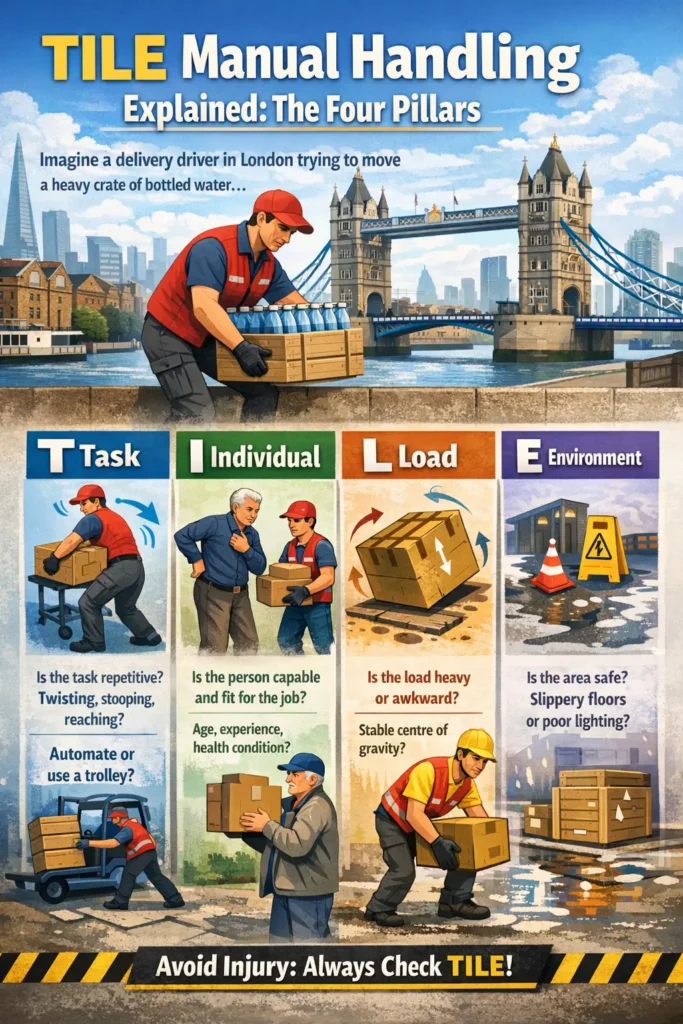
Let us take a closer look at the acronym tile stands for by breaking down each pillar. Imagine a delivery driver in London trying to move a heavy crate of bottled water. Without a t i l e manual handling check, they are at high risk of a slipped disc.
Task (T)
This involves looking at the movement itself. Does the task require twisting, stooping, or reaching upwards? In addition, how often does the worker need to perform this move? If a task is repetitive, the risk of injury increases significantly. Therefore, we must always ask if there is a way to automate the task or use a trolley instead.
Individual (I)
Every person has different physical capabilities. For example, a young apprentice might have more strength than a worker nearing retirement, but they may lack the experience to lift safely. Moreover, does the individual have a pre-existing back condition? We must ensure the person is fit for the specific job at hand.
Load (L)
Here, we look at the object itself. Is it heavy, bulky, or difficult to grasp? Furthermore, is the centre of gravity stable? A box of loose metal parts is much harder to carry than a solid wooden block. When we ask what tile stands for when risk assessing, the “Load” is often where the most obvious dangers hide.
Environment (E)
The space around you is just as important as the object you are lifting. Are the floors slippery or uneven? Is the lighting poor? In the UK, we often deal with rainy weather that makes outdoor loading bays dangerous. Therefore, the acronym t.i.l.e forces us to check the ground beneath our feet before we take a single step.
What Does TILE Stand for?
TILE is a fundamental acronym used in UK manual handling risk assessments. It helps workers and managers evaluate key factors before performing tasks, reducing the likelihood of injuries.
The Meaning of TILE
The acronym TILE stands for:
- T – Task: What is the task, and how is it performed?
- I – Individual: Who is performing the task, and what are their capabilities?
- L – Load: What is being lifted, pushed, or carried, including weight, size, and shape?
- E – Environment: Where is the task taking place? Consider hazards like slippery floors or tight spaces.
Using TILE allows organisations to assess risks systematically. For example, a warehouse worker lifting boxes must consider the weight (Load), their own strength and any pre-existing injuries (Individual), the nature of the lifting task (Task), and whether obstacles or uneven surfaces exist (Environment).
Why TILE Manual Handling is Important
In addition to reducing injuries, TILE manual handling encourages safer working habits. For example, in a healthcare setting, nurses moving patients are guided by TILE to ensure correct techniques and equipment are used. Moreover, the systematic assessment reduces workplace accidents, which, according to HSE reports, cost UK businesses over £15 billion annually in lost productivity and compensation claims.
What Does TILEO Stand for?
While TILE is widely used, some organisations adopt TILEO, which adds an O – Other Factors element to the assessment. This includes organisational policies, equipment availability, and workflow management.
Understanding TILEO
TILEO expands the safety framework:
- T – Task
- I – Individual
- L – Load
- E – Environment
- O – Other Factors
These “other factors” might include whether lifting aids are available, if team coordination is needed, or if there are time pressures. For example, in a UK construction site, TILEO ensures workers consider scaffolding stability, available lifting equipment, and team communication before moving heavy materials.
What Does LITE Stand for?
LITE is another approach used for simplified risk assessments. It stands for:
- L – Load
- I – Individual
- T – Task
- E – Environment
LITE is often applied in light manual handling tasks, such as office relocations or small-scale warehouse work, where loads are manageable, but risk assessment is still
necessary.
TILEO Explained
TILEO is an extension of the traditional TILE manual handling risk assessment. While TILE focuses on Task, Individual, Load, and Environment, TILEO adds one more crucial element. Therefore, it helps assess risks that may otherwise be missed.
O Stands for Other Factors
The “O” in TILEO stands for Other factors that can affect manual handling safety. These are risks not fully covered by the original TILE elements. For example, common “Other” factors include:
- Time pressure or rushing tasks
- Fatigue or long working hours
- Weather conditions, especially in outdoor UK work
- Poor communication between workers
- Use of unsuitable clothing or PPE
- Lack of training or supervision
Therefore, tileo’s meaning goes beyond physical movement and looks at wider workplace conditions.
The Importance of TILEO in Manual Handling
TILEO is especially important in modern UK workplaces where work is often fast-paced and unpredictable. For instance, a care worker assisting a patient late in a long shift may be physically capable. However, fatigue and stress increase the risk of injury.
In addition, industries such as construction, logistics, and healthcare frequently face “Other” risks like tight deadlines or changing environments. By applying tileo manual handling assessments, employers can reduce accidents caused by human and organisational factors.
Moreover, tileo risk assessment supports compliance with UK health and safety laws, including the Manual Handling Operations Regulations (MHOR). As a result, businesses that use TILEO often see fewer injuries and stronger safety cultures.
LITE Explained
LITE is a simplified manual handling risk assessment tool used in many UK workplaces. Unlike more detailed methods, LITE manual handling focuses on quick decision-making before a task begins. Therefore, it is especially useful when time is limited.
The LITE acronym stands for Load, Individual, Task, and Environment. In other words, it helps workers quickly assess whether a task is safe before lifting or moving something. Because of its simplicity, LITE is often used in care, retail, and office settings.
Key Considerations in Using LITE
Although LITE is quick and simple, it still requires careful thinking. Before carrying out a task, workers should consider:
- Load: Is the item too heavy, bulky, or awkward?
- Individual: Is the person fit, trained, and physically capable?
- Task: Does the task involve twisting, reaching, or repetition?
- Environment: Is the area clear, well-lit, and free from hazards?
However, if any risk seems high, a more detailed TILE or TILEO assessment should be used instead.
The Relevance of LITE in Manual Handling
LITE plays an important role in everyday manual handling across the UK. For example, a care assistant helping a resident stand up must make a fast decision. Therefore, a lite assessment helps prevent unsafe lifting in real time.
In addition, LITE supports safer habits by encouraging workers to pause and think. UK employers often use lite manual handling as part of basic training. As a result, staff become more confident and injuries are reduced.
Taking it Further: TILEO and TILEE Risk Assessments
While TILE is great, sometimes we need to dig deeper. This is where tileo manual handling and other variations come into play.
O Stands for Other Factors
The “O” in tileo meaning refers to things like clothing and equipment. For instance, is the worker wearing restrictive clothing that prevents a proper squat? Or perhaps they are using a pallet jack that hasn’t been serviced in years. By acknowledging tileo stands for these external factors, we create a much safer environment.
What Does TILEE Stand For?
In some specialised training, you might even see an “E” at the end. So, what does tilee stand for? It usually stands for “Equipment” or “Exercise.” This encourages workers to check their tools or perform light stretches before a heavy shift. Understanding what does tilee stand for or tilee stands for ensures that no part of the preparation is missed.
Comparison Table: TILE vs TILEO vs LITE in Manual Handling (UK)
| Feature | TILE | TILEO | LITE |
|---|---|---|---|
| Full Form | Task, Individual, Load, Environment | Task, Individual, Load, Environment, Other factors | Load, Individual, Task, Environment |
| Common Question Answered | What does TILE stand for in manual handling? | What does TILEO stand for? | What does LITE stand for in manual handling? |
| Primary Use | Standard manual handling risk assessment | Advanced or high-risk manual handling tasks | Quick, low-risk manual handling assessment |
| Complexity Level | Moderate | High | Low |
| Includes “Other Factors” | ❌ No | ✅ Yes | ❌ No |
| Best For | Warehouses, construction, manufacturing | Healthcare, social care, complex lifts | Offices, retail, light lifting |
| Typical UK Industries | Logistics, factories, building sites | NHS, care homes, emergency services | Admin offices, schools, retail |
| Risk Level Covered | Medium risk tasks | High or unpredictable risk tasks | Low-risk tasks |
| Speed of Assessment | Medium | Slower but more thorough | Fast |
| Legal Alignment (MHOR 1992) | ✅ Yes | ✅ Yes (best practice) | ✅ Yes (for low-risk tasks) |
| Used in Patient Handling | ⚠️ Sometimes | ✅ Yes (recommended) | ❌ No |
| Example Scenario | Lifting boxes in a warehouse | Moving a patient with mobility issues | Moving small office equipment |
| Training Requirement | Recommended | Essential | Basic awareness |
| Common Keyword Searches | tile manual handling, acronym tile | tileo manual handling, tileo stands for | lite manual handling, lite assessment |
TILE Manual Handling in Action: UK Workplace Examples
Let’s see how this works on the ground. These real-world scenarios show TILE manual handling in practice.
- Healthcare: Patient Moving and Handling Using TILEO
Sarah, a nurse in Glasgow, needs to help Mr. Jones from bed to chair.
- Task: Repositioning a person (high risk).
- Individual: Sarah is trained, but Mr. Jones is anxious and unable to support his weight fully.
- Load: A live, fragile person.
- Environment: A small room with limited space around the bed.
- Other Factors (O): Mr Jones’s condition changes daily. Sarah is nearing the end of a long shift.
- Assessment: Sarah decides to use a mobile hoist, following her TILEO assessment. This controls all the identified risks.
- Logistics & Warehousing: Pallet and Box Movement
Mark, in a Daventry distribution centre, must break down a pallet of mixed goods.
- Task: Repetitive lifting, bending, and placing.
- Individual: Mark is fit, but he’s had a minor shoulder strain before.
- Load: Boxes vary wildly in size, weight, and grip.
- Environment: The warehouse is loud, busy, and the floor can be slick.
- Assessment: Using TILE, Mark fetches a workstation trolley. He brings boxes to waist height to inspect them first, avoiding sudden, awkward lifts of unknown loads.
TILE Manual Handling Real-Life Examples
Warehouse Lifting Tasks
A Birmingham-based logistics company implemented TILE risk assessments. Workers now evaluate box weight (Load), their fitness level (Individual), lifting method (Task), and aisle width and floor conditions (Environment). Since implementation, reported back injuries dropped by 30% in one year.
Healthcare Patient Transfers
NHS trusts use TILEO to transfer patients safely. Considering equipment, staff availability, and patient condition (Other Factors) ensures safe handling and reduces musculoskeletal disorders among nurses.
Construction Material Handling
Construction firms in London use TILEO for moving heavy materials. Teams assess load, environment, and available equipment, which helps prevent slips, trips, and falls on-site.
Office Relocation
Even in offices, TILE and LITE are useful. During office moves, staff assess desk and chair weights, workspace limitations, and team coordination to prevent minor injuries.
Before → After Storytelling: TILE vs TILEO vs LITE in UK Workplaces
| Assessment Tool | Before Using the Framework | After Applying the Framework |
|---|---|---|
| TILE | A warehouse worker in Leeds regularly lifted boxes without assessing weight or posture. As a result, minor back pain was common, and sick days slowly increased. | After introducing TILE manual handling, the worker assessed the task, load weight, and environment before lifting. Consequently, lifting aids were used, posture improved, and back-related absences dropped significantly. |
| TILEO | In a care home in Kent, staff moved residents without fully considering unpredictable movement or staffing levels. Therefore, near-miss incidents and staff strain were frequent. | By adopting TILEO manual handling, carers assessed additional factors such as resident behaviour, available equipment, and team coordination. As a result, patient transfers became safer, and staff injuries were reduced. |
| LITE | Office staff in Manchester moved boxes during an office relocation without planning. However, awkward lifting caused shoulder strains and fatigue. | After applying a LITE assessment, staff quickly evaluated load size, personal limits, and clear pathways. Consequently, lighter loads and teamwork prevented injuries and completed the move efficiently. |
What is Safe Manual Handling?
Understanding Safe Manual Handling
Safe manual handling ensures tasks are performed without causing injury. It involves proper planning, posture, and equipment usage. According to HSE, safe handling can reduce musculoskeletal injuries by up to 60% in UK workplaces.
Common Injuries from Unsafe Manual Handling
- Back strains and sprains
- Shoulder and neck injuries
- Repetitive strain injuries (RSI)
- Slips and falls
Best Practices for Safe Manual Handling
Before Lifting:
- Assess load and environment
- Plan the lift
- Ensure PPE is available
While Lifting:
- Keep the load close to the body
- Maintain a neutral spine
- Avoid twisting
While Pushing or Pulling:
- Keep feet shoulder-width apart
- Push rather than pull where possible
- Use mechanical aids when available
Importance of Training and Ergonomics:
Regular training and ergonomic adjustments help reduce injury risk, especially in UK industries like healthcare and logistics.
How is TILE Used in Assessing Risks?
Application of TILE in Risk Assessment
TILE provides a systematic framework for evaluating tasks. For example, a warehouse manager can observe employees performing tasks, document risks related to Task, Individual, Load, and Environment, and implement control measures accordingly.
Injuries Prevented by TILE Assessments
By applying TILE and TILEO, UK workplaces reduce injuries such as back pain, shoulder strains, and slips, which are common in manual handling tasks.
Before vs After: The Impact of Proper Manual Handling Assessments
| Before: Risks Ignored | After: Risks Managed with TILE, TILEO & LITE |
|---|---|
| Lifting tasks are rushed with no planning. | Tasks are planned using TILE manual handling principles. |
| Workers rely on guesswork rather than assessment. | Risks are checked using TILE meaning before lifting. |
| Loads are too heavy or awkward for individuals. | Loads are adjusted based on the individual (I) capability. |
| Poor posture causes back and shoulder pain. | Safer techniques reduce strain and injury. |
| Environmental hazards like tight spaces are ignored. | The Environment (E) is assessed and improved. |
| Extra risks, such as time pressure, are overlooked. | TILEO manual handling includes other factors like fatigue. |
| No formal checks before assisting someone to move. | LITE manual handling ensures quick, safe decisions. |
| Frequent injuries and staff absences occur. | Fewer injuries and improved attendance. |
| HSE inspections raise compliance concerns. | Compliance with UK MHOR regulations is maintained. |
| Low morale and poor safety culture. | Strong safety culture and worker confidence. |
The UK Legal Framework: MHOR 1992 and Your Duties
Understanding what TILE stands for is part of a legal duty. The Manual Handling Operations Regulations 1992 (MHOR) are the law here.
Understanding the Manual Handling Operations Regulations
These regulations place clear duties on employers. They must avoid hazardous manual handling where possible. If it can’t be avoided, they must assess the risk (using TILE!) and then reduce it.
Employer Duties: Avoid, Assess, Reduce
First, can you eliminate the lift? Use automation or deliver directly to point of use? If not, you must conduct a risk assessment. Finally, you must implement controls—like providing a trolley or retraining staff.
Employee Duties and Responsibilities
You have duties too. You must use equipment properly, follow safe systems of work, and report any dangers or injuries. It’s a team effort.
Common Mistakes in Manual Handling
- Poor lifting techniques
- Ignoring risk assessments
- Overloading
- Neglecting proper equipment
- Inadequate planning
- Lack of communication
- Overlooking environmental hazards
- Improper use of PPE

Avoiding Mistakes: Use TILE/TILEO/LITE
Fostering a Proactive Safety Culture in Your UK Workplace
Safety must be part of your culture. It’s about more than just posters.
Leadership Commitment and Employee Engagement
Managers must lead by example. If they use TILE and equipment, others will follow. Involve your team in risk assessments—they have the best ideas.
Reporting and Learning from Near-Misses
Encourage reporting of near-misses. These are free lessons that prevent future injuries. Never punish someone for reporting a concern.
How to Foster a Safety Culture
Ergonomics and Its Role
Proper ergonomics reduces injury risk. Simple strategies include height-adjustable workstations, lifting aids, and team coordination.
Benefits of Ergonomics
- Fewer injuries
- Improved productivity
- Cost savings in compensation
Tools, Equipment, and Aids for Safer Handling in the UK
- One of the best outcomes of a TILE assessment is realising you need a tool. Using equipment is a sign of smart planning, not weakness.
- Simple Aids: Trucks, Trollies, and Pallet Movers
A simple sack truck can transform a risky lift. Invest in a variety of trolleys for different floors and loads. Encourage their use. - Choosing the Right Kit: A Cost-Benefit for Safety
Weigh the cost of equipment against the cost of an injury. A £100 trolley is far cheaper than a £10,000 injury claim and lost productivity.
Conclusion
TILE, TILEO, and LITE manual handling are essential tools for reducing injuries and promoting workplace safety across the UK. By systematically assessing Task, Individual, Load, Environment, and Other Factors, organisations can prevent musculoskeletal disorders, reduce costs, and comply with MHOR regulations.
Whether you work in healthcare, logistics, construction, or offices, applying these frameworks can make a real difference in safety outcomes. Start incorporating TILE, TILEO, and LITE assessments today to protect employees and improve productivity.
Get valuable training, UK-focused support, and the skills employers want. No experience needed.
Join 50+ graduates who landed tech jobs with our industry-focused training programme designed for beginners.
Explore Now - Our Job Ready ProgrammeFrequently Asked Questions (FAQs)
What does TILE stand for in manual handling?
TILE stands for Task, Individual, Load, Environment. It helps identify risks before lifting.
What does TILEO stand for and how is it used?
TILEO adds “Other factors” to TILE, considering organisational or environmental variables.
What does LITE stand for in manual handling?
LITE is similar to TILE, used for light tasks. It stands for Load, Individual, Task, Environment.
How can TILE help prevent injuries in UK workplaces?
By assessing all key factors, TILE reduces musculoskeletal injuries and ensures safe lifting techniques.
What are the legal requirements for manual handling in the UK?
Employers must follow the Manual Handling Operations Regulations (MHOR) 1992 and ensure risk assessments and training.
Can TILE, TILEO, and LITE be applied together?
Yes, they complement each other. TILE/TILEO for complex tasks, LITE for light tasks, creating a complete safety framework.



All Courses
Personal Development
Employability
Career Bundle
Management
Free QLS Certificate
IT & Software
Business
Technology
Health & Care
Quality Licence Scheme Endorsed Courses
Health & Safety
Training
Marketing
Job Ready Programme
Design
Accounting & Finance
Health and Fitness
Healthcare and Medical
Animal Care
Psychology
Microsoft Office
Teach & Education
I.T
HR and Leadership
Counselling and Therapy
Teaching & Child Care
Health and Social Care
Electrical & Electronics
Law
Food Nutrition
programming
Administration & Office Skills
Education
Language
Engineering
Cooking & Baking
Law & Criminology
Accounting
QLS Bundle
Office Skills
Awareness
Photography
Finance
Lifestyle
Diet and Nutrition
Makeup & Beauty
Therapy
Sports
First Aid
Accounting & Bookkeeping
Mathematics
Excel
Web Design
Top Rated Course
Diet and Fitness
Counselling
Agriculture
Networking & Design
General Education
Biotechnology
Audit
Economics
Lifestyle & Recreational
Adobe Photoshop
Travel and Tourism
Categories

Awarded By